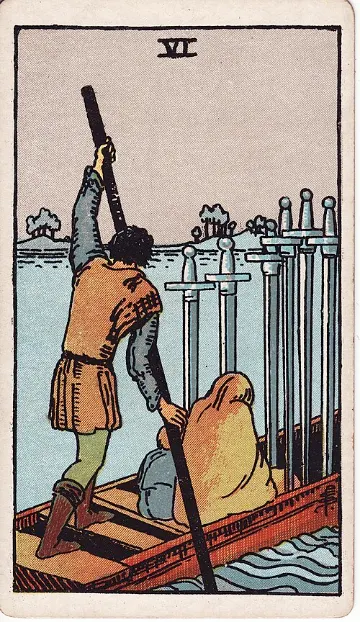
A ferryman poles a small boat across the water with a cloaked adult, a child, and six swords. The Six of Swords depicts movement that includes passengers and what they carry. Waite's upright meaning is a journey, route, or practical way through; his reversal turns unexpectedly toward declaration, confession, and publicity. Modern readers often see transition away from strain and, reversed, difficulty leaving it behind. The image does not disclose the travelers' destination or promise that a new shore solves everything. It asks what route is workable, who shares the passage, and what needs to be said before or during the crossing.
Look at the image
Pamela Colman Smith puts a standing ferryman at the rear of a small boat, using a pole to move it. A cloaked adult and a child sit ahead of him, partly screened by six upright swords. The water is visibly uneven in one part of the scene and quieter in another, but the travelers' goal is not shown in detail. No one waves goodbye or celebrates arrival. The swords travel with them rather than remaining on the shore. That detail gives the crossing weight: movement can change a situation without erasing what made the journey necessary. Notice also that the passage depends on someone's labor at the pole.
Upright: find the workable route
Waite describes a ferryman carrying passengers toward a farther shore and reads the upright Six as a journey, route, or expedient. In a modern reading, that may be a move, a handover, or a shift in how you handle an ongoing problem. Begin with the route rather than a fantasy of instant relief. What must be arranged, who can help, and what obligations travel with you? The ferryman's work suggests that support can be practical rather than dramatic. A plan may be modest and still matter. If a transition involves other people, ask what they need and what they have agreed to carry. The boat moves because its passengers and guide have a way forward.
Reversed: what must be spoken
Waite's reversed Six turns toward declaration, confession, and publicity; he also records an older account of a proposal of love. That is different from the common modern reading of a delayed or resisted transition. If this card appears reversed, ask whether a necessary fact, decision, or invitation has yet to be spoken aloud. A modern reading might still fit a route blocked by unclear support or by old conflict carried into a new setting. Check which account matches the situation. Would a direct statement help the passage, or would a better plan be needed first? Speaking is most useful when it clarifies responsibility and gives others room to answer.
Six of Swords in love and relationships
In love, the Six can describe two people changing the way they live or speak after a difficult period. It may also fit an actual move or a decision to leave a relationship. Upright, the practical details matter: who is traveling, what remains unresolved, and what support each person can offer. Reversed, Waite's disclosure theme can bring a needed conversation or invitation into focus, while a modern reading may highlight hesitation. Ask what needs to be said before any shared plan can be made. The adult and child in the boat remind us that a relationship transition can affect people beyond the two making the central choice.
Six of Swords as feelings
For your own feelings, this card may reflect a quiet wish for distance, a hope for steadier ground, or the mixed relief and sadness of changing course. Name what you want to move toward, not only what you want to leave. If you ask how another person feels, the travelers' covered faces do not answer for them. Listen to what they have said about the change and whether their actions support it. Upright may fit willingness to make a practical passage. Reversed may suggest an important statement still waiting, or reluctance that needs a conversation. The emotional truth often emerges while people arrange the crossing together.
Six of Swords in career and money
At work, the Six can fit a team handover, a change of process, or a move to a different role after repeated friction. List what must transfer: files, decisions, responsibilities, and people who need support. A good handover takes the swords on board without making them someone else's hidden surprise. Reversed, a declaration or public decision may be needed before the new plan can begin; alternatively, the route may still lack resources. In money matters, compare the cost of the move with the cost of staying and set a small reserve for the crossing. A workable transition is made from actual capacity, not from a promise that the farther shore will be perfect.
Six of Swords versus Five of Swords
The Five shows swords scattered after a dispute while people separate on a shore. The Six gathers six swords into a boat and carries them across water. The cards can form a sequence: first name the conflict and its cost, then decide how to move without pretending it never happened. If both appear, ask what the Five requires you to acknowledge and what the Six needs you to arrange. Is the next step a conversation, a transfer of responsibilities, or a genuine change of setting? The boat does not repair every broken agreement, but it can make a considered departure or transition possible.
Is the Six of Swords a yes or no card?
For a carefully planned transition with a workable route, the upright Six may lean yes. It favors movement supported by real steps rather than the hope that any change will be better. Reversed asks whether a declaration, agreement, or missing resource is needed first. A useful question might be “Should I accept the transfer after the handover terms are written down?” instead of “Will moving fix everything?” The first can be checked against duties, timing, and support. The second asks the unseen shore to guarantee an outcome it cannot show. The card's answer is strongest when the plan includes everyone who must make the crossing.
A reading example: a careful handover
A project coordinator is offered a new role while the current team is still handling a difficult launch. They draw the Six of Swords. Before accepting a start date, they list open issues, the people who own each one, and the decisions only they can explain. They ask their manager to assign a replacement and schedule two handover meetings. They also state what they will be available for afterward and what must be handled by the new owner. The move becomes possible because the work has a route across, not because the past is left untouched. The passengers, guide, and swords all have a place in the plan.
Questions to ask
- What must travel with me, and who shares the crossing?
- Which fact or decision needs to be spoken aloud?
- What makes the next shore workable in practice?