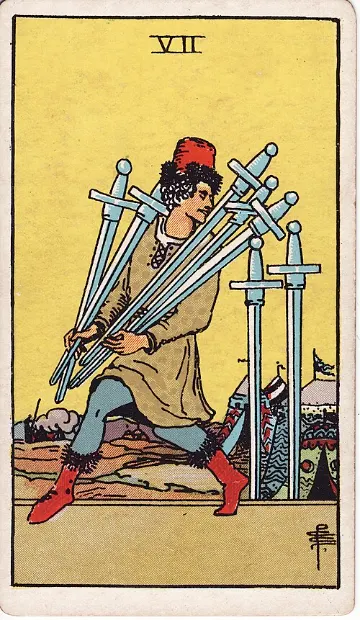
A figure carries five swords away from a camp while two remain planted in the ground. The Seven of Swords invites a question about strategy, secrecy, and what a plan leaves behind. Waite's upright meanings vary widely: hope and confidence appear beside quarrelling and a plan that may fail. His reversal is equally split between useful counsel and damaging talk. Modern readings often focus on deception, but the picture does not settle the figure's motive. In love or work, the practical issue is who needs to know what, what can rightly remain private, and whether a clever route will still make sense when its consequences arrive.
Look at the image
Pamela Colman Smith shows a brightly dressed figure carrying five swords away from tents. Two blades remain upright in the ground. The figure looks over a shoulder while walking the other way, and small people are visible near the camp. The load is awkward and conspicuous despite the cautious movement. None of the people tells us whether this is theft, escape, or a maneuver within an ongoing conflict. The two swords left behind are a visible limit to the plan, though their meaning remains open. Begin with what the image shows: speed, a divided attention, and an incomplete removal. Motive needs more than the posture alone.
Upright: test the plan
Waite gives the upright Seven unusually mixed meanings: a design or attempt, hope and confidence, but also quarrelling and a plan that may fail. That range fits the picture's uncertainty. In a contemporary reading, the card may invite discretion or ask whether secrecy is doing work that a direct request could do better. Identify the aim, the people affected, and the information they need for their own decisions. Keeping an early idea private can be sensible; concealing a decision that changes someone else's obligations is different. If the plan depends on a false impression, ask what happens when the remaining two swords are noticed. A clever move should withstand that moment.
Reversed: counsel or damaging talk?
Waite's reversed Seven has a striking split: good advice and instruction on one side, slander and idle talk on the other. A modern reversal may also describe a concealed plan becoming visible or the strain of maintaining it. Ask what kind of communication is actually taking place. Is someone offering specific guidance that helps a decision, or circulating a claim without checking it? If you need counsel, choose a person who understands the stakes and can keep appropriate confidence. If a rumor is spreading, return to what can be verified. The card's reversal need not declare guilt; it can make the quality and consequences of speech the central issue.
Seven of Swords in love and relationships
In relationships, the Seven can sharpen the difference between privacy and concealment. Each person can have thoughts, friendships, and space that belong to them. A choice that changes shared plans, finances, or consent calls for a different level of openness. Upright, ask what information is needed for both people to choose freely rather than searching for a hidden villain. Reversed, Waite's advice-versus-gossip contrast is useful: a trusted conversation may help, while speaking about a partner through rumor can deepen distrust. If something feels unclear, ask about the concrete action and listen to the answer. The figure's backward glance is an image, not evidence of someone else's secret.
Seven of Swords as feelings
For your own feelings, the card may describe caution, an urge to protect an unfinished plan, or discomfort with how much you are withholding. Try naming the reason: are you waiting for facts, preserving a healthy boundary, or avoiding a response you expect to be hard? If you ask about another person's feelings, the camp scene cannot give their private account. Notice what they have agreed to share and whether their actions match that agreement. Upright may fit guarded independence. Reversed may bring the need for honest counsel or a conversation about a rumor. Both are clearer than turning a sideways look in the picture into mind-reading.
Seven of Swords in career and money
At work, an independent tactic can be valuable when a proposal needs development before a public meeting. Define the point at which colleagues must be informed, especially if their time or authority will be used. Waite's possible failed plan suggests testing assumptions before betting a project on surprise. Reversed, seek reliable advice and document decisions rather than relying on hallway talk. In money matters, inspect terms that someone would rather leave vague: fees, obligations, and who carries a loss if the plan changes. Discretion protects a negotiation; secrecy about material costs can make an attractive deal unsound. Count the two swords left behind when measuring the plan's completeness.
Seven of Swords versus Six of Swords
The Six places passengers, a ferryman, and six swords in one visible boat. The Seven shows a single figure moving swords away from a camp while others remain behind. Both involve movement, but the first asks how people travel together and the second asks what is being handled privately. If both appear, identify who is part of the change and who has not been told. A quiet preparatory step may be fair; a hidden decision that other people must live with needs another look. Use the Six to plan the shared route and the Seven to test whether the private strategy supports or undermines it.
Is the Seven of Swords a yes or no card?
For a plan that depends on misleading someone affected by it, the Seven tends toward no: revise the method before proceeding. For a bounded private step, such as drafting an idea before seeking feedback, it may lean yes. Reversed, seek good advice and separate it from rumor before committing. Make the question exact: “Should I prepare a confidential draft before the team meeting?” differs from “Should I commit the team without telling them?” The first may create something useful to discuss. The second hands them the cost of a decision they did not make. A yes here should survive being explained when the time comes.
A reading example: a confidential proposal
An employee wants to propose a new service but fears a half-formed idea will be dismissed. They draw the Seven of Swords. They draft a one-page proposal privately, check the estimated cost, and ask one experienced colleague for advice under an agreed confidence. They do not spend the team's budget or promise its labor before the proposal is reviewed. At the meeting, they explain the idea, its risks, and what would need approval. If the response is no, the private preparation has still clarified the case. The card's strategy works because discretion ends where shared responsibility begins.
Questions to ask
- What is the plan trying to achieve, and what could make it fail?
- Who needs to know before the decision affects them?
- Would counsel help more than keeping or spreading a rumor?