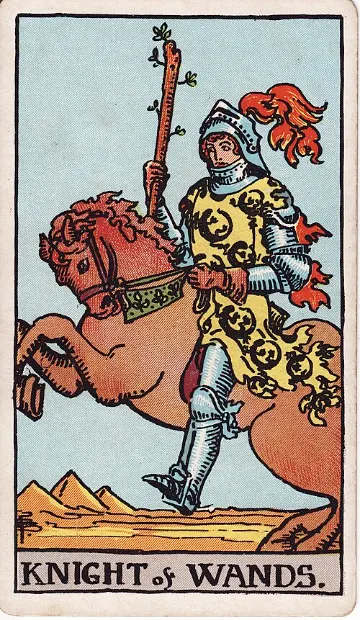
An armored rider raises a leafy staff while the horse lifts a foreleg above sparse ground. No opponent or destination appears. Waite gave the upright Knight meanings of departure, travel, and change of residence; his reversal turns to interruption, division, and discord. Modern readings often emphasize bold action and attraction. The useful question is not whether speed is good or bad, but where the movement leads, who is affected, and which promise will still matter once the first rush passes.
Look at the image
Pamela Colman Smith shows an armored rider with a red helmet plume, a patterned yellow tunic, and a leafy staff held upright. One of the horse's forelegs is raised; low, pyramid-like mounds sit across sparse ground. Waite describes a traveler rather than a fighter on a warlike errand. The motion is vivid, but the picture supplies no opponent, map, or visible destination. It cannot tell us whether the departure is planned or impulsive. Notice the raised staff and the horse's tension, then ask what the rider is leaving, what they are moving toward, and who else must adapt to the pace.
Upright: departure with a purpose
Waite's upright Knight includes departure, absence, flight, emigration, and change of residence. Modern readings also use the rider for bold initiative or a project finally put in motion. Those meanings meet when a real move is under consideration: a trip, a new role, or a proposal that changes the schedule. Name the destination, cost, and first obligation after arrival. Acting quickly can break a stalemate, but speed does not answer whether a plan is funded or whether a promise can be kept. If other people must move with you, agree on what they are being asked to carry.
Reversed: interruption or discord
Waite's reversed meanings are rupture, division, interruption, and discord. He does not simply describe a rider who is less enthusiastic. A modern reading may see haste that outruns a plan, but an external interruption can also stop a sound decision. Ask which is happening. Did the route close, did a partner withdraw, or did someone make a commitment before checking the terms? State the change plainly and renegotiate the next step with those affected. A reversed Knight is not proof that a person cannot follow through; the evidence is in what was agreed, what changed, and how they respond now.
Knight of Wands in love and relationships
In love, the Knight can fit a fast attraction, a visit, or a relationship shaped by travel and changing plans. Movement can be exciting when both people know what is being offered. Upright, ask whether the next meeting is a date, a temporary adventure, or a step toward a shared routine. Reversed, a canceled trip or disagreement over pace may need a direct conversation. Neither position can diagnose someone as a permanent commitment risk. Look at whether they make plans together, communicate changes promptly, and respect a slower pace when the other person needs it. Chemistry deserves honest logistics.
Knight of Wands as feelings
For your own feelings, the Knight may describe urgency, attraction, restlessness, or relief at finally taking action. Those feelings can point in different directions. If asking what someone else feels, a moving horse cannot reveal their private intentions. Observe whether they propose a specific plan, ask what works for you, and return after the exciting first step. Waite's upright absence can also point to physical distance rather than emotional distance. Reversed, an interruption may have changed how either person feels, but a missing reply is not enough to explain why. Ask about the plan and the change instead of inventing a motive.
Knight of Wands in career, travel, and money
At work, the Knight may fit a short-notice assignment, relocation, launch, or pitch that asks for a quick decision. Check the fee, travel costs, deadline, and who handles existing duties while you are away. If the move creates opportunity, give it a schedule that extends beyond the announcement. A bold proposal earns trust when someone can deliver the follow-up. Reversed, identify whether the obstacle is a canceled booking, divided team, or rushed commitment with missing resources. For money, compare the reward with transport, accommodation, and the work left behind. Momentum matters, but the budget travels too.
Page versus Knight of Wands
The Page of Wands stands still with a leafy staff, attending to a message or possible beginning. The Knight is mounted with the staff raised and the horse already in motion. The Page asks what the offer says and what small test could clarify it; the Knight asks what happens when someone acts on it. If both appear, an invitation may have become a deadline before the details are settled. Do not confuse a request for more information with reluctance to act. A clear brief can let the Knight move quickly without leaving the Page's useful questions unanswered.
Is the Knight of Wands a yes or no card?
For a bounded, reversible action with a route and resources, the upright Knight can lean yes: make the call, book the visit, or send the proposal. It does not guarantee that a major relocation will work merely because movement is pictured. Reversed suggests pausing to resolve an interruption or disagreement before committing others to the journey. Ask “Should I take the two-day assignment if the client covers travel and my current work has a handoff?” The conditions can be checked. “Will this person stay forever?” asks a card about motion to promise a lifetime outcome.
A reading example: a short-notice commission
A photographer is offered a three-day out-of-town commission and draws the Knight of Wands. The brief sounds exciting, but the initial fee omits transport and the client wants edited images the morning after the return trip. The photographer asks for travel reimbursement, a realistic delivery date, and a contact who can approve the shot list. They also arrange a handoff for a local booking. Once those terms are confirmed, the trip becomes a deliberate opportunity rather than a scramble. If the client refuses, declining protects the work already promised. The Knight's energy helps the decision move; the written terms determine its direction.
Questions to ask
- What is moving, and what destination is actually agreed?
- Who is affected by the change of pace?
- Which promise remains after the first rush?