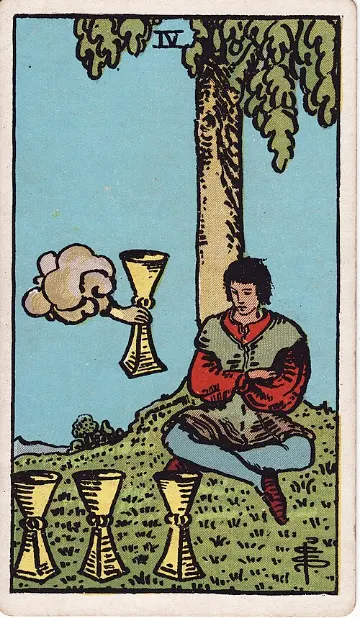
A figure sits beneath a tree with arms folded, three cups on the ground, and a fourth offered by a hand from a cloud. The Four of Cups can meet a person at the point where an offer arrives but interest, energy, or clarity does not. Upright, it often raises a question about weariness and attention. Reversed, something new may begin to stir, though the wider situation determines whether that change is welcome. In love or work, the card asks what is actually being offered and whether there is room to receive it. The picture does not prove that the figure has failed to notice the cup or must accept it.
Look at the image
Pamela Colman Smith places the seated figure beneath a tree, with three cups standing close together on the ground. A fourth cup comes from a cloud hand at the figure's side. The crossed arms and downward gaze can suggest distance from the offer, but the image does not show whether the person has missed it, considered it, or chosen to wait. A. E. Waite described contemplation of the three cups and a fourth that gives no consolation. That older account emphasizes dissatisfaction rather than a simple failure to notice a gift. The new cup's value remains unknown; its unusual arrival alone does not make it the right choice.
Upright: when satisfaction stalls
Upright, the Four of Cups may describe boredom, emotional fatigue, or a sense that familiar options no longer satisfy. Waite's older list includes weariness and satiety: having enough of something is not the same as feeling nourished by it. If a new invitation arrives during that pause, ask what is tiring you before calling the offer good or bad. A quiet afternoon can help you hear a real preference. A month of postponing every answer may point to a decision you are avoiding. The card makes room for rest and honest appraisal without treating every unaccepted offer as a mistake.
Reversed: a new opening or another delay?
Reversed, the Four can show attention returning to the world after a long inward spell. Waite associated the reversal with novelty, new instruction, and new relations, but a reversed card does not guarantee that the next offer fits. It can also expose how much energy is still needed before someone can respond. Compare the card with the question and surrounding cards: is there a genuinely different possibility, or a familiar request presented in fresh packaging? Name one detail that has changed. If nothing has changed, declining again may be clear judgment. If it has, the person may be ready to look without promising an immediate yes.
Four of Cups in love and relationships
In a love reading, the offered cup can resemble a date, an apology, or a bid for more time together. For someone single, the card may describe little interest in dating right now, even when an invitation is kind. For partners, three established cups may stand for habits that have become predictable while a different way of connecting goes untested. Neither reading tells you to accept attention you do not want. Reversed, a conversation may become possible after space apart, or the same unresolved issue may return under a new promise. Ask what each person has actually offered, requested, and agreed to change.
Four of Cups as feelings
If the question is about your own feelings, notice the difference between wanting solitude and feeling shut out. The crossed posture might fit either, and both deserve a different response. You may be grateful for an invitation yet unable to enjoy it this week. If you ask how someone else feels, the picture cannot reveal their private thoughts. Their reply, willingness to make plans, and respect for boundaries give better evidence. Reversed may fit a person beginning to engage again, but it can also mark a tentative look rather than a settled feeling. Leave room for them to say what they mean instead of reading silence as certainty.
Four of Cups in career and work
At work, the fourth cup can be a job offer, a new project, or a proposed change to an old role. The first question is not whether it looks impressive but whether it addresses what has become stale. A higher title may still bring the same workload; a lateral move may offer the learning you actually miss. Compare pay, time, support, and decision rights with your present situation. If you feel flat about every option, take a short break before committing where possible. Reversed, a new assignment may restore interest, but ask what resources make it workable. Novelty by itself will not repair an exhausting schedule.
Four of Cups versus the Ace of Cups
Both cards show a cup presented by a hand from a cloud, yet the scenes ask different questions. In the Ace, the offered cup dominates the image, making arrival and emotional possibility the central event. In the Four, three cups already stand before a seated person, and the new offer enters a scene of weariness or contemplation. A reading that turns every Four into an Ace misses the weight of what came before. If both appear together, identify the new possibility, then ask whether the person has the attention and desire to meet it. An opening can be real without being welcome at this exact moment.
Is the Four of Cups a yes or no card?
The Four rarely gives a useful categorical yes or no. For a low-pressure invitation, it may say “not yet”: get clear about interest and capacity before replying. For a decision with a deadline, it may say to ask for the missing terms rather than drift past the choice. Reversed can make a fresh look more likely, but it is not an automatic yes. If the question is “Will they accept me?” the card cannot speak for another person's decision. Ask instead whether to make a respectful offer, what you can accept in return, and when a clear answer is needed. A deliberate no can be more honest than indefinite silence.
A reading example: the job offer
Imagine you are offered a position after months of feeling stuck. The salary is better, but the description sounds much like the work that exhausted you. You draw the Four of Cups upright. Rather than rejecting it on the spot or accepting from fear of missing out, you ask about hours, support, and who sets priorities. The employer answers clearly and offers a day to decide. You discover that one part of the role would give you the creative work you miss, while the schedule would leave less time at home. The card has not chosen for you; it has helped turn a vague feeling into terms you can weigh and answer.
Questions to ask
- What about the current options has stopped satisfying me?
- What is this new offer asking of me in practice?
- What would help me answer clearly before the decision is made for me?