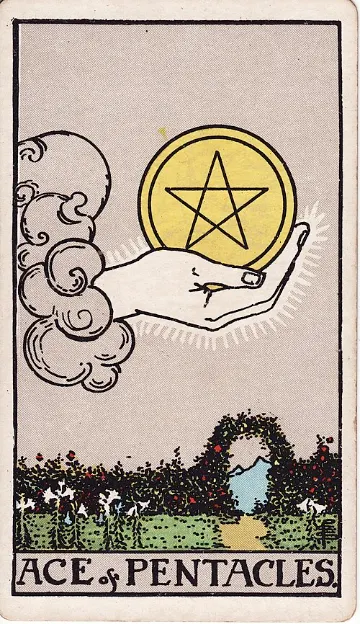
A hand from a cloud presents one large pentacle above a cultivated garden. A path runs through a hedge arch toward pale hills, but the card does not show anyone taking it. The Ace of Pentacles can mark a tangible opening: an offer, a usable skill, a place, or money with conditions attached. Upright, it invites a first step that gives the resource a purpose. Waite's reversed meanings are more complicated than a lost chance: they include great riches as well as the harmful side of wealth. In love and work, the card asks what has actually been offered and what continuing care would make it worthwhile.
Look at the image
Pamela Colman Smith gives the Ace one dominant object: a pentacle held in a hand emerging from a cloud. Below it, flowers grow around a garden and a hedge arch opens toward pale, distant hills. The hand presents a resource, but there is no pictured recipient and no completed journey. The cultivated ground matters as much as the bright coin. Someone has already tended this place, and anything begun here will need attention after the first offer. Waite's brief description identifies the cloud-hand and pentacle; the wider scene lets us ask what the resource could grow into, who can use it, and what the path beyond the arch would require.
Upright: an opening is not an outcome
Upright, the Ace of Pentacles can fit a job lead, a first client, a new tool, or access to a place where a project could begin. Waite associated the card with contentment, gold, and welcome news, but the picture still shows the moment of presentation. Ask what is actually available: a signed offer, a conversation, a grant application, or an idea for earning money? These are different stages. A modest opportunity with clear terms may be more useful than a dazzling one that cannot be acted on. Take a first step that tests the resource's value, then decide what time, money, and care you can continue to give it.
Reversed: wealth and its costs
Waite's reversed account includes both the harmful side of wealth and great riches. The reversal does not simply make the pentacle disappear. Modern readers often use it for a delayed or missed opportunity, an offer with poor terms, or a resource that has not been put to use. Look at the real situation before choosing among those readings. Is the promised money available, and what obligation comes with it? Would accepting the offer crowd out something important, or is hesitation hiding a workable beginning? A large gain can carry an unwanted cost, while a small chance can be lost through neglect. The terms decide more than the card's direction.
Ace of Pentacles in love and relationships
In love, a pentacle can stand for the practical room a relationship needs: time to meet, a reliable plan, a shared home, or support that is offered and welcomed. The Ace may be the start of that provision, not proof that a bond is already secure. If someone gives a gift, ask what the gesture means to both people rather than assuming it buys closeness or commitment. If partners are planning together, speak plainly about money, work, and the care the arrangement will require. Reversed, an attractive plan may ask one person to carry too much, or a genuinely useful offer may arrive before the other is ready. Mutual terms matter.
Ace of Pentacles as feelings
When drawn for your own feelings, the Ace may show a wish to make affection tangible: setting aside time, offering help, or building something shared. That impulse is different from a guarantee that the other person wants the same future. If you ask about someone else's feelings, a coin in a cloud cannot disclose their private thoughts. Notice whether they make and keep plans, and ask what kind of connection they want. Reversed, someone may value the possibility but lack the time or capacity to act on it now. The distinction between goodwill and readiness becomes clearer in a real conversation than in the shine of the offered pentacle.
Ace of Pentacles in career and money
For career questions, the Ace can point to a role, training place, customer, or piece of equipment that could support future work. Check the pay, hours, ownership, costs, and date when the offer becomes real. A verbal promise and a signed agreement belong to different stages of the path. For a new venture, try a small sale or paid pilot before building a budget on an imagined audience. Reversed may expose fees, unstable income, or a good opportunity without the resources needed to use it. The garden image rewards stewardship: what you can maintain matters more than the first bright impression of the coin.
Ace of Pentacles versus Seven of Pentacles
The Ace shows a resource being offered above a garden. In the Seven of Pentacles, a worker pauses beside a plant already bearing pentacles and considers what has grown. The Ace asks whether to begin and what the opening contains; the Seven asks whether existing effort is producing enough to continue. If both appear, do not confuse the promise of a new resource with evidence of its return. Set a first milestone when you accept the offer, then make time to review it later. A seed and a harvest can belong to the same story, but they cannot be measured at the same moment.
Is the Ace of Pentacles a yes or no card?
For a small step toward a concrete, affordable opportunity, the upright Ace can lean yes: request the terms, apply, visit the space, or test the tool. It is not a blanket yes to any purchase or a promise that an investment will pay off. Reversed is not an automatic no, especially given Waite's mixed account of wealth. It asks whether a hidden cost, missing resource, or delay changes the decision. A useful question specifies the offer and its conditions: “Should I accept this trial at the stated fee and time?” can be checked; “Will this coin make me rich?” cannot be answered from the image.
A reading example: paid training with conditions
Imagine a worker is offered a paid training program for a new role and draws the Ace of Pentacles. The advertisement promises a better salary, but participation requires two evenings each week and a one-year commitment afterward. They ask for the written pay schedule, the cost of leaving early, and examples of the work graduates actually do. They also arrange one conversation with someone already in the role. If the terms fit their time and goals, the program is a tangible opening worth taking. If the new salary depends on conditions they cannot meet, the bright pentacle is still an offer they can decline. The card helps separate possibility from the whole path.
Questions to ask
- What resource is actually available now?
- Which condition of this offer needs checking?
- What small act of stewardship would make it useful?