
La Poule noire begins as an adventure memoir before it becomes a catalogue of talismans. An unnamed French officer enters Egypt as a military surveyor, loses his unit in an attack, and crosses a concealed pyramid threshold at the moment he expects to die. The book converts that defeat into initiation. Its secrets appear credible inside the fiction because the narrator has been wounded, healed, taught a language, tested for virtue, and shown marvels before he is allowed to describe them.
- Edition record
- Paris, Brasseur aîné, 1820
- Narrative setting
- Napoleon’s Egyptian expedition
- Authority chain
- Officer → sage → ancient books → demonstrations
A military survey collapses into a rescue story
The narrator calls himself an officer in the Egyptian expedition and says a general sent him to draw plans of the pyramids. That assignment gives him a modern, technical reason to be at the monument: he arrives with instruments, mounted escorts, and the confidence of an imperial army. A sudden attack destroys that position. His companions are killed, his weapons and clothes are taken, and he crawls wounded toward the pyramid. The scene strips away rank, equipment, and witnesses until only a solitary narrator remains. The book can now replace official knowledge with a secret history available to one survivor.
At sunset a stone moves and an elderly Muslim man emerges with a lantern. He examines the bodies, hears the survivor, treats his wounds, and carries him through a hidden opening. The pyramid is no longer a monument measured from outside. It becomes a house with a concealed door, winding descent, locked interior rooms, books, medicines, furniture, and treasure vaults. This change in viewpoint is the first piece of ritual machinery. The officer must lose the surveying gaze before the text permits him to see an inhabited archive beneath the stone.
Healing, language, and adoption make knowledge transmissible
The sage does not immediately hand over a book of signs. He supplies a restorative drink and balms, watches the officer sleep, and teaches him Turkish so that speech can replace gestures. Recovery and language lessons slow the plot. They also answer a practical problem in the fiction: how can a French outsider understand an Egyptian secret? The narrator earns access by becoming a patient, student, and adopted son. Translation is dramatized as a personal apprenticeship rather than acknowledged as ordinary print production in Paris.
A second threshold opens when the sage displays coffers of gold and gems. Treasure proves that his knowledge has material consequences inside the story, while his refusal to describe it as mere avarice supplies a moral defense. He says decades of study, prayer, and virtue produced command over elemental beings. The narrator is asked to renounce vice and discipline his passions before instruction begins. This moral examination works as a warranty that cannot be checked from outside the tale: success confirms purity, while failure can be blamed on an unworthy operator.
The pyramid gathers several kinds of ancient authority
The hidden library is said to contain manuscripts saved from the burning of the Ptolemies’ library. Hieroglyphic writing, pyramids, Zoroaster, Socrates, Pythagoras, Plato, Trismegistus, and later spirit lore are assembled into one imagined inheritance. They do not belong to one historical school. Their accumulation is the point: Egyptian monument, Greek philosophy, Persian sage, elemental cosmology, and Christian language about the Supreme Being all appear to certify the same master. The long title performs the same work by advertising necromancy, cabala, sylphs, undines, gnomes, secret sciences, treasure, and command of beings in one package.
The theology also protects the hierarchy of the tale. The sage attributes power to God, divides spirits into classes, and presents human command as a reward for wisdom. Infernal beings are not the highest source of knowledge; they are subordinate actors beneath divine permission and the initiated will. That arrangement lets the book advertise frightening powers while retaining prayers, virtue, and providence as its frame. It is a literary solution to a commercial problem: sensational magic can be offered as the fruit of moral philosophy rather than as open rebellion.
Worked reading: the pyramid door turns defeat into initiation
The moving stone divides the opening. Before it moves, the officer has a commission, military escort, and plan-making task but no secret. After the attack those credentials fail; the door opens only when he is wounded, alone, and praying. Beyond it, healing liquor, fire-marked books, a gold-covered casket, a 270-year-old teacher, and staged spirits establish another kind of authority. Bodily rescue earns trust, and gratitude binds the narrator to preserve the teaching.
The episode also reverses who explains Egypt. The French officer begins as the person commissioned to map the pyramid. Inside, he cannot speak to his rescuer and has to learn like a child. The Turkish sage reads characters that European scholars supposedly cannot interpret and treats the monument as a lived archive. Yet this reversal still serves a French first-person publication: the officer eventually carries the secrets to Marseille and tells them to the reader. The fiction borrows the authority of an Eastern teacher while giving the European narrator control of the printed transmission.
The sequence is therefore tighter than a decorative Egyptian setting. Survey, ambush, rescue, healing, language, adoption, moral trial, cosmology, and demonstration form successive credentials. Remove the ambush and the narrator has no reason to enter the pyramid. Remove the language lessons and transmission becomes implausibly instant. Remove the virtue test and the book loses its explanation for failure. Every adventure episode closes a gap in the authority claim that the later catalogue will need.
The 1820 object and later witnesses tell different stories
Google Books records a French edition printed by Brasseur aîné in 1820 under the long La Poule noire, ou la poule aux oeufs d’or title. The Warburg Innes catalogue records the same title with the fictive place and date “En Égypte, 740,” while identifying Paris, Brasseur, 1820 and describing a small illustrated volume. The false ancient location on the title surface and the modern printer in the catalogue repeat the narrative’s double movement: remote antiquity is claimed, but the surviving object belongs to the French cheap-print world after Napoleon’s expedition.
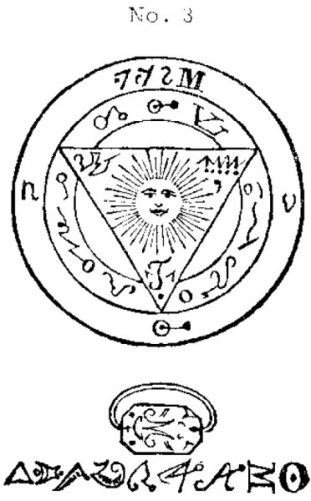
The Global Grey English text is useful for following the complete memoir, demonstrations, figure sequence, material list, death of the sage, voyage home, and final hen-training episode. It is a modern transcription and translation, not a facsimile of every feature in the 1820 copy. The Wellcome volume around 1850 is a different witness again. It binds a Dragon Rouge text to a three-page “Secret de la Poule noire,” but does not reproduce this officer’s pyramid apprenticeship or the twenty-two-part material inventory. A shared bird and title phrase do not make the appendix an abridged copy of every narrative section.
Primary texts and object records
- Google Books record, La Poule noire, Imp. de Brasseur aîné, 1820 ↗
- Warburg Institute, Innes Collection catalogue entry for La Poule noire ↗
- Global Grey, The Black Pullet public-domain text and figures ↗
- Global Grey, The Black Pullet PDF edition ↗
- Wellcome Collection, Le véritable dragon rouge followed by La poule noire ↗