
Two different operations circulate under the Black Pullet name. In the long narrative, a golden egg is a vessel in a spectacular hatching scene; the resulting bird is trained to detect gold and later finds a buried chest. In the Wellcome Dragon Rouge witness, pages 103–105 present a much shorter crossroads operation using an existing hen to compel a horned spirit. The shared black bird and treasure promise conceal a major change in ritual logic.
- Long narrative
- Production → training → search
- Wellcome appendix
- Offering → appeal → spirit service
- Physical seam
- Numbered pages 103–105
The hen section grows out of the talisman catalogue
The long text does not introduce the black hen at the beginning despite its title. A hooded black bird first appears during the Figure 5 treasure demonstration, carried by one of seven bronze-colored spirits. After the twenty-two material specifications and two prayers, the sage returns to those birds and attributes their success in finding gold to instinct joined with magical language. The hen is therefore a second technology of treasure finding, linked backward to a talisman pair and forward to a separate training sequence.
The sage gives this knowledge another ancient pedigree. A jeweled manuscript is associated with Oromasis, named as the father of Zoroaster, and written in rose-colored hieroglyphic characters. Like the burned Alexandrian books earlier in the narrative, this object is impossibly precious and inaccessible except through the teacher. Its role is literary authorization. A specialized animal secret receives a named ancient owner, an exotic script, and a jewel-covered carrier before the text turns to the actual sequence.
The golden egg is a vessel that disappears, not a product laid by the hen
The spectacular version begins with aromatic woods, dried plant matter, oils, gum, focused sunlight, and fire. The resulting cinders are enclosed inside a manufactured golden egg, which is set on black velvet beneath a faceted crystal bell. After another spoken address, the bell glows, the golden shell disappears, and a small black pullet is reported in its place. The narrative then supplies a simpler alternative built around an ordinary egg, an entirely black hen, darkness, silence, isolation, and the claim that black surroundings impress the hen’s imagination.
That sequence clarifies an often blurred title. The central bird does not repeatedly lay minted golden eggs in the surviving English narrative. A golden egg is consumed in the bird’s first appearance, while the mature hen later detects hidden gold. “Hen with the golden eggs” compresses production and treasure into a familiar promise, but the story distributes them across different objects and times: golden container, black hatchling, trained search behavior, and recovered wealth.
Training turns marvel into a repeatable search narrative
Seven mature hens are first tested inside the pyramid. Gold is hidden under cushions, in wall crevices, and in the sage’s turban; the birds are uncovered, released, and described as carrying the pieces back. A second test moves outside, where sacks have been buried in sand. This repetition changes the narrative proof. The first hatching is a singular transformation witnessed by the initiate, while training produces a behavior that can be tried across locations.
After the sage dies and the officer reaches Marseille, Odous continues the instruction. Gold is placed in the bird’s sleeping basket while its eyes are covered, then concealed in a garden. The hen scratches near a tree and the officer uncovers a large locked chest said to contain money, plate, and jewels worth 1,500,000 francs. Figure 12 opens the lock, joining the bird system back to the talisman catalogue. The episode is written as a chain of mutually reinforcing marvels: animal detects site, manual labor exposes box, ring opens barrier, inventory supplies a numerical fortune.
Worked comparison: the golden egg becomes a crossroads bargain
In the full narrative, the sage manufactures the conditions of birth. Fragrance, sunlight, glass, cinders, gold, black velvet, crystal, speech, and prayer culminate in a new bird. The animal is then nurtured, trained, tested, transported, and tested again. Treasure comes through detection. Even when spirits carry money during Figure 5, the black bird is identified as what enabled them to find it. The hen functions as a sensor whose authority grows through demonstrations.
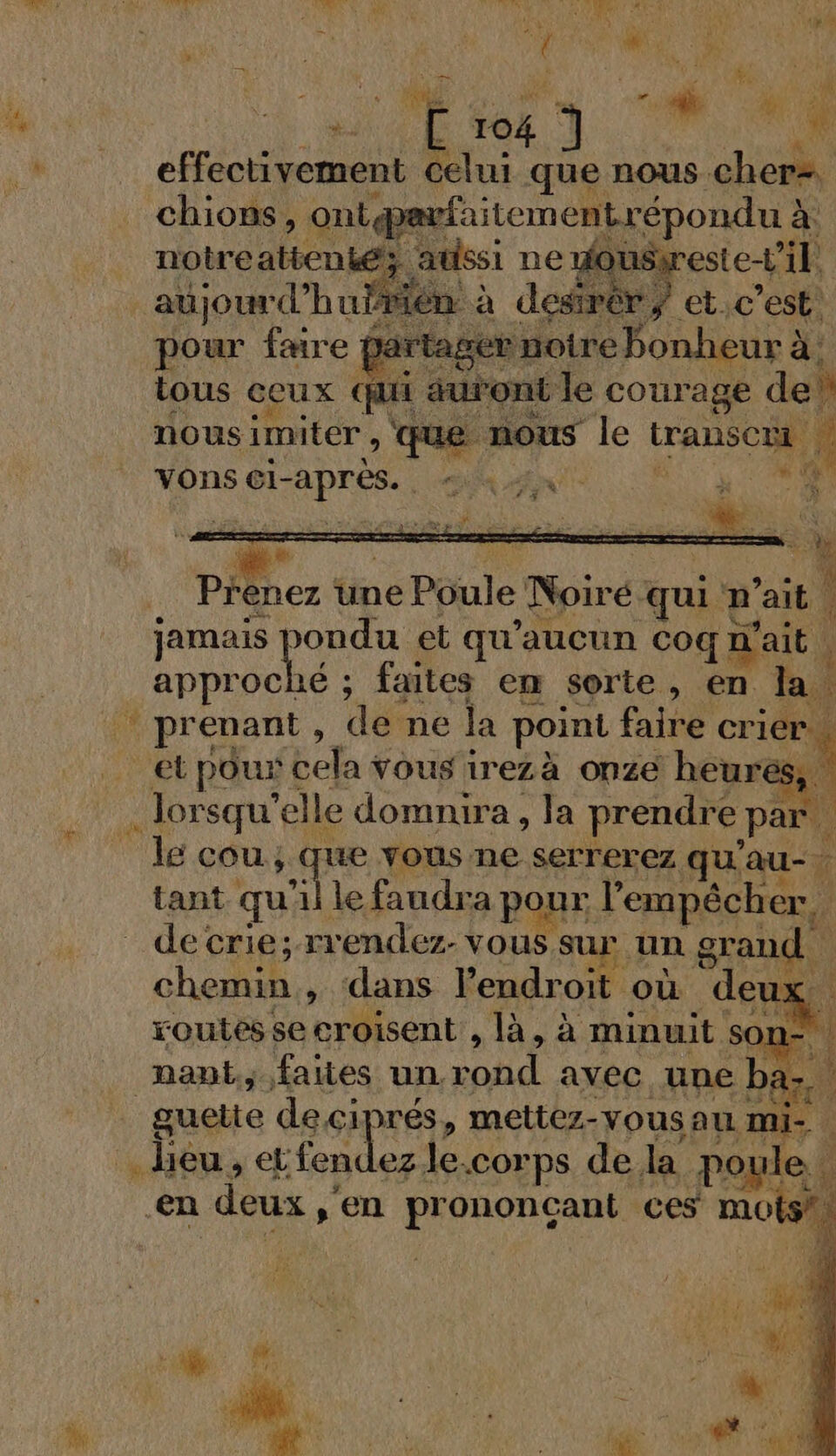
Wellcome page 104 begins with an already living black hen defined by sexual and reproductive purity. The brief text sends the operator to a crossroads at midnight, establishes a cypress boundary, and violently sacrifices the bird while repeating a formula. Page 105 then redirects the reader to an earlier prayer and “great appeal” elsewhere in the Dragon Rouge. A horned human figure in scarlet is expected to appear and receive commands. Here treasure comes through compelled service, not trained animal perception.
The comparison changes every major role. Golden egg becomes absent; hidden pyramid becomes public crossroads; sage and adopted son become solitary operator; bird as treasured companion becomes bird as offering; long apprenticeship becomes cross-reference to earlier pages; discovered chest becomes general wealth promised by a spirit. The short appendix preserves the black hen as a memorable token while replacing the full story’s educational and animal logic with the surrounding Dragon Rouge system of appeal, appearance, order, and claimed obedience.
Pages 103–105 make the appendix physically visible
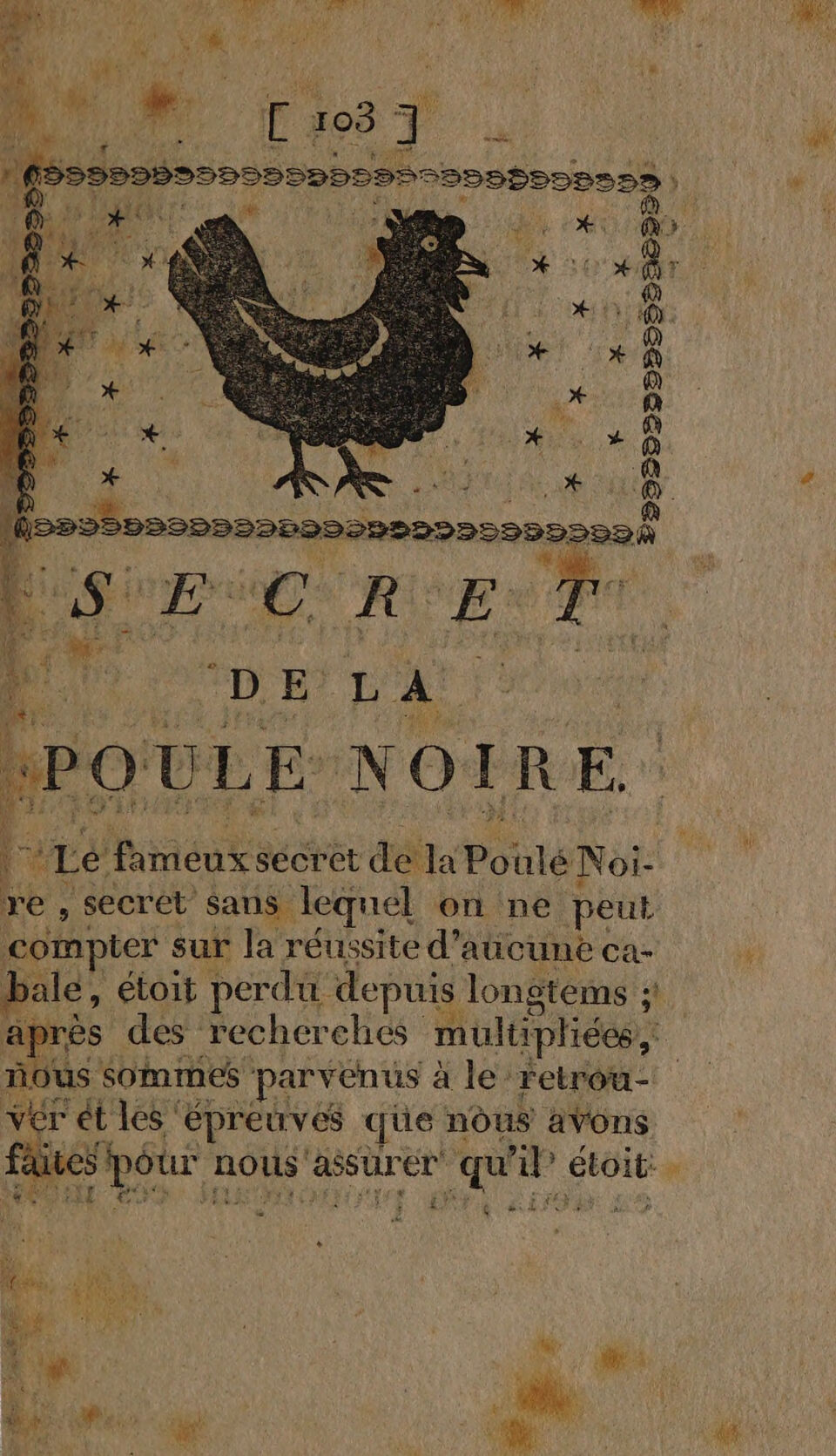
The Wellcome object gives the compressed version a precise boundary. Numbered page 103 opens with a woodcut black hen inside a starry frame and the heading “Secret de la Poule Noire.” Page 104 moves from a claim that the lost secret has been recovered into the operation itself. Page 105 completes the formula, borrows the volume’s earlier prayer and appeal by page number, describes the expected horned figure, and adds a requirement of prior devotions and clear conscience. The next numbered page begins the table of contents.
This three-page position matters. The appendix is not a second hundred-page book hidden after the Dragon Rouge. It is a compact terminal secret whose instructions depend on the work printed before it. The table on pages 106–108 lists the Dragon Rouge chapters and operations, then gives “Secret de la Poule noire” at page 103 as its final item. Binding and cross-reference turn the hen operation into a climax and sales attraction while the woodcut gives it an immediately recognizable visual identity.
The compressed afterlife keeps treasure and discards apprenticeship
The long narrative explains ownership of treasure through inheritance, virtue, initiated knowledge, animal instinct, and repeated trials. Its narrator returns to France, buys property near Marseille, preserves the sage’s ashes, trains the hen with Odous, and keeps the source of his prosperity secret. The story gives wealth a biography. It also includes a convenient moral defense: only a pure and persistent reader is said to succeed, so the claim cannot be separated from character.
The appendix removes almost all of that architecture. It needs only the rarity of the animal, a charged place and hour, a bounded space, borrowed prayers, and a spirit who is said to obey. The resulting wealth has no chain of teaching or trained search. This compression shows how grimoire print could extract a striking motif from a larger narrative and make it function inside another book. The historical relationship is visible in shared treasure language and bird imagery, but the actions and agents are not interchangeable, and neither witness supplies evidence that its claimed results occurred.
Primary texts and object records
- Global Grey, The Black Pullet public-domain text and figures ↗
- Global Grey, The Black Pullet PDF edition ↗
- Wellcome Collection, Le véritable dragon rouge followed by La poule noire ↗
- Wellcome IIIF manifest b33030169 ↗
- Wellcome IIIF canvas b33030169_0109.jp2, numbered page 103 ↗
- Wellcome IIIF canvas b33030169_0110.jp2, numbered page 104 ↗