
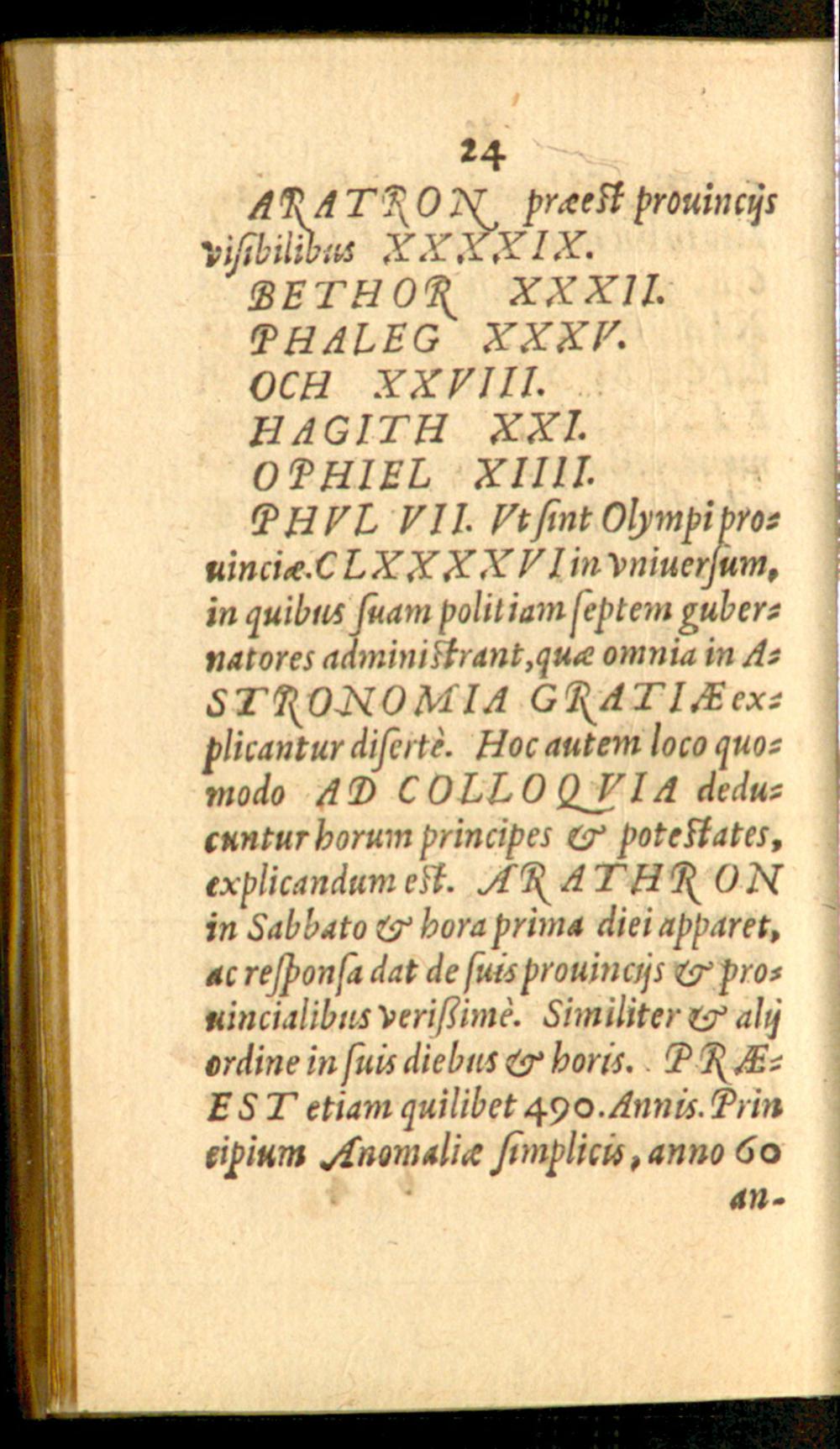
Aphorisms 15–17 name seven governors of the heavens. Their planetary associations and extraordinary offices are claims made by a 1575 magical text, not astronomical observations.
- Source passage
- Aphorisms 15–17
- Named governors
- Seven
- Printed total
- 196 provinces
Why they are called Olympic
In this book Olympus is a name for the heavenly order inhabited by these figures. Aphorism 15 places them in the firmament and says their actions depend on divine permission. Aphorism 16 lists the seven names. Aphorism 17 then associates each with the traditional seven planets in the order Saturn, Jupiter, Mars, Sun, Venus, Mercury, and Moon. This is a sevenfold Renaissance cosmology in an explicitly Christian devotional frame. It should not be merged with Greek mythology merely because “Olympic” resembles “Olympian,” nor with the Ars Goetia because both traditions describe spirits.
The powers ascribed to them vary. Aratron’s Saturnian passage includes stone, alchemy, and longevity; Bethor’s Jupiter passage mentions dignity and treasures; Phaleg’s Mars passage is short and concerns honors in war. Och is solar and receives an elaborate passage on wisdom and gold. Hagith, Ophiel, and Phul are tied respectively to Venus, Mercury, and the Moon. The details are uneven because the source is uneven; a profile that gives all seven identical lists of powers would be later editorial invention. Their passages differ in length as well as subject, making Phaleg’s brief martial entry especially striking beside Och’s elaborate solar account.
Province count and character evidence
The 1575 printed page assigns 49 provinces to Aratron, 32 to Bethor, 35 to Phaleg, 28 to Och, 21 to Hagith, 14 to Ophiel, and 7 to Phul. Those figures total 186, although the same leaf prints a total of 196. A descending-by-seven scheme would instead assign 42 to Bethor and total 196. Peterson’s parallel transcription shows the corrected numeral in brackets. The printed 32 and the corrected 42 reveal how later tables can quietly regularize the early print. This small arithmetic discrepancy is easy to miss in a tidy contemporary chart.
Aphorism 17 introduces characters for the governors; the work also speaks of a character given or confirmed in a particular encounter. A modern vector sigil may reproduce a historical drawing, redraw it, or silently import one from a later book. The 1575 print provides one historical form of each character, while later books may redraw the lines. Even a photographed symbol is evidence of a printed figure, not proof that its alleged supernatural office exists.
Uneven accounts and later wording
Aphorism 17 gives the seven governors unequal amounts of attention: Phaleg’s passage is unusually short beside Och’s or Aratron’s. Turner’s 1655 printing offers later English wording, while the Basel print preserves the early name list and the province-number discrepancy.
The associated weekdays sometimes appear in modern charts, and aphorism 16 specifically mentions Aratron in the first hour of Saturday before referring to the others in their days and hours. That historical sentence belongs to the book’s larger planetary scheme, framed by earlier aphorisms demanding prayer and moral restraint. It does not establish that a particular day or hour produces a result.