
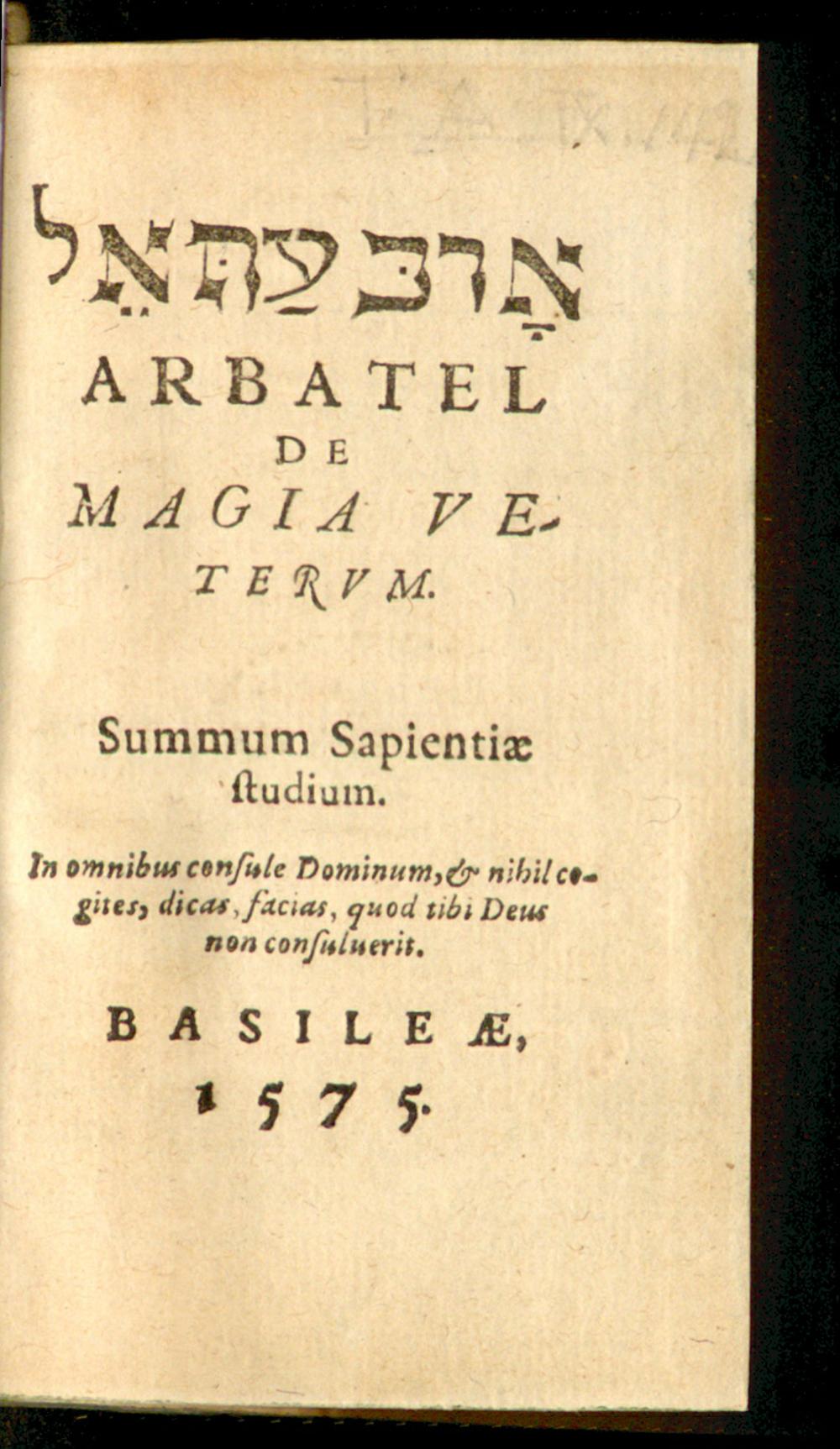
The surest starting point for the Arbatel is a physical book: a Latin octavo printed at Basel in 1575 and preserved by the University Library Basel.
- Printed
- Basel, 1575
- Copy
- Universitätsbibliothek Basel · AN VI 37
- Extent
- 87, [1] pages; illustrated
A dated object, an uncertain author
The Basel title page names the work Arbatel de magia veterum, calls the study of wisdom its highest pursuit, and gives Basileae, 1575. That imprint establishes a sixteenth-century printed witness. The title’s “of the ancients” is a claim about the wisdom the book offers, not evidence that the surviving text was written in antiquity. The Basel catalogue attributes the printing to Peter Perna in square brackets. That is a cataloguer’s identification of the printer, not a signature by the unnamed author of the text. The shelfmark AN VI 37 identifies the surviving Basel copy.
The library describes an 87-page book with one unnumbered page and illustrations. A small printed volume can be materially different from the sprawling “grimoire” a modern search result suggests. Its introductory frame announces nine parts of magic, yet the extant book supplies only the Isagoge in seven groups of seven aphorisms. A claim that all nine books were published in 1575 would go beyond this copy. The object therefore gives both an exact date and a limit: its surviving pages are the evidence, while an announced larger architecture remains a plan on paper.
What the photographed pages show
The reproduced title page is image 5 of the Basel library’s IIIF sequence. Its Hebrew heading, Latin title, devotional motto, and date are visible on the same leaf. The line advising the reader to consult the Lord belongs to the printed book’s own Christian framing. The lettering belongs to the sixteenth-century print. The second page image is printed page 24, where Aphorism XVI continues its list of seven Olympic governors and their numbered provinces. Looking at the page matters because a polished table on a modern website can conceal a numerical problem present in the early print.
On printed page 24, Bethor is assigned XXXII provinces, while the total below is CLXXXXVI, or 196. The other entries descend in sevens from Aratron’s 49, so a consistent series would give Bethor 42. Modern editors usually mark XLII as a correction. The printed 32 and the corrected 42 are different readings; neither should be silently substituted for the other. This single page exposes a numerical problem that a tidy list of planetary correspondences can hide.
Reading the Basel copy and Turner translation
The Basel copy preserves both the 1575 title page and the page carrying the province list. Its shelfmark AN VI 37 and DOI 10.3931/e-rara-8789 identify the same physical book. Later reprints can reset page breaks, rearrange front matter, or correct a numeral without announcing the change. Comparing them with the Basel leaves distinguishes a printer’s reading from a later editorial decision.
The PDF includes OCR, but early modern type and long-s forms can make automated text unreliable. For a word or numeral that changes an argument, the photographed leaf preserves the printed form. Robert Turner’s English translation offers another valuable witness, but it was printed eighty years later inside a collected book. Turner’s familiar English wording is his 1655 rendering, not a line from the 1575 Basel Latin. That eighty-year gap matters when the two are treated as the same text.
Source records
- University Library Basel, Arbatel de magia veterum (1575), AN VI 37 ↗
- University Library Basel, complete 1575 scan (DOI 10.3931/e-rara-8789) ↗
- Basel copy, title page, image 5 in the IIIF manifest ↗
- Basel copy, printed page 24, Aphorism XVI, image 28 ↗
- Joseph H. Peterson, parallel Latin and Turner English transcription ↗