MEMORY · HOSPITALITY · ACCOUNTABILITY
What to Put on an Ancestor Altar: Objects With Offices
A photograph is not automatically welcome, an heirloom is not proof of virtue, and an offering is not a universal language. The right object earns its place by the relationship it can truthfully hold.

STAR & SIGIL
Give every altar object a speaking office
Shape a contact working from portraits that name, vessels that host, heirlooms that testify, and living objects that carry lineage onward.
Arrange the speaking objects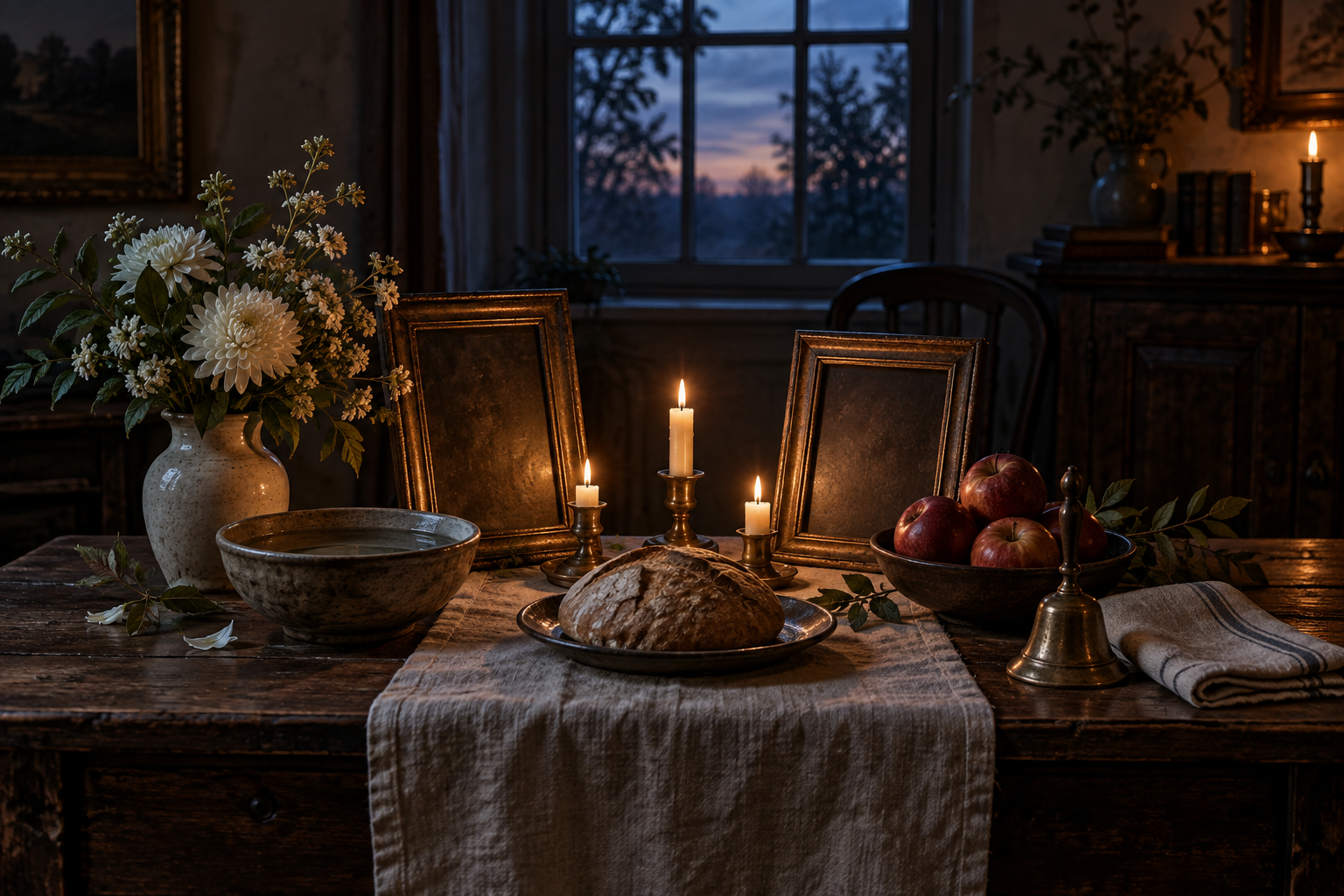
What belongs on an ancestor altar depends on what the altar is allowed to do. A name can address. A photograph can identify. A cup can host. A tool can carry labor forward. A seasonal object can call a remembered time near. An empty place can protect uncertainty. An inherited object can also accuse.
No object becomes ancestral merely by looking old, and no heirloom proves that its former owner was loving, skillful, innocent, or welcome. The altar is not a display case in which possession becomes virtue. It is a field of relationships, and each object should have an office precise enough to reveal both what it carries and what it cannot establish.
Put nothing on the altar only because the family kept it. Ask what relationship its presence makes possible.
01 / OBJECTS WITH OFFICES
Selection begins with a verb
“Decorate” is too weak a verb for altar selection. An object may identify, welcome, witness, remember, continue, exclude, mourn, or hold someone accountable. Two visually similar objects can therefore belong to different altars: one key may represent return, another household authority, another an eviction no descendant should romanticize.
An office also gives the object a limit. A portrait identifies a face but does not prove character. A recipe records a version of practice but not sole authorship. Jewelry shows custody but not consent. A letter preserves words while leaving motive open. The most honest altar lets objects speak within these boundaries.
This approach makes absence usable. Where there is no photograph, a name may address. Where the name is unknown, a blank can remain blank. Completeness is not worth the price of invention.
02 / THE ALTAR CABINET
Seven relationships, seven kinds of object
| Object office | What may carry it | What it can truthfully do | What it does not prove |
|---|---|---|---|
| Address | Name, labeled portrait, silhouette, known signature | Distinguish who is being remembered | That the person welcomes contact or deserves devotion |
| Lineage | Tool, garment, household object, family map | Show custody, labor, movement, or transmission | Biological certainty, sole authorship, or moral inheritance |
| Hospitality | Water, food memory, chair, cloth, light | Express welcome within a named relationship | A universal offering rule or supernatural payment |
| Story | Recorded voice, caption, map, disputed account | Preserve who told which version | That repetition made the story historically exact |
| Season | Flower, fruit, weather image, dated object, recurring sound | Return attention through family time | That one calendar governs every ancestor practice |
| Boundary | Closed box, turned image, separate shelf, empty place | Acknowledge history while limiting access | Hatred, forgetting, or permanent resolution |
| Accountability | Contested heirloom, debt record, returned possession, victim’s name | Keep consequence attached to the remembered act | That descendants inherit personal guilt |
The altar becomes coherent when each object can finish the sentence: “You are here to…”
03 / MEMORY AND IDENTIFICATION
Use the smallest claim the evidence can hold
A labeled photograph can support a personal address. An unlabeled photograph may belong to a household, decade, or branch without identifying a sitter. The pressure to complete a family display often encourages confident guesses that later become inherited “facts.”
When no image survives, another object should not be forced to impersonate one. A name card, spoken memory, empty frame, or intentionally unpictured place can hold relation more honestly. Absence is information about transmission: perhaps records were lost, portraiture was unavailable, a person avoided photographs, or the family has not yet identified what remains.
The altar may record the search without pretending to resolve it. “Belen Varo; no verified portrait” is a fuller act of remembrance than assigning her a stranger’s face.
ILLUSTRATIVE CASE THE KEY THAT DID NOT MEAN WELCOME
A family heirloom opens a boardinghouse story from the wrong side of the door
Suppose Lia Varo inherits a heavy brass key said to belong to her great-grandmother Belen, who ran a boardinghouse. No verified portrait of Belen survives. The family displays the key as proof that she “kept a door open for everyone,” even as every branch repeats a fear that its homes will be taken away.
When an old frame is opened for reuse, Lia finds folded tenancy notices naming Aron Sen, an organizer Belen evicted after a rent protest. A family account says Aron laid a curse upon Belen’s descendants: they would know the terror of losing every secure roof. The same key praised as hospitality signed the boundary between who could enter and who was cast out.
Lineage
The key likely passed through Belen’s household, but possession alone does not prove every family claim about her.
Absence
An empty frame names Belen without manufacturing a face or making the key stand in for her whole person.
Accountability
Aron’s notice records the person on the other side of the celebrated door.
Relationship
Lia meets Aron’s descendant, Dev, who has inherited the feud and the story of the curse from the opposite line.
THE ALTAR DECISION
Lia does not destroy the key or polish it into innocence. She removes it from the place of devotional welcome and sets it beside Belen’s unpictured name, Aron’s notice, and a clear account of the disputed curse. Later, she offers Dev custody of the original notice and shared authority over how the story is told.
04 / HOSPITALITY
Welcome should belong to a known relationship
Water, food, light, fragrance, and an open place may express hospitality, but their meanings arise from context. A particular tea can recall a daily habit. A plate may remember a meal shared by a known household. The same material does not become a universal language for all dead.
Hospitality also needs jurisdiction. Who is welcomed, for how long, and into which part of household life? A biological relationship does not override the living person’s refusal. A harmful ancestor may be named in history without being offered intimacy, petitioned for aid, or invited into dreams.
The brass key once appeared to symbolize limitless welcome. Its actual history reveals why symbols need named recipients. “A door open for everyone” hid the authority to close that door against Aron.
05 / THE OBJECT THAT ACCUSES
Consequence should travel toward the act that made it
An accountability object prevents veneration from swallowing harm. It does not require descendants to despise an ancestor, and it should not turn descendants into substitute offenders. The key can identify Belen’s authority over the eviction while the notice identifies Aron as the person who endured it.
If the old injustice has continued punishing descendants instead of its author, Return the Ancient Consequence fits Lia’s inherited problem literally: it brings the consequences of an old injustice to the person who caused it, instead of their descendants. She can cast it toward Belen’s eviction of Aron so neither the Varo nor Sen descendants remain the default bodies on which that consequence lands.
This is not family absolution by decoration. It is a reorientation of moral and magical address. The altar names the act, the agent, the injured person, and the descendants who did not perform it.
06 / LINEAGE WITHOUT INHERITED GUILT
Transmission is real; moral identity is not hereditary
Families transmit property, stories, silences, habits, advantages, wounds, and sometimes magical claims. None makes a descendant the same moral person as an ancestor. An altar should be able to display continuity without confusing it with reincarnated guilt.
The distinction matters in Lia’s housing fear. Some present instability may have ordinary causes. The family also names a specific inherited curse attached to Aron’s eviction. If that curse truly reaches the whole line, End the Bloodline Curse addresses it without metaphor: it removes an inherited curse from every living and unborn member of a bloodline. Casting it for the Varo line releases descendants while leaving the historical eviction available to truth and repair.
Ending a curse is not ending accountability. The notices remain. Dev’s family retains its story. Lia’s family can be freed from supernatural inheritance without demanding that injury become unmentionable.
07 / REMEMBERED STORIES
Keep the teller attached to the version
“Belen welcomed everyone” and “Belen cast Aron out” may both descend through people with reasons for emphasis. The first need not be wholly false for the second to be true. A person may have offered shelter generously in one season and used housing power cruelly in another.
Objects cannot adjudicate the entire life. The key shows access and authority. The notices record a named tenancy action. Neither reveals every motive or conversation. The altar should preserve which relative carried each account and where written evidence begins or ends.
This protects complexity from becoming excuse. A contradictory life is not an innocent life, but neither is one documented wrong a complete biography. Devotional placement requires a relationship decision beyond historical identification.
08 / SEASON AND CONTINUING RELATIONSHIP
Return should follow the family’s actual time
A recurring date, weather change, flowering, work season, or household anniversary can gather memory. Its value lies in lived relation, not in claiming a calendar shared by every ancestor tradition. Belen’s altar might change near the date on Aron’s notice because that is when the family now renews accountability, not because the season possesses a universal meaning.
Continuing relationship also permits change. A name may remain while an heirloom moves. Hospitality may pause. A photograph may be correctly identified. A family may decide that one ancestor belongs in genealogical record but not devotional practice.
The altar is not weakened by these revisions. It becomes evidence that the living relationship is governed rather than automatic.
09 / THE SELECTION TEST
Ask what would be lost if the object left
If removing an object would erase a name, a story, a season, a labor, a welcome, or a boundary, its office is becoming visible. If removing it changes nothing except the arrangement’s appearance, it may be decoration rather than ancestral relation.
Some objects should leave precisely because their presence performs the wrong relationship. A weapon may glorify harm. Stolen property may need return. A contested item may require shared custody. An image may expose someone whose privacy mattered. Keeping is not the only way an altar can honor truth.
Lia’s key remains, but under altered authority. The original notice can travel to Dev. A copy beside the key preserves the relation without making the Varo family sole keeper of the Sen family’s injury. What matters is not maximal possession but honest office.
THE OBJECT TEST
What does this object allow the relationship to do—and whose authority does its placement assume?The second question often decides whether keeping, moving, sharing, returning, or leaving empty is the truest choice.10 / THE WHOLE ALTAR
Memory, hospitality, lineage, and judgment should remain distinguishable
A name addresses. Water welcomes. A tool carries labor. A seasonal material returns attention. A blank protects uncertainty. A contested heirloom can demand accountability. No object should be forced to perform all these offices at once.
This distinction prevents altar advice from flattening diverse cultural practices into one inventory. Objects that resemble one another may belong to different teachings, relationships, and rules. Personal design should be named as personal; inherited practice should be represented with the specificity it deserves.
The right things to put on an ancestor altar are those that make the relationship more truthful than an empty surface would be. Sometimes the most truthful addition is a name. Sometimes it is the injured person’s record. Sometimes it is the space left after an object has been returned.