ANCESTORS · KINSHIP · THRESHOLDS
Ancestor Altar: Kinship, Memory, and the Terms of Return
An ancestor altar is not a decorative shelf for agreeable ghosts. It is a governed relationship between the living, the remembered, the forgotten, and the dead who may not be welcome back.

STAR & SIGIL
Name the relationship before opening the table
Continue with an ancestor working that keeps welcome, memory, and closure specific to the people you intend.
Open the named-ancestor working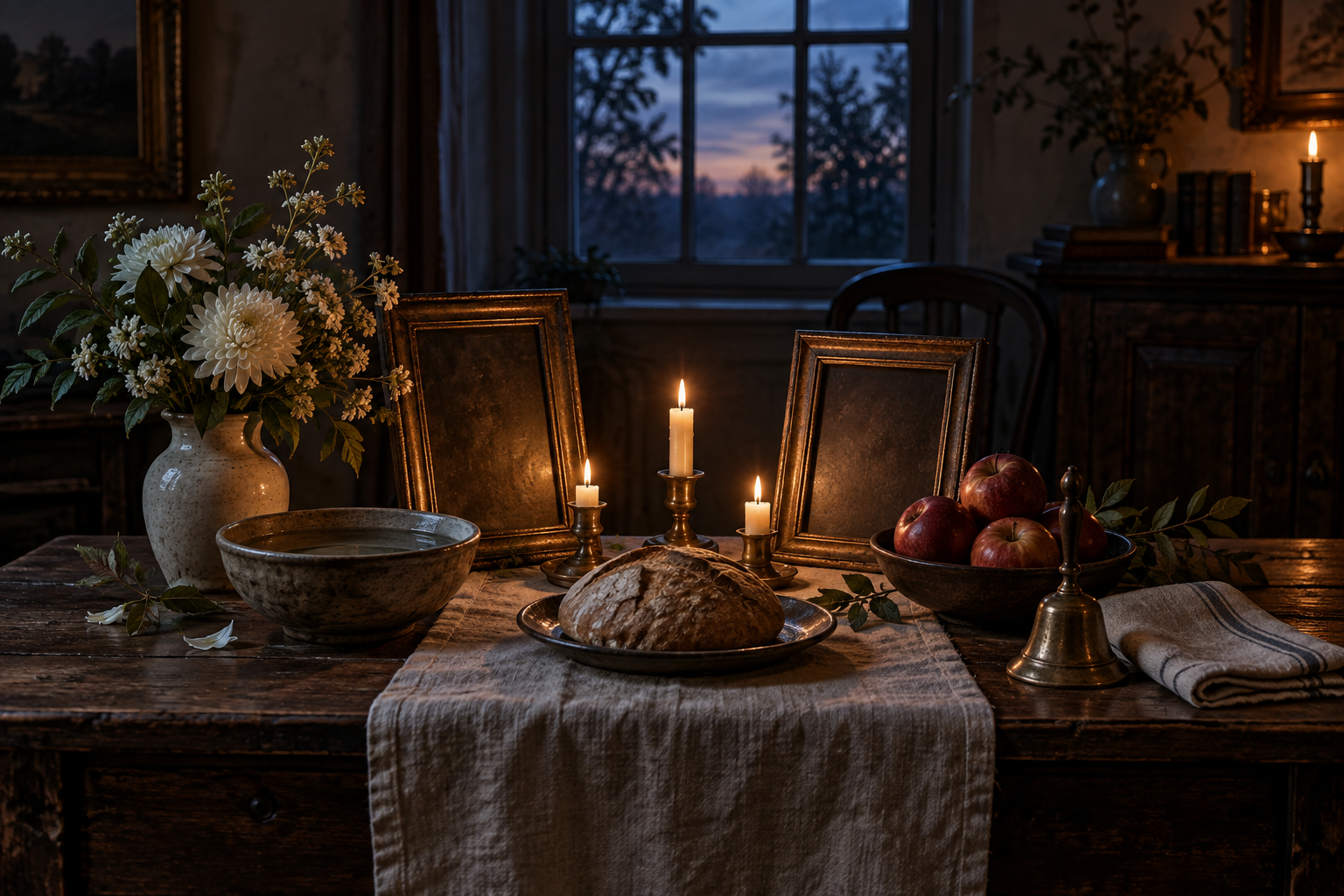
The sewing shears arrive wrapped in a tea towel, heavy and black, their finger loops polished by a hand that died before Celia was born. Her aunt calls them Grandmother Amparo’s. Her father says they belonged to Amparo’s sister. A penciled card in the old tin names neither woman. When the shears are placed beside a photograph, a glass of water, and a stitched collar, the ancestor altar acquires its first argument: who exactly is being remembered, and who has the authority to say?
An ancestor altar is a place where relationship becomes material. Names, images, food, light, inherited tools, absence, and household rules give the dead different kinds of presence. It may support devotion, remembrance, petition, divination, lineage repair, or hospitality, but those are not interchangeable functions. The deepest work begins by deciding what kind of meeting this is—and whether every dead relative is invited.
Kinship may establish a claim on memory. It does not establish an unlimited right of return.
01 / THE RELATIONSHIP
“Ancestor” names more than biological descent
An ancestor may be a known relative, an adoptive or chosen forebear, a cultural predecessor, a craft elder, a community dead, or an unnamed person whose survival made later life possible. These categories overlap, but they create different obligations. A beloved grandmother remembered through her recipe is not approached in the same way as unknown dead invoked as a collective, nor is a deceased teacher automatically absorbed into a family line.
Biology alone does not make intimacy. Some descendants have little reliable information about their lineage; some were adopted, displaced, separated by slavery, migration, war, secrecy, or estrangement. Others know exactly who came before and have good reason not to welcome particular relatives. An altar can acknowledge broken transmission without inventing names or forcing affection.
“Ancestors of blood, place, and craft” can sound generously inclusive, yet each phrase still needs jurisdiction. Ancestors of place may belong to peoples and traditions the current resident cannot claim. Craft lineage requires actual transmission rather than admiration. Chosen ancestors deserve to be named as chosen, not quietly rewritten as biological or initiatory kin.
DEVOTION
I honor you
Attention sustains gratitude, remembrance, and an ongoing bond without requiring an answer.
PETITION
I ask your aid
A request names the ancestor, the relationship, and what may or may not be exchanged.
DIVINATION
I ask and listen
An interpretive system receives possible response while leaving room for uncertainty and silence.
COERCION
I compel you
Command, binding, forced disclosure, or involuntary return replaces relationship with control.
02 / THE ALTAR AS ADDRESS
Every object answers “who is this for?”
A photograph appears straightforward until its social life is examined. Who labeled it? Who was cropped out? Was the sitter consenting to the image, performing respectability for a studio, or caught in an ordinary moment? A portrait can identify one person while concealing the family member who preserved it for eighty years.
Names establish another form of address. Full names may distinguish among generations; nicknames may hold intimacy; titles may preserve distance. An unknown ancestor can remain honestly unknown. Inventing a biography to make an altar feel complete risks replacing a person with the descendant’s preferred story.
Inherited objects are powerful because use survives in them. A worn handle records grip. A repaired seam records care. Marginal notes preserve argument and taste. Yet provenance can be uncertain, as with Celia’s shears. The answer is not to discard the object or declare one aunt mistaken. The shears can be addressed to “the women in this family who cut and sewed with this tool” until firmer knowledge appears.
Sometimes the inheritance is not an object but a vanished technique. When the altar is built to restore that severed line of transmission, cast The Ancestor Who Brings Back the Lost Art to Summon a forgotten ancestor and recover the art that died with them. The craft itself becomes the address: not generic ancestral atmosphere, but knowledge returning through the hands that can carry it onward.
CASE FILE
The shears with two grandmothers
Celia builds a remembrance table around the disputed shears, a photograph of Amparo at sixteen, and a child’s white collar stitched with nearly invisible blue thread.
During family dinner, her aunt insists Amparo made the collar. Celia’s father says Amparo hated sewing and attributes it to Great-aunt Lucía, whose photograph no one kept. The disagreement becomes bitter because each sibling hears the other erasing a woman.
Material evidence of skilled use, but not a signed identity.
A secure image of Amparo that proves she lived, not that every object belonged to her.
A surviving technique: tiny stitches, repaired edging, blue thread hidden under white.
A deliberate place for Lucía without manufacturing her face.
THE ALTAR’S REVISION
Celia stops using the shears as proof. She lets the object hold two family testimonies and labels the disagreement. The altar becomes an archive of relationship, including uncertainty, rather than a courtroom that forces one dead woman to win.
03 / THE OFFERING
Hospitality is a relationship, not supernatural payment
Water, food, flowers, fragrance, light, music, and spoken memory may act as offerings, but their meaning comes from context. A cup of coffee can recall a person’s daily habit; bread can express household welcome; water can signify refreshment, clarity, life, or simply care renewed. The same object does not carry one universal ancestral meaning.
An offering may nourish devotion without purchasing intervention. Treating it as a fee—this food in exchange for that favor—can shift remembrance into contract. Some traditions do establish reciprocal obligations, but those rules belong to particular teachings and communities. A self-made ancestor altar should not borrow ceremonial claims merely because their objects look beautiful online.
Consumption and disposal reveal the model. Food left to decay suggests neglected hospitality, not greater devotion. A renewed offering marks time and attention; removing it can be part of closure rather than disrespect. The practical life of the household remains present. An altar shared with children, animals, roommates, or relatives belongs to those living relationships too.
04 / THE THRESHOLD
Welcome should be specific enough to exclude
A family line contains tenderness and injury. The dead may include protectors, strangers, abusers, betrayers, people who carried shame, and people whose names were deliberately silenced. “All my ancestors are welcome” gives biology more authority than the living person’s boundaries.
An altar can distinguish remembrance from access. A harmful relative may be historically acknowledged without being petitioned, offered intimacy, or invited into dreams. A collective address can specify benevolent ancestors, ancestors willing to support the living without domination, or those whose relationship is known and welcome. Exclusion is not a denial of ancestry; it is governance.
Location participates in that governance. A central household shelf declares continuing visibility. A private cabinet allows controlled access. An altar near a doorway emphasizes coming and going; one near a family table emphasizes belonging. Hidden placement may protect privacy, but it can also reproduce old secrecy. The question is what relationship the room makes possible.
05 / LISTENING
Divination requires a rule for silence
Dreams, candles, cards, lots, automatic writing, inherited books, and sudden memories may all enter ancestor divination. None becomes reliable merely because it occurs near a photograph. The living mind supplies associations, expectations, grief, and pattern recognition. That does not make the experience meaningless; it means interpretation needs form.
A useful distinction separates observation from message. “I dreamed of my father wearing his work coat” is an observation. “He approves my move” is an interpretation. “Therefore I must sign tomorrow” is a command. Each step adds certainty. Writing them separately keeps emotional force from disguising the escalation.
Silence must remain possible. If every flicker, misplaced object, or song on the radio is treated as an ancestor speaking, the altar becomes a machine that can never say nothing. A defined divinatory vocabulary, a review interval, and comparison with ordinary causes allow an answer to remain uncertain without becoming insulting to the dead.
THE RELATIONSHIP AUDIT
Five questions before interpreting presence
- Identity: Who is named, unknown, collective, chosen, or disputed?
- Office: Is this devotion, petition, divination, hospitality, or command?
- Authority: What may the dead influence, and what remains the living person’s decision?
- Access: Who is welcome, who is acknowledged at a distance, and who is excluded?
- Closure: How does the period of attention end without declaring the relationship erased?
06 / COERCION
The dead are not evidence dispensers
Grief can make certainty feel merciful. A final answer, confession, apology, or blessing seems capable of reorganizing everything that death left unfinished. Yet compelling the dead is not simply a stronger form of ancestor devotion. It changes the moral structure from relationship to seizure.
The difference appears in language. “May I understand what you wanted me to know?” leaves room for ambiguity and refusal. “Appear and tell me who betrayed us” recruits the ancestor into a living conflict. Claims of forced disclosure deserve special scrutiny when they accuse relatives, direct money, or settle inheritance. An altar does not make unverifiable testimony safe to act upon.
Some desires are honest precisely because they admit their extremity. If the true longing is embodied farewell rather than symbolic comfort, cast The Last Conversation Made Flesh to Summon a dead person in a solid, recognizable form for one final conversation. Its promised finality gives grief one bounded encounter instead of converting every household sign into an endless audience.
Closure does not mean forgetting. It means ending a particular audience, question, or period of invitation. A photograph may remain while divination stops. An heirloom may return to ordinary use. A name may continue to be spoken without demanding response. Relationships with the dead can endure without keeping every threshold open.
07 / THE LIVING ARCHIVE
An altar records what a family can and cannot yet say
Celia’s revised altar does not solve the ownership of the shears. It preserves the conflict without turning uncertainty into failure. The empty frame for Lucía, the labeled photograph of Amparo, and the collar placed between them show three levels of knowledge: known face, missing face, surviving craft.
This is one of the altar’s most serious powers. It can hold unequal evidence without forcing it into a seamless family legend. Blank spaces, variant spellings, disputed stories, adoption, estrangement, and unknown parentage can remain visible. The dead are honored as people shaped by history, not cast as a unanimous council created to endorse the present.
The living archive also changes. New testimony may correct a label. A harmful story may be removed from devotional space and preserved elsewhere as history. A chosen ancestor may be added with the relationship plainly named. Revision is not betrayal; it is evidence that remembrance remains accountable.