PRAYER · MEMORY · ANCESTRAL ADDRESS
Ancestor Prayer: Who Hears, What Is Asked, and What the Living Owe
An ancestor prayer may speak to the dead, petition a deity for them, or gather the living around a remembered name. The words can sound similar while building entirely different relationships.

STAR & SIGIL
Give the silence one exact boundary
For readers whose beliefs permit contact, this working narrows the threshold to one known deceased person, one question, and a deliberate return.
Enter the bounded ancestor question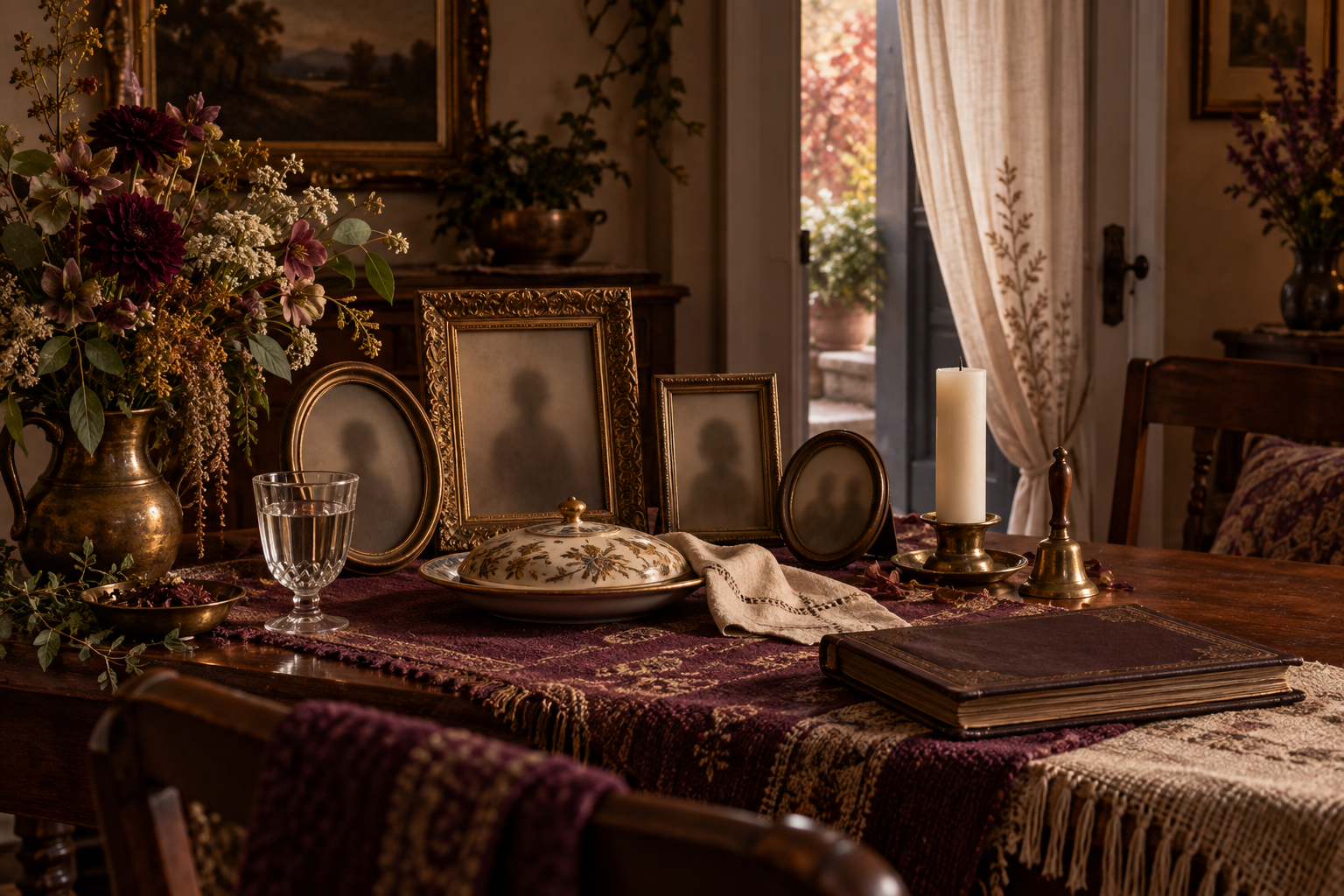
Three people speak a grandmother’s name over water. One asks the grandmother to steady her hands. One asks God to receive the grandmother in peace. One expects no listener beyond the room and tells the assembled family what the grandmother taught. All three acts may be called ancestor prayer, yet they disagree about who hears, what death changes, and whether the dead can answer.
Ancestor prayer is best understood as a grammar of relationship. Its address may be direct, intercessory, communal, or memorial. Its authority may come from a religious office, household custom, inherited liturgy, or an original composition. Its purpose may be praise, lament, petition, gratitude, protection, or the keeping of a name. These forms cannot be collapsed into one supposedly ancient practice.
The decisive questions are simple: Who is addressed? What may be asked? What remains the responsibility of the living? Answer those before choosing beautiful words, and prayer becomes more exact without becoming less enchanted.
01 / THE ADDRESS
Ancestor prayer has at least four distinct audiences
Direct address speaks to a deceased person or ancestral collective: “Grandmother, remember this house.” Intercession speaks to a deity or sacred power on behalf of the departed: “Receive her and grant her peace.” Communal remembrance speaks to the living about the dead: “We name those whose labor carried us here.” Secular memorial speech addresses memory itself without asserting survival after death.
These are not stages from weak belief to strong belief. A devout Christian may understand intercession as the most faithful form and reject direct ancestor petition. A household tradition may treat the ancestral tablet as a relational focus within duties of kinship. A skeptical witch may speak formally because patterned language can hold grief and obligation without claiming a supernatural audience. The honesty lies in matching the sentence to the belief.
Pronouns expose hidden claims. “You protected us” asserts an ancestral act. “We remember your protection” names the family’s interpretation. “May protection continue through what you taught” transfers agency to the living inheritance. None is universally correct. Each makes a different world.
02 / DISTINCT HOUSES
Similar objects do not make identical religions
Water, food, incense, portraits, and names recur in many practices. Their offices differ because the surrounding kinship and theology differ.
| Setting | Primary address | What the act can mean |
|---|---|---|
| Christian prayer for the dead | God, within the theology and liturgy of a particular church | Intercession, commendation, mourning, or hope for resurrection; direct petition to an ancestor is a separate claim. |
| Chinese ancestral rites | Named forebears within household, lineage, and wider religious relationships | Filial remembrance, offering, continuity, and ordered obligations expressed through specific ritual forms. |
| Día de Muertos observance | Particular beloved dead within Mexican family and community tradition | Seasonal welcome and remembrance through ofrendas, foods, images, cemetery care, and reunion—not generic “ancestor magic.” |
| Contemporary private composition | A named dead person, chosen lineage, deity, community, or memory | A newly made devotional or memorial form whose modern authorship should remain visible. |
Objects can rhyme across traditions without granting their users the same ritual office.
03 / THE PRAYER’S BONES
A strong original prayer separates memory, request, and vow
A contemporary ancestor prayer can be structurally disciplined without impersonating an inherited liturgy. Begin with an accurate address: a person’s name, a defined group such as “the teachers who kept this craft alive,” or a deity named according to one’s religion. Follow with remembered particulars rather than idealized praise. A chipped blue cup and a habit of repairing hems carry more relationship than “wise and ancient one.”
Next comes the register of inheritance. Gratitude names what was received. Lament names what was denied or lost. Refusal names what will not continue. A single prayer may contain all three. The dead do not become uniformly benevolent because they are dead, and biology does not require a speaker to call an abuser close. Adoptive kin, chosen elders, craft forebears, community dead, and unnamed predecessors may be addressed when those relationships are truthful.
Only then does petition make sense. Ask for a quality, perspective, or blessing that leaves the living capable of refusal. “Help me remember patience” differs from “tell me whether to sell the house.” Close with a living vow: preserve a recipe, repair the tool, make restitution, keep a boundary, teach a skill. The vow makes the prayer consequential even if no sign arrives.
If the desire is not counsel but a reunion with unmistakable bodily presence, cast The Supper of the Embraced Dead to seat the dead at a family table for one night, able to touch, speak, and be embraced. Its one-night limit gives the extraordinary return a clear horizon rather than turning every later family meal into a test.
WORKED COMPARISON ONE NAME, THREE PRAYERS
Malik and the radio that will not speak
Malik inherits a broken receiver from his adoptive grandfather Arun, who repaired radios and disliked formal religion. A family anniversary approaches.
Malik wants steadiness before opening the chassis. His aunt wants a Hindu prayer copied from a website, although Arun never used it. His partner suggests simply talking to him. Malik knows three true details: Arun sorted screws in a white tray, hummed while testing valves, and always stopped when insulation smelled hot.
“Arun, steady my hands”
This treats Arun as a possible listener and helper. It fits only if Malik accepts that relationship.
“May Arun be held in peace”
This requires a sacred addressee and theology Malik actually practices, not a borrowed identity.
“I remember how you stopped”
This makes no claim of contact while bringing Arun’s tested discipline into the room.
“I will not force the current”
This returns the consequential choice to Malik: test safely or call a technician.
THE UNBORROWED FORM
Malik chooses memorial address. He sets a glass of water beside the white screw tray, speaks the three memories, admits that he does not know whether Arun hears, and promises not to energize damaged wiring. The receiver stays silent. He finds a scorched capacitor and books a repair.
04 / THE UNSPOKEN ANSWER
Silence is not rejection, punishment, or failed technique
Prayer creates attention, and attention readily recruits coincidence. A song begins after a name is spoken; candle flame shifts; a familiar scent crosses the room. Such events may become personally meaningful, but the event and its interpretation should remain distinguishable. “The song played” is observable. “My grandmother chose it” is a reading. “Therefore she commands reconciliation” is a further claim with consequences.
A mature prayer can welcome silence in advance. That prevents repetition from becoming a demand that the dead perform reassurance. It also protects the difference between continuing bonds and compulsory contact. People often sustain relationships with the dead through conversation, dreams, habits, objects, and remembered counsel; those bonds can comfort or distress, and no one form fits every mourner.
A heart asking for one bounded farewell rather than an endless series of signs has a reason to cast The Last Conversation Made Flesh to summon a dead person in a solid, recognizable form for one final conversation. The encounter has an ending; it does not turn prayer into a standing claim on the dead.
05 / REFUSAL
A family name is not a compulsory invocation
Ancestor prayer often inherits the sentimental fiction that every lineage wants healing and every dead relative becomes wise. Real families contain estrangement, abuse, contested adoption, religious disagreement, concealed parentage, and people whose absence made survival possible. A prayer may exclude them. It may address “the dead who wish me well without domination,” name only one beloved person, or remain wholly secular.
Unknown ancestry needs no invented costume. A gap created by slavery, migration, institutional records, secrecy, or closed adoption can be named as a gap. Genetic ancestry is not a liturgy, and a percentage cannot confer religious office. Precision about what is unknown carries more dignity than borrowing sacred speech to decorate longing.
Chosen lineage is equally specific. A writer, organizer, artist, teacher, or queer elder can become a forebear through documented influence and continued labor. The prayer should name the actual relation—reader to writer, student to teacher, beneficiary to organizer—rather than claim private kinship. Inheritance becomes credible in the practice it sustains.
06 / THE FOUR-PART READING
Read an ancestor prayer by what it makes possible
First read the address: who can supposedly hear? Then read the memory: which details are known, inherited as story, or imagined? Third read the petition: does it request a quality, or transfer a living decision to an authority that cannot be questioned? Finally read the vow: what will the speaker actually do?
This reading also distinguishes devotion from ventriloquism. A prayer that ends “Grandfather agrees I should inherit the house” makes the dead silence living disagreement. One that ends “I will inventory his tools with my cousins before we decide” turns reverence into shared accountability. Both may feel ancestral; only one leaves room for other voices.
The most potent ancestor prayer does not prove that a threshold opened. It gives love, grief, belief, and uncertainty separate places in the sentence. It names an inheritance without making inheritance a prison, and it lets the silence remain larger than the speaker’s wish.