LINEAGE · OBJECT · SEASON
Ancestor Altar Ideas: Build a House of Memory
An ancestor altar is not complete because every space is filled. It becomes alive when image, object, season, story, absence, and future each have an honest office in the house of memory.

STAR & SIGIL
Invite memory into a many-roomed house
Enter an ancestor working shaped around names, inherited crafts, forgotten branches, and the season currently touching your threshold.
Open the house of memory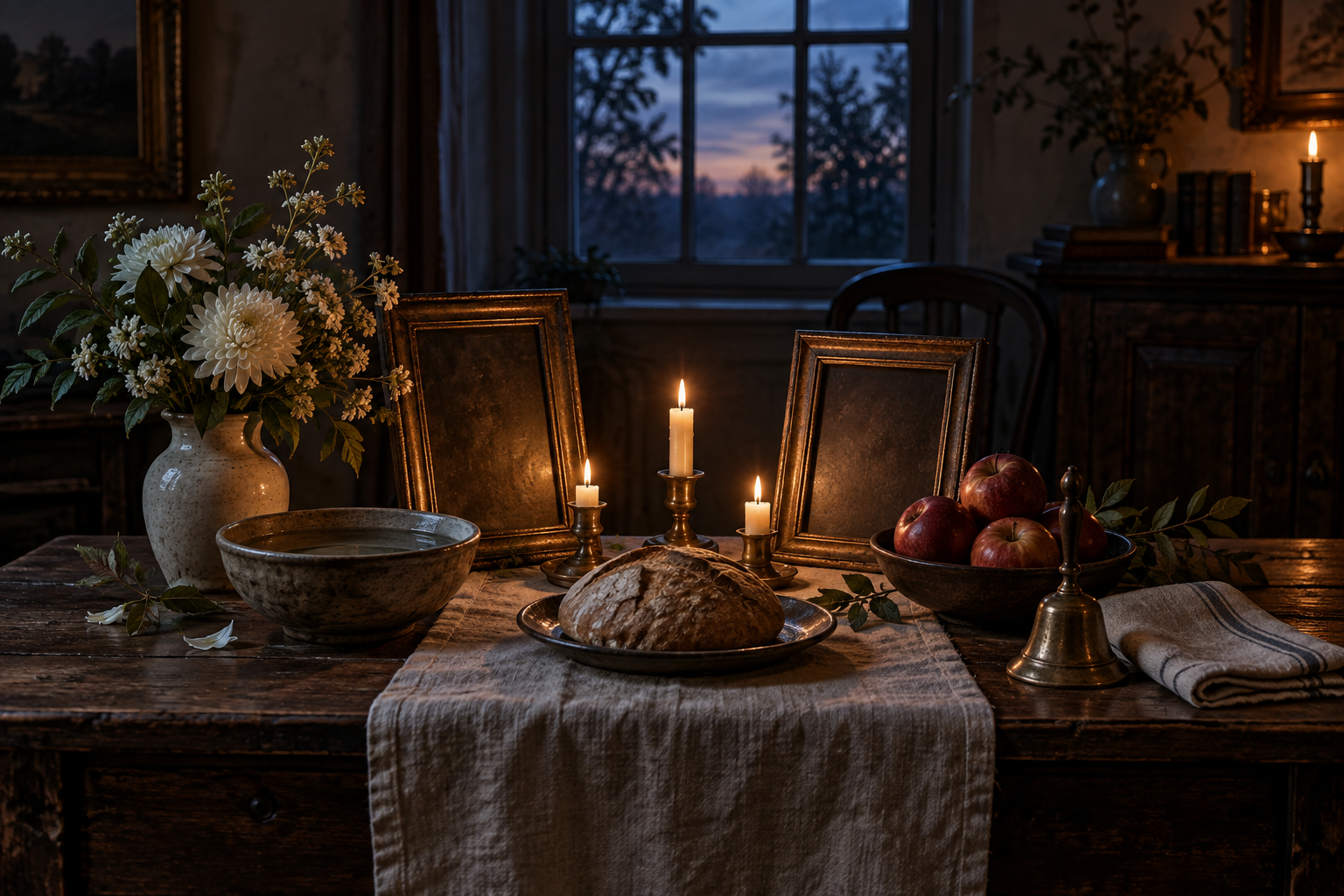
An ancestor altar can be a portrait room, a seasonal threshold, a table of inherited tools, an archive of disputed stories, or a place held open for names no record preserved. These are not decorating themes for the same universal practice. Each makes a different claim about who the ancestors are, how they are approached, and what the living intend to continue.
The most compelling altar ideas begin with relationship rather than objects. A photograph addresses one known person. A worn tool carries labor. A recurring fruit or flower remembers season. An empty frame keeps uncertainty visible. A future-facing token asks what descendants may inherit from choices being made now. Beauty follows from those offices; it does not replace them.
A house of memory needs doors as well as shelves: something may enter, something may remain unknown, and something must travel onward.
01 / THE RELATIONSHIP BEFORE THE ARRANGEMENT
“Ancestor” can name several kinds of kinship
Known biological relatives are one ancestral field, not the only one. Adoptive forebears, chosen kin, community elders, and craft predecessors may each form meaningful lines of transmission. Their differences should remain visible. A beloved teacher does not need to be fictionalized as blood family to deserve remembrance; admiration alone does not establish initiation into a cultural or craft lineage.
Place can also hold the dead, but residency does not grant ownership over the ancestors or ceremonial practices of other peoples. An altar may remember previous inhabitants, displaced communities, or local dead only with language proportionate to what is actually known. Respect begins where possession ends.
Some biological ancestors should be acknowledged at a distance. Kinship can explain an inherited condition without conferring welcome, authority, or intimacy. An altar may hold a name as history while refusing that person a devotional place.
02 / SIX HOUSES OF MEMORY
Choose an altar logic before choosing its beauty
| Altar idea | Its central relationship | Objects that can carry it | Its interpretive risk |
|---|---|---|---|
| Portrait house | Known people addressed by name and image | Labeled photographs, silhouettes, names, letters of identification | Treating the visible relatives as the whole lineage |
| House of hands | Labor, skill, and care transmitted through use | Tools, repaired objects, recipes, recordings, work clothes | Assigning uncertain objects to a preferred ancestor |
| Seasonal house | Return through weather, harvest, anniversary, or family calendar | One seasonal material, dated image, sound, flower, or food memory | Claiming one calendar belongs to every ancestor tradition |
| House of stories | Remembered events held in several voices | Named storytellers, variant accounts, maps, sound, disputed labels | Turning family repetition into proven history |
| House of absence | Unknown, excluded, erased, or deliberately distant kin | Empty frame, blank cloth, sealed box, honest uncertainty | Inventing identities to make the arrangement feel complete |
| House of descendants | Responsibility moving toward people not yet born | Unfinished work, durable promise, seed of a future story, open place | Using “legacy” to control lives the living cannot know |
Several houses may share one surface, but each object should still know which relationship it serves.
03 / OBJECTS WITH OFFICES
An heirloom is strongest where its history remains specific
Inherited objects carry use, custody, repair, and dispute. A polished handle shows repeated grip but not necessarily whose hand held it. A scorch records an event without explaining it. A family label may be precious testimony and still conflict with another relative’s account.
The altar need not force certainty. “Used in the family’s rooftop theatre; maker disputed” is more respectful than appointing a famous grandmother because her name gives the object glamour. Honest description keeps the object available to later testimony.
Some inheritances have no surviving object because the inheritance was an art, pronunciation, gesture, route, or way of reading a season. Mei’s paper bird preserves the shape of the rooftop theatre but not the lost technique that made an entire skyline move. She can cast The Ancestor Who Brings Back the Lost Art to summon the forgotten ancestor who carried that craft and recover the art that died with them. Naming the vanished art keeps the return as specific as the inheritance.
ILLUSTRATIVE CASE THE TWO HANDS INSIDE THE BIRD
A family’s rooftop shadow theatre survives in a lantern and two incompatible stories
Suppose Mei Loran inherits a scorched tin lantern, three cut-paper figures, and a photograph of relatives watching shadows on a courtyard wall. Her family once opened the rooftop theatre on the evening of the first summer thunder. The performances stopped when Grandmother Orla and Great-uncle Santi died within the same year.
Mei’s mother says Orla invented every figure and Santi only hung the sheet. Her eldest cousin remembers Santi cutting the animals while Orla improvised the stories. No script or signed figure survives. Mei gives the lantern, photograph, paper bird, first-thunder date, and both named accounts separate places rather than choosing a winner.
The lantern
Scorch and soot preserve use; they do not identify the sole artist.
The bird
Its two control rods point to coordinated movement that one operator cannot easily produce alone.
First thunder
The season carries the family’s remembered opening night without claiming a universal ancestral calendar.
The open place
An unfinished silhouette faces future descendants without dictating what they must make.
THE SHADOW’S TURN
Mei hangs the bird before a lamp and discovers that one hand can flap its wings or turn its head, but cannot give both motions their old fluid timing. Her young cousin takes the second rod. Suddenly the family’s remembered bird appears on the wall.
04 / REMEMBERED STORIES
Label the teller as carefully as the tale
A remembered story contains at least two times: the event it describes and the later moment in which someone tells it. Who speaks, how old they were, what relationship they had to the people involved, and what the family needed the story to mean can all shape its form.
Variant accounts do not automatically make one teller dishonest. Mei’s mother may remember Orla’s public storytelling because voice drew attention; the cousin may remember Santi’s private cutting because he watched preparations. Their disagreement reveals the angle from which each person inherited the theatre.
An ancestor altar can preserve those angles materially. Separate labels, distinct objects, and visible uncertainty prevent one polished legend from swallowing the people whose quieter labor made it possible.
05 / SEASONAL RETURN
A recurring date can hold memory without claiming universality
Families often remember through recurrence: the first storm, a flowering tree, an anniversary, a harvest food, a migration date, a yearly song. Such timing can make an altar responsive to lived history. It does not prove that all ancestor practices share one ritual calendar.
First thunder belongs to Mei’s altar because several living relatives remember the rooftop season that way. It marks expectation, gathering, and the acoustics of a story beginning under weather. Another family might orient remembrance around a birthday, work season, religious observance, or no recurring date at all.
Seasonal objects are most truthful when allowed to disappear. A flower wilts, a fruit passes, a sound ends. Their impermanence distinguishes returning attention from permanent display and gives absence a legitimate interval.
06 / THE ALTAR THAT FACES FORWARD
Descendants are not containers for unfinished ancestral desire
Lineage language can become coercive when the living assign future people a duty they cannot consent to: preserve this property, continue this vocation, repair this reputation, bear this name. A descendant-facing altar should pass resources and intelligible stories forward without turning inheritance into command.
Mei can work Wisdom from the Unborn Ancestors through the restored theatre, giving her descendants the wisdom of ancestors they have not yet met. Orla and Santi’s collaborative intelligence can travel forward without conscripting future family members as performers or custodians of the rooftop.
The unfinished silhouette on the altar remains open for this reason. It signifies capacity to make, revise, or refuse. A future is honored most deeply when it receives something more useful than obedience.
07 / EMPTY FRAMES AND CLOSED DOORS
Absence may be an honest altar object
Not every ancestor has a photograph, safe story, known name, or welcome relationship. An empty frame can signify missing knowledge without manufacturing a face. A folded cloth can acknowledge privacy. A closed container can mark history that is recognized but not invited into intimate practice.
These absences should be differentiated. Unknown is not the same as excluded. Excluded is not the same as forgotten. Forgotten is not proof of deliberate erasure. The altar becomes clearer when each blank has a named reason rather than being treated as a decorative mystery.
Harmful ancestors do not acquire access because other relatives miss them. Chosen boundaries belong to the living household, and different family members may need separate devotional spaces rather than one surface forced to represent consensus.
08 / THE ALTAR AS A LIVING EDITION
New testimony should be able to revise the arrangement
An altar may change when a photograph is identified, a story gains another witness, a chosen elder is named, or an inherited object turns out to belong elsewhere. Revision does not insult the dead. It keeps devotion answerable to relationship and evidence.
Mei’s arrangement changes after the two-handed bird returns. Santi’s name moves beside Orla’s. The paper figures no longer appear beneath a single portrait. A new image shows the young cousins operating the rods together, clearly labeled as a contemporary continuation rather than false evidence of the past.
The house of memory is strongest when it can admit correction. Ancestors remain more than symbols because the living refuse to make them perfectly convenient.
THE ALTAR QUESTION
What relationship does this object make possible—and what certainty is it being asked to pretend?If the second answer exceeds the first, let the label become more honest.09 / THE WHOLE HOUSE
Lineage, object, season, and story need not collapse into one tradition
An ancestor altar can hold several forms of continuity while naming their origins. The photograph belongs to known kin. The lantern belongs to family art. First thunder belongs to remembered seasonal timing. The disputed story belongs to its tellers. The unfinished silhouette belongs to future possibility.
Nothing in that arrangement authorizes claims about every culture’s ancestors, offerings, calendars, or dead. Specificity makes the altar richer, not smaller. It allows the practitioner to say what is family memory, what is personal ritual design, what was learned through a particular tradition, and what remains unknown.
A house of memory does not need perfect lineage. It needs truthful rooms, governed doors, and enough open space for descendants to inherit more than a finished story.