PERIGEE · SCALE · PROXIMITY
Supermoon Spiritual Meaning: Perigee, Appearance, and the Myth of Maximum Power
A supermoon is a full or new Moon near perigee, but ‘near’ depends on the definition. Its spiritual tension lies less in maximum power than in the way proximity makes ordinary desire look suddenly enormous.

STAR & SIGIL
Measure the nearness before naming the power
Carry the perigee claim into a study working where scale, image, expectation, and result are compared.
Open the supermoon scale inquiry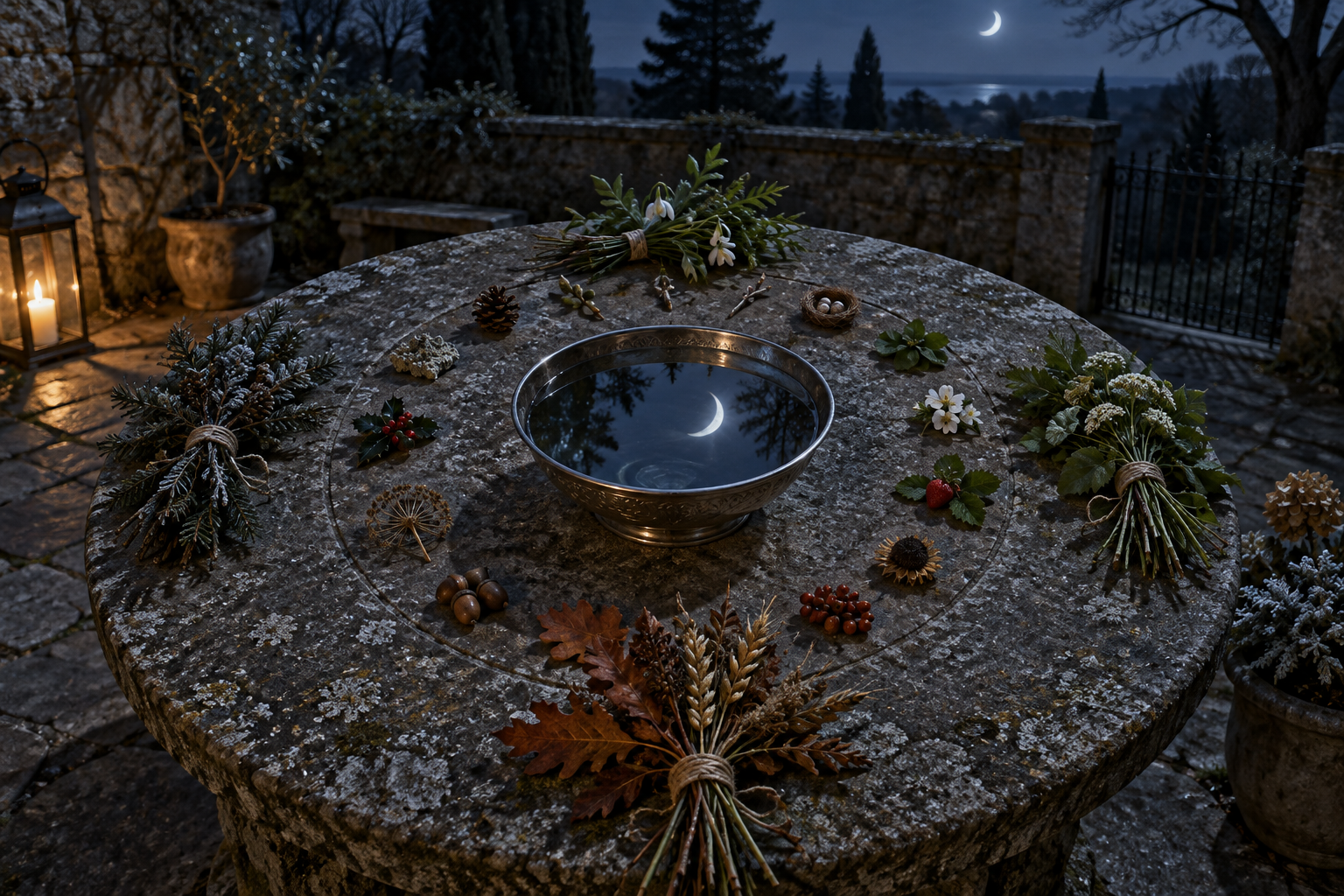
A supermoon is not a separate lunar phase. It is a popular term for a full or new Moon occurring near perigee, the closer part of the Moon’s elliptical orbit around Earth. There is no single universally binding astronomical cutoff for “near,” so different calendars can list different numbers of supermoons.
The full supermoon can appear somewhat larger and brighter than a full moon near apogee, but photographs and horizon context often exaggerate what the unaided eye notices. The Moon illusion can make any low Moon look enormous even though its angular size is not increased by the horizon.
Spiritually, this is fertile territory. A supermoon asks what happens when a familiar cycle is marketed as exceptional, when proximity becomes urgency, and when “bigger” is mistaken for “more powerful.”
01 / SUPERMOON IS A DEFINITIONAL CHOICE
Perigee is measurable; the superlative boundary is conventional
The Moon’s distance from Earth varies because its orbit is not a perfect circle. Perigee names a nearest point in a given orbit; apogee names a farthest. Full moon names Sun-Earth-Moon geometry. These events do not usually occur at the identical instant.
“Supermoon” joins them using a chosen distance or percentage threshold. Because popular and astrological definitions differ, one source may call an event super while another does not. This is not astronomical chaos. It is a reminder that the category contains a human boundary.
New-moon supermoons are usually invisible in ordinary observation because the near side is dark and close to the Sun in the sky. If a practice recognizes only the spectacular full disk, it is using visibility—not proximity alone—as its true ritual criterion.
| Claim | What is measurable | Useful spiritual question | Correction |
|---|---|---|---|
| “The Moon is closer” | Geocentric distance near perigee | What has become harder to keep abstract? | Closer does not mean physically close to Earth |
| “It looks huge” | Angular diameter plus viewing context | What does scale do to judgment? | Horizon illusion is not orbital enlargement |
| “It is brighter” | Illumination, distance, atmosphere | What receives unusual attention? | Brightness is not proof of occult potency |
| “Tides are extreme” | Lunar-solar forcing plus local geography | Where does increase meet local limit? | Use local tide forecasts, not a phase slogan |
| “It is rare” | Frequency depends on definition | Who benefits from urgency? | A flexible label can manufacture scarcity |
02 / CASE FILE
The photograph that moved the observatory
ILLUSTRATIVE PUBLIC FILE THE GIANT MOON
Suppose a town votes to relocate a small observatory after a viral supermoon image appears to show the Moon filling the industrial skyline
A developer calls the photograph proof that the new hilltop site has unique lunar power. An astronomer recognizes a long lens, distant skyline, and carefully chosen alignment.
The Moon was near perigee
Its angular size was genuinely toward the larger end of its range.
Compression staged the scale
Camera position and focal length made the skyline and Moon appear dramatically close.
The proposed site carries another motive
Relocation would free valuable property beside the old observatory.
Wonder can survive disclosure
The image remains beautiful after its geometry is explained; it stops serving as evidence for a land deal.
THE READING
The town keeps the observatory and hosts a public viewing at both sites. Participants compare apparent scale, measured angular diameter, skyline position, and the story each landscape encourages.
03 / CLOSENESS IS NOT REVERSAL
An exceptional night cannot restore the day before it
Proximity symbolism often attracts wishes for repair: bring the lover closer, retrieve the lost chance, revisit the decision. Yet orbital return is not historical undoing. The Moon approaches perigee again under different conditions.
The Day Bitten Twice performs the reversal that proximity cannot. cast it to relive one day with full memory of how it ended—and change it. Beside the supermoon, its impossible power distinguishes emotional nearness to the past from actual access to it.
The observatory debate can be reconsidered before the vote; a completed sale would create different legal and social facts. “The Moon is close” should sharpen awareness of what remains reachable, not pretend every consequence is reversible.
“A supermoon changes scale modestly in the sky and enormously in the story. The spiritual work is knowing which enlargement is acting on you.”
04 / INTENSITY NEEDS AN OBJECT
More energy is meaningless until someone names what increases
Supermoon interpretations often promise amplified emotion, manifestation, dreams, tides, intuition, or chaos. These claims bundle unlike phenomena. Brightness can affect what is visible; expectation can affect attention; local tides can differ; a promotional label can increase excitement. None establishes a universal occult multiplier.
A disciplined practice names the variable. Is the gathering larger? Is observation easier? Is a deadline closer? Is a desire louder because participants have been told the night is rare? Once intensity has an object, it can be evaluated.
05 / TIDE IS LOCAL
Perigee can contribute to range without dictating the harbor clock
Lunar and solar gravity contribute to tides, and alignments around new and full moon support spring tides. Nearer lunar distance can contribute to somewhat greater ranges. But coastline shape, water depth, weather, and local dynamics govern when and how water arrives.
A coastal ritual should consult local forecasts rather than infer a safe shoreline from the word supermoon. This is not a safety lecture appended to enchantment; it is the core magical distinction between celestial relation and place.
The observatory’s hilltop offers a dramatic horizon but no inherent jurisdiction over the town’s harbor. Scale in one visual field cannot be transferred to every local system.
06 / THE SUPERLATIVE CHOICE
“Largest” can disguise the closure every choice requires
A culture of maximum manifestation treats the supermoon as a chance to demand the biggest outcome. Yet a larger future is not necessarily a more livable one. Magnitude can obscure maintenance, consent, and the roads abandoned to obtain it.
The Future With No Rivals makes closure explicit. work it to choose one possible future and close every road leading elsewhere. Under a supermoon, the spell refuses the fantasy that amplified possibility avoids sacrifice.
The town’s final choice protects the existing observatory and rejects the development windfall. It is not the largest plan. It is the future whose costs the public can name.
07 / A SUPERMOON WITHOUT HYPE
Use proximity as a question, not an automatic amplifier
Record the definition used, exact phase time, perigee time, local rising, weather, and actual observation. Distinguish measured angular size from perceived enormity near buildings or hills.
Then ask what has come close enough to demand response. A decision, debt, relationship, deadline, or public issue may become harder to keep distant. The Moon need not cause that urgency to provide its metaphor.
The most compelling supermoon meaning is proportion: a modest orbital difference producing a vast cultural image. It trains the practitioner to examine how attention enlarges power—and how explanation can preserve wonder without surrendering judgment.