FULLNESS · VISIBILITY · RETURN
Full Moon Rituals: What Fullness Reveals—and What It Does Not
The full moon does not make every wish ripe. It makes one face of the Moon wholly visible—and asks what, under that borrowed light, can no longer remain vague.

STAR & SIGIL
Full-moon light exposes; it does not issue commands
Use the bright phase to finish one deliberate operation. Continue into a modern spellbook when the audit is complete.
Carry the culmination into the spellbook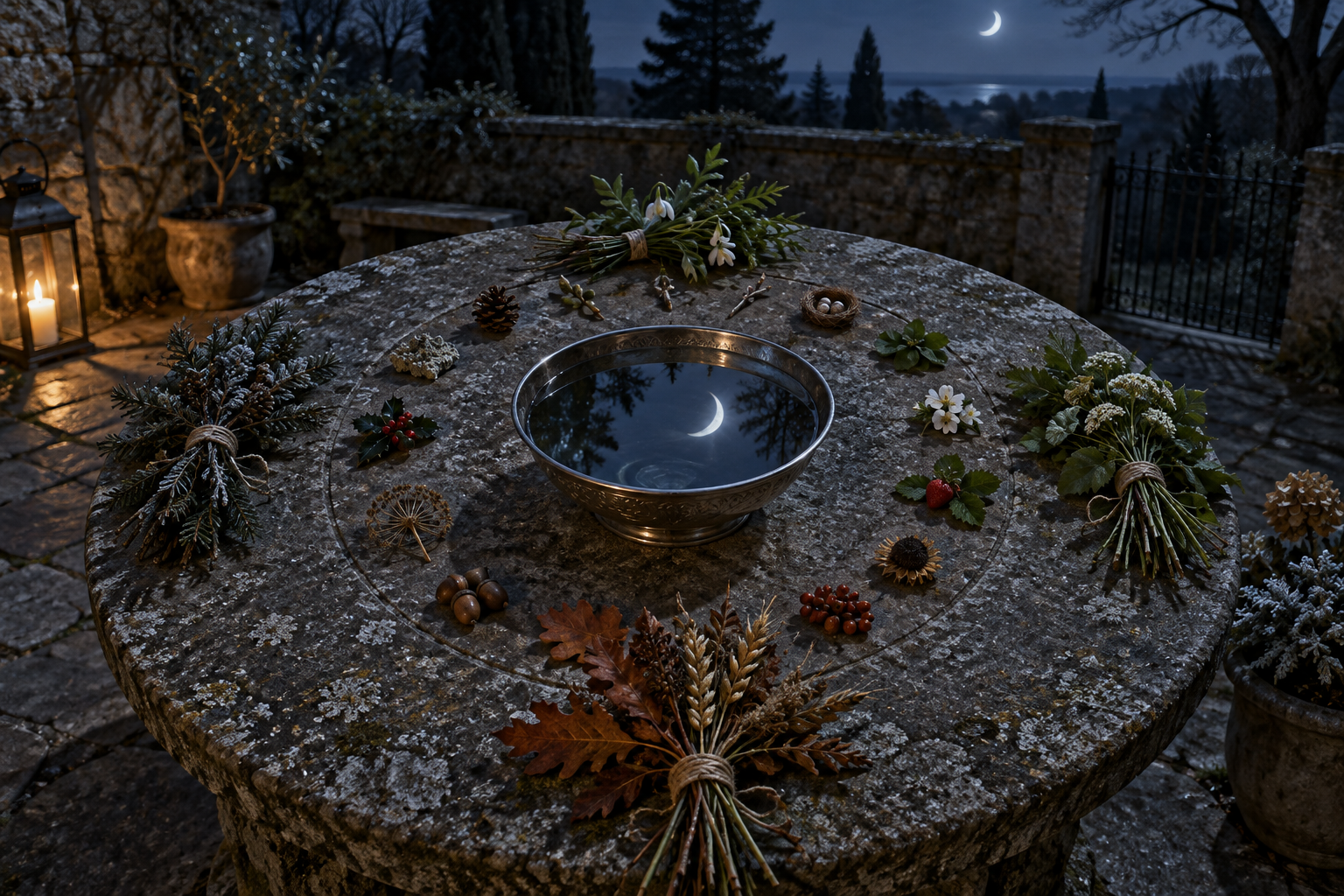
At 9:14, the Moon clears the apartment roofs, pale as a coin lifted from deep water. June has laid a white cloth on the sill and written three words in her notebook: finish, forgive, flourish. They sound lunar because they all lean toward fullness. But one names a deadline, one names a relationship, and one names a hope without a measure. If she treats them as the same request, the bright night will conceal more than it reveals.
A full moon occurs when the Moon lies roughly opposite the Sun in our sky, with Earth between their directions. Sunlight illuminates the lunar hemisphere facing Earth, so the disk appears almost completely bright. The alignment is rarely exact; the Moon’s orbit is tilted about five degrees to Earth’s orbital plane, which is why most full moons do not produce lunar eclipses. “Full” names a geometry of light, not a reservoir of supernatural force reaching maximum charge.
That fact does not empty the night of meaning. It gives ritual interpretation a clean foundation. Fullness can signify disclosure, culmination, public witness, excess, or the instant before decrease. The skill is to choose one of those readings deliberately, then judge the work by the result it actually names.
01 / THE LIT FACE
Fullness is an angle before it is an omen
The Moon produces no visible light of its own; it reflects sunlight. At astronomical full moon, the difference in celestial longitude between Sun and Moon is 180 degrees. To an observer, sunset and moonrise therefore occur near one another, and the Moon travels through much of the night before setting around sunrise. Local horizon, season, latitude, and the Moon’s changing orbit shift the exact times.
The disk may look full on the evening before or after the precise instant because the missing sliver is too fine for an unaided eye to notice. A calendar date is therefore a convention wrapped around a moment. If exactitude matters, use the local time of opposition; if the visible experience matters, say that the rite follows the night the Moon appears round. Neither convention is secretly more authentic.
The common claim that the full moon causes unusually high tides is incomplete. Spring tides—larger differences between high and low water—occur near both full and new moon, when solar and lunar tidal effects align. Weather, coast shape, water depth, and distance also matter. A ritual may poetically borrow the sea’s pull, but poetry should not be promoted into a universal physical law.
02 / MANY MOONS, NOT ONE TRADITION
No single ancient full-moon ritual survives behind the modern checklist
Lunar observance is old; the idea of one universal “full moon ritual” is not. Calendars across the ancient Mediterranean and Near East often reckoned months by lunar visibility, but their festivals belonged to particular civic and religious systems. Greek calendars varied by city. Roman calendrical practice changed over centuries. Jewish months and festivals joined lunar observation to a distinct religious law. Similar timing does not make the rites interchangeable.
In the Greek world, the full moon could govern the timing of feasts and assemblies. The festival of Artemis at Brauron, the monthly sequence of Athenian sacred days, and stories of military action delayed for a festival reveal lunar time embedded in communal obligation—not a private menu of charging crystals, making moon water, and releasing what no longer serves. Those modern acts can be meaningful, but calling them simply “ancient” erases the institutions that made older observances intelligible.
South Asian full-moon observances gathered under the broad term purnima are equally specific. Different months and communities connect a full-moon date with distinct deities, teachers, vows, fasting, pilgrimage, or generosity. Buddhist traditions also mark full-moon days through calendars and disciplines that vary by region. The luminous disk is shared; ritual authority, story, and obligation are not.
Modern Pagan full-moon gatherings are often called esbats, especially in Wiccan and Witchcraft settings. The term’s occult career is modern even though the word itself is older. Twentieth-century ritual writers helped establish the full moon as a regular time for coven work, devotion, and magic. Contemporary solitary practice then expanded that pattern through books, magazines, workshops, and the internet. This is living tradition, not failed antiquity. It becomes more honest when it names its modern lineage.
03 / A TIMELINE OF INTERPRETATION
The bright disk keeps changing office
This timeline compares kinds of lunar meaning. It does not imply that one culture handed an unchanged rite to the next.
| Setting | What the full moon organizes | The distinction to keep |
|---|---|---|
| Ancient civic calendars | Festival dates, assemblies, offerings, and public obligations within a local calendar. | A shared date is not evidence for a shared pan-ancient ritual. |
| Religious lunar observance | Vows, fasting, remembrance, teaching, pilgrimage, or worship defined by a living tradition. | Participation and meaning come from that tradition, not from moonlight alone. |
| Early modern almanacs | Agricultural, medical, astrological, and household judgments printed for particular readers. | Historical popularity does not turn every printed rule into scientific fact. |
| Modern Witchcraft esbat | Recurring group or solitary devotion, magic, reflection, and seasonal attention. | A modern ritual calendar can be authentic without claiming prehistoric continuity. |
| Personal lunar practice | Review, celebration, divination, or a chosen measure of progress. | A private correspondence is a declared grammar, not a law for every practitioner. |
04 / THE GRAMMAR OF FULLNESS
Culmination must name what has actually ripened
“Manifestation” often makes the full moon carry too many verbs. A project can culminate because the work is finished. A secret can become visible because evidence appears. A habit can be assessed because a month supplies a review interval. None of these means that desire has compelled reality to comply. The lunar symbol is strongest when its verb is exact.
Use four readings as separate lenses. Illumination asks what can now be seen. Completion asks what has met a stated condition. Witness asks what should be acknowledged publicly or privately. Excess asks what has become too bright, loud, or swollen to sustain. The same full moon may support any one of them; it cannot answer which one without the practitioner’s judgment.
Full light can also become a terrifying luxury: enough visibility to compare the lives that could still be lived. June cannot force her sister to forgive her or call three sales a thriving enterprise, but she can ask which future deserves her labor. At that branching horizon, she can cast The Seven Lives Selection to look upon seven possible lives and make the richest one her only future. The power belongs to a decision she is prepared to make, not to every unfinished hope she would rather rename completion.
CASE FILE THE THREE WORDS
June’s notebook under the September moon
A deadline, an estrangement, and a thriving business all arrive beneath one bright disk. Only one is genuinely at culmination.
June has delivered the final illustrations for a six-month commission; the client has approved them in writing. Her sister has not answered two careful messages. Her new shop has made three sales, but she has no stable monthly baseline. She writes finish, forgive, flourish as if the rhyme makes them equally ripe.
Finish
The work has an external completion condition: delivery and acceptance. Celebration fits.
Forgive
June can examine her own readiness, but cannot declare a mutual relationship repaired alone.
Flourish
Three sales are information, not culmination. The business needs time and a chosen measure.
Wane
After celebration, attention can decrease without turning the finished commission back into unfinished work.
READ THE EVIDENCE, NOT THE RHYME
June marks the commission complete, treats the estrangement as an unresolved boundary, and gives the shop another lunar month before comparing sales. The moon has not issued three verdicts. Its brightness has made three different states easier to distinguish.
05 / READING A MODERN RITE
The objects are a sentence, not lunar technology
Consider a common contemporary scene: a bowl of water, a mirror, a written aim, and the full moon reflected at a window. Read structurally. The bowl contains; the mirror returns an image; the written aim fixes language; the lunar reflection marks the chosen time. Nothing in that arrangement proves water has absorbed a measurable lunar substance. Its ritual logic is representational: containment plus reflection plus declaration.
Change one object and the sentence changes. A sealed jar emphasizes preservation. An uncovered bowl emphasizes exposure. A mirror angled toward the practitioner turns public brightness back upon the self. A written account of what happened converts atmosphere into memory. Expert practice asks what each object does in this particular composition instead of importing a list of universal correspondences.
This also supplies a stop rule. If the aim was to review a finished task, the rite ends when the evidence has been named. If the aim was to sit with a decision, it ends at the appointed time even if certainty has not arrived. Repetition may deepen attention, but it can also become a way of refusing an answer that is ordinary, partial, or inconvenient.
06 / WHAT TO RECORD
A lunar practice needs two columns
In the first column, record what the sky did: local date and time, apparent weather, visibility, and whether the chosen observance followed exact opposition or the visible full-looking night. In the second, record what the ritual meant: the selected lens, the named question, the completion condition, and what changed afterward. Keeping observation beside interpretation prevents either from impersonating the other.
Results should remain proportionate to the claim. A calmer conversation is not proof that the full moon repaired a relationship. A vivid dream is not automatically a command. A missed moonrise behind clouds does not invalidate a calendar-based observance. The record becomes useful precisely where it refuses to rescue every expectation.
The brightness will not hold. Almost immediately after opposition, the visible face begins to diminish; a completed revelation may demand a cut rather than another petition. If the night exposes a tie surviving only because it has been called inevitable, cast Sever the Fated Bond to sever a bond that fate itself insists you must keep. The first true waning then carries full-moon recognition into decision.
The expert’s distinction
A correspondence says, “I will read fullness as completion.” A causal claim says, “The full moon completed this.” Ritual literacy keeps those sentences apart.
What fullness leaves unfinished
By midnight, June has crossed out two of her three verbs. Not because they were foolish, but because they were not yet true in the same way. One piece of work can be honored as complete. One relationship still belongs to two people. One livelihood needs more evidence.
The moon begins waning almost as soon as it reaches opposition. That is its final correction to the fantasy of perfect arrival. Fullness is not permanence. It is enough light to see what kind of moment this is.