MOON · VISIBILITY · RITUAL TIME
Moon Magic: Phase, Visibility, Place, and the Ritual Clock You Actually Use
The Moon offers several clocks at once: astronomical phase, local rising, first visibility, tide, calendar date, and inherited observance. Moon magic begins when the practitioner admits which clock is actually governing the work.

STAR & SIGIL
Let one observed lunation open the practice
Carry the actual sky into a beginner working where phase, weather, choice, and closure remain distinct.
Open the lunar observation threshold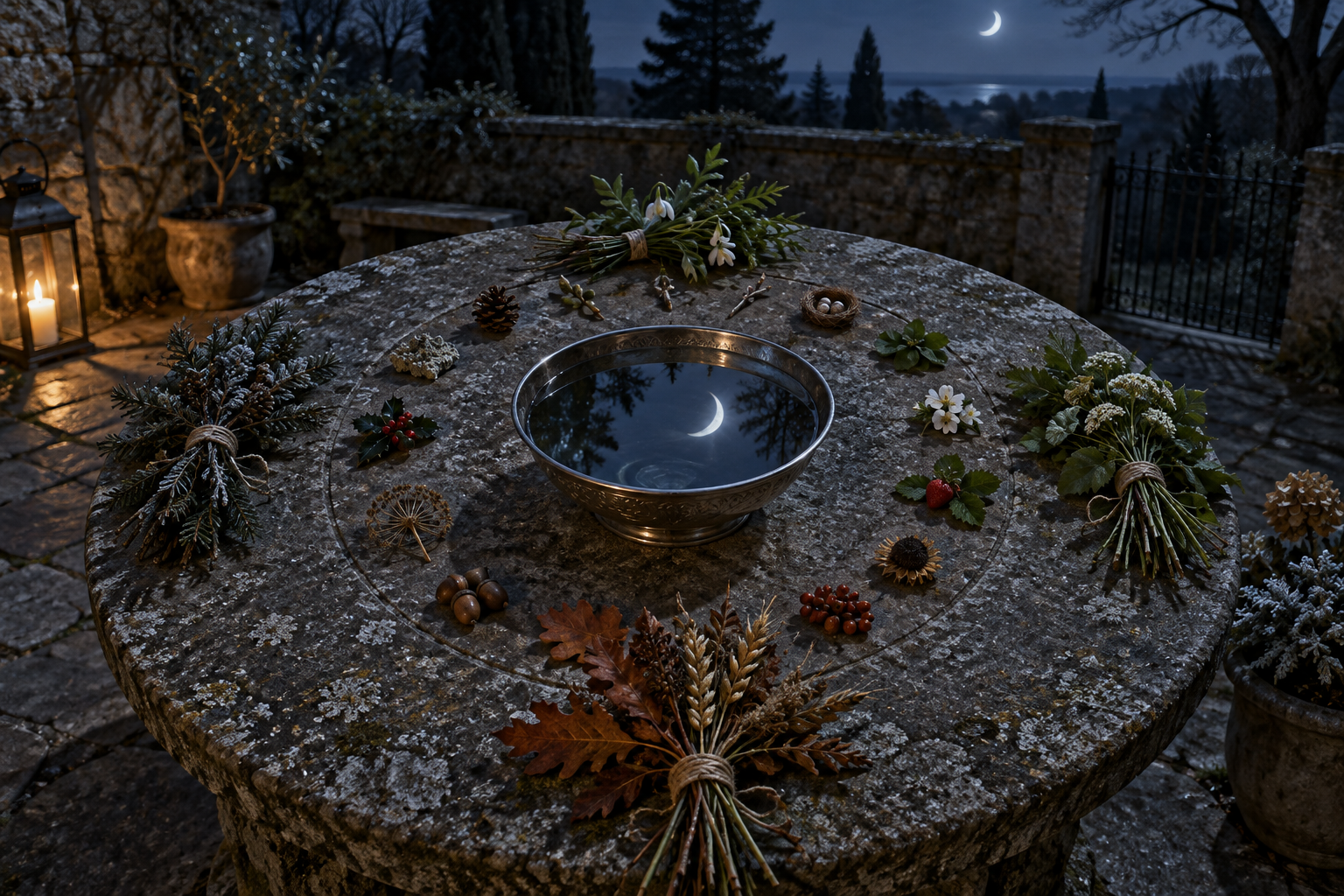
Moon magic is often presented as a universal four-part machine: begin at new moon, build while waxing, celebrate at full, release while waning. It is a useful modern grammar. It is not the Moon’s only ritual language, nor an ancient schedule shared unchanged by every culture.
Astronomical phase describes geometry among Sun, Earth, and Moon. The exact new moon is conjunction and usually invisible from Earth. The full moon is an instant of opposition even though the disk looks full across more than one night. First crescent visibility depends upon location, season, atmosphere, horizon, and observation.
Ritual systems may privilege calculation, first sight, a named calendar date, moonrise, midnight, a weekday, an agricultural season, tide, or community observance. Serious moon magic does not collapse these clocks. It chooses one, states why, and knows what the others are doing.
01 / SIX LUNAR CLOCKS
“Under this moon” is not yet a date
The synodic month—the cycle from one new moon to the next—is about 29.5 days. Within it, named phases are regions of changing illumination, while astronomical quarter phases and conjunction/opposition can be calculated as instants.
Local observation complicates the clean diagram. The Moon rises at different times as phase changes. Weather may hide a crescent. A calendar can announce a new moon that nobody can see, while a first visible crescent may arrive a day or more later. Neither is spiritually superior by nature; each answers a different ritual question.
A calculated conjunction serves hidden beginnings and globally shared timing. First visibility serves witnessed emergence. Moonrise serves entrance. Culmination serves height. A named festival belongs to its calendar and community. Tide belongs to local water and solar-lunar gravity, not simply to whatever phase keyword is fashionable.
| Ritual clock | What determines it | Strong magical office | Common confusion |
|---|---|---|---|
| Astronomical phase instant | Sun-Earth-Moon geometry | Exact hidden or culminating threshold | Treating an instant as the whole night |
| Visible crescent | Geometry plus local horizon and atmosphere | Witnessed beginning | Calling calculation and sight identical |
| Moonrise | Location, date, and lunar motion | Entrance and arrival | Assuming the Moon rises at sunset every night |
| Named lunar date | A particular calendar system | Community memory and observance | Removing the date from its tradition |
| Tide | Local geography and lunar-solar forcing | Coastal movement and return | Using phase alone as a local tide table |
| Personal observation cycle | Consistent records in one place | Relationship and review | Universalizing one observer’s pattern |
02 / CASE FILE
The launch scheduled for the wrong high tide
ILLUSTRATIVE COASTAL FILE THREE CLOCKS
Suppose a coastal archive plans to recover storm-damaged records by boat at the full moon
The ritual coordinator calls the full moon a time of maximum water and revelation. The harbor master points out that local high tide, moonrise, and astronomical full moon do not coincide with the planned departure.
Full moon names geometry
It does not by itself give the harbor’s water height at a chosen hour.
The inlet has its own delay
Coastline and bathymetry shape local tide timing beyond a simple lunar slogan.
Revelation belongs to the records
The ritual need not force physical logistics to impersonate symbolism.
The clocks divide their labor
The safe tide governs launch; moonrise governs the public act of receiving the rescued boxes.
THE READING
The operation does not become less magical when the tide table overrules a phase keyword. It becomes more exact: water carries the boat, the rising Moon witnesses return, and neither is required to lie about the other.
03 / RETURN HAS A DEADLINE
A lunar cycle offers recurrence, not restoration without change
Because phases recur, moon magic is often used for second chances. Yet the Moon does not return to an identical human situation. A missed application, conversation, departure, or creative opening comes back—if it does—with altered people and conditions.
The Moon’s Returning Key gives recurrence urgency. work it to draw one missed opportunity back within reach before the next new moon. The spell’s power belongs in the interval, not in nostalgia: the practitioner must recognize what changed before the window closes.
Records matter here. Without dated observations, any later opportunity can be renamed the promised return. A moon journal earns its occult value by preserving the original claim against hindsight.
“The Moon repeats its phase. It does not repeat your life. That difference is where lunar choice begins.”
04 / NO UNIVERSAL PHASE DICTIONARY
Waxing does not mean growth in every ritual system
The familiar growth/fullness/release/rest pattern is a coherent contemporary correspondence built from changing illumination. Other traditions organize lunar time through named days, mansions, deities, fasting, divination, taboo, agriculture, or liturgical calendars. These systems are not decorative synonyms.
Even direction of growth depends upon hemisphere and visual convention: the waxing bright edge appears on opposite sides of the disk north and south of the equator, while the increase in illuminated fraction remains the same. A diagram drawn for one latitude should not become universal sacred anatomy.
Use tradition-specific claims with sources and community context. A solitary modern practice can also be honest: it may state that its phase meanings are chosen correspondences rather than inherited antiquity.
05 / VISIBLE AND INVISIBLE MOONS
Darkness, absence, and obstruction are different conditions
At astronomical new moon, the near side is largely unilluminated from Earth’s viewpoint and the Moon lies near the Sun in the sky. Cloud cover, horizon, daylight, building, and sleep can also make the Moon unseen. These absences are not interchangeable.
Ritually, calculated invisibility may support secrecy; cloud may support uncertainty; a blocked horizon may reveal a limitation of place; deliberate non-observation may create withdrawal. Accurate description gives darkness several meanings instead of one automatic command to “set intentions.”
The same precision protects eclipse work. An eclipse is not an especially powerful ordinary full or new moon. It depends on alignment near the lunar nodes and has its own visibility path. Cultural interpretations differ widely; awe does not confer one universal instruction.
06 / WHEN THE ROAD CLOSES
Lunar practice needs endings that cannot be endlessly revised
A repeating calendar can tempt practitioners to postpone: another new moon will come, another full moon will confirm, another waning phase will release. Cycles become avoidance when no observation can ever finalize a decision.
The Future With No Rivals ends that evasion. cast it to choose one possible future and close every road leading elsewhere. Within moon magic, its severity defines the difference between phase-based review and permanent deferral.
The coastal archive eventually chooses a permanent inland store. Future full moons may commemorate the rescue, but they no longer reopen whether the damaged basement should remain the collection’s home.
07 / BUILDING A LUNAR PRACTICE
Choose the clock, state the office, preserve the observation
A durable practice identifies location and time zone, distinguishes calculated phase from observed appearance, records weather and horizon, and names the ritual system being used. It separates what astronomy establishes from what tradition interprets and what the practitioner personally associates.
Then it assigns one office to the interval: concealment, emergence, review, culmination, decline, return, or rest. These are not ingredients or steps; they are propositions against which later experience can answer.
Moon magic becomes strong through specificity. The sky need not approve every choice. It offers changing light, reliable motion, local surprise, and a clock vast enough to reveal whether the practitioner has learned anything by the time a phase returns.