
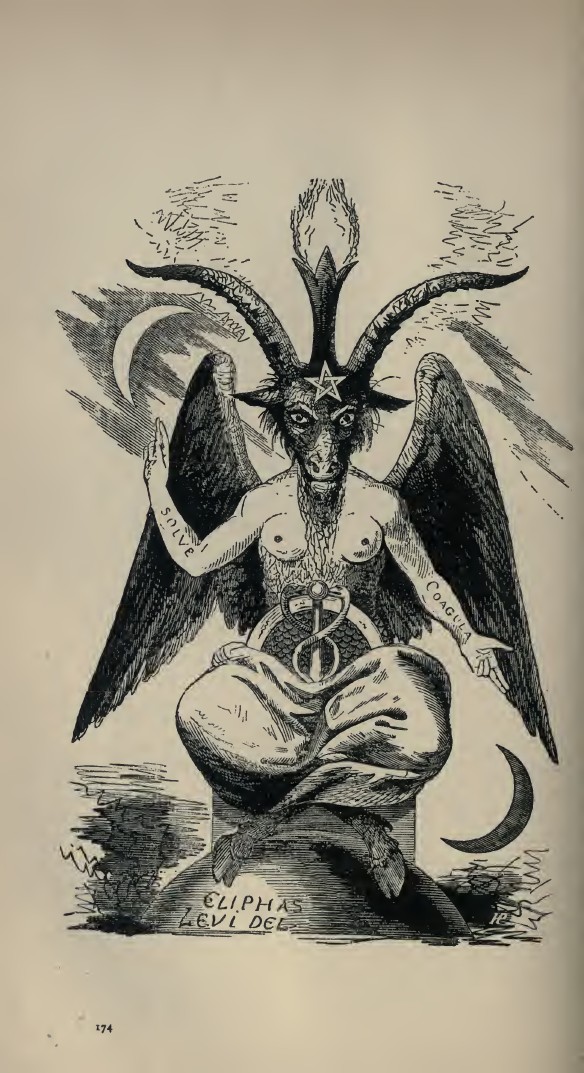
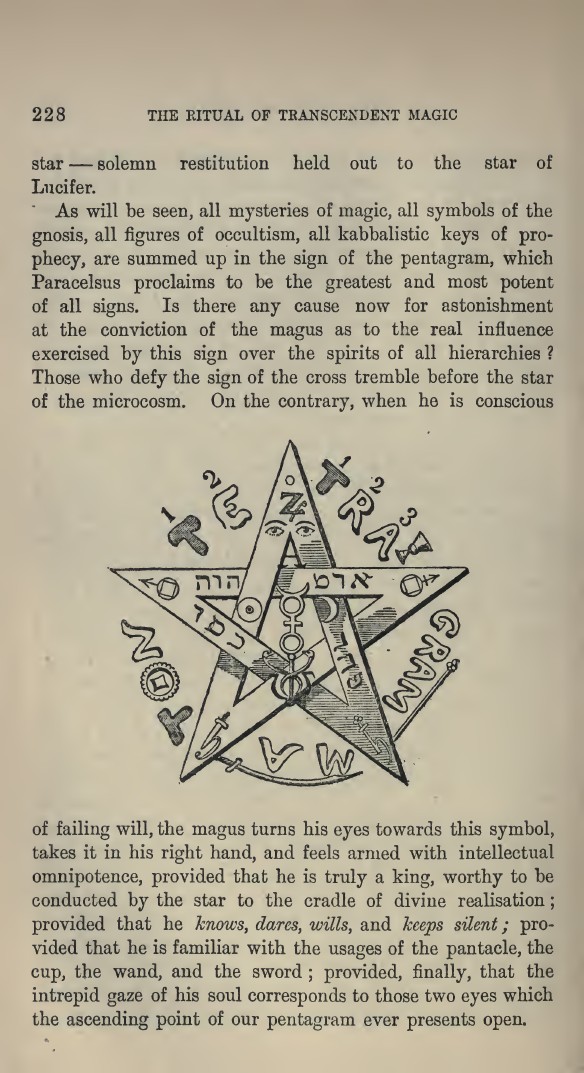
Lévi’s two most famous images are often torn apart: the pentagram becomes a generic occult star, while Baphomet becomes a mascot for whatever a viewer fears or desires. In the book they belong to one argument. The star tells force which way to run. The goat shows apparently irreconcilable forces held in a single body. Together they visualize the sovereignty Lévi claims for a will that can balance opposites without being devoured by either.
- Ritual chapter
- V · The Blazing Pentagram
- Plate
- Figure XIII · page 228
- Baphomet key
- One point ascendant
The pentagram is a human body turned into a command sign
Doctrine chapter five names the pentagram as the sign of the microcosm: four limbs and a governing head. Its power comes from orientation. With one point above, intellect rules the elemental body; with two points above, the image resembles horns and presents matter or disorder above reason. Lévi loads that rotation with paired names; morning and evening star, Mary and Lilith, initiation and profanation, order and confusion. The geometry stays the same while the hierarchy changes. A turn of the figure becomes a diagnosis of who or what is ruling whom.
This is not simply a good upright star versus an evil inverted star. Lévi’s deeper concern is command. The operator must stand as a coherent microcosm before attempting to govern any larger field. A star with its “head” down pictures a will inverted by appetite, fear, fixation, or frenzy. A star held upright pictures the claimed restoration of intellect over the four elemental poles. The symbol is therefore both badge and mirror: it announces mastery, then accuses the wearer if the announced mastery is absent.
Consecration turns five lines into a ritual instrument
Ritual chapter five takes the doctrine off the page. Lévi specifies an object made from seven metals or traced in gold on unused marble; he also allows vermilion on prepared lambskin. The figure is breathed upon five times, sprinkled, exposed to a compound of five perfumes, addressed through five angelic or planetary names, and carried around the four quarters plus the center. The repeated fives make the operator rehearse the shape through breath, scent, movement, matter, and voice. A drawn star becomes a multisensory score.
Placement changes with the stated class of spirit. For a spirit of light, one point faces the tripod; for a spirit of darkness the relation is reversed and the rod or sword is set against the star’s head. Lévi insists that an omitted act can void the operation or turn its force back on the operator. This severity reveals what “consecration” does in his system: it removes ambiguity. Every material, direction, name, and gesture makes the will say the same thing. The object is powerful because no part of the performance is allowed to contradict another.
Baphomet is the pentagram’s paradox made flesh
The Sabbatic Goat on page 174 carries the upright pentagram between its horns. That one detail matters more than the animal head. Lévi uses it to distinguish his figure from a simple Satan portrait. A torch rises above the skull as intelligence above matter. One hand points toward the pale crescent and the other toward the dark crescent, matching mercy with justice in Waite’s wording. The arms bear solve and coagula, dissolution and fixation. Wings lift while the seated body presses toward the earth; breasts signify maternity; the caduceus veils universal generation; scales, fur, feather, human torso, and cloven feet gather different orders of life into one impossible organism.
The horror of the image is deliberate. Lévi wants the reader to feel repulsion and then discover structure inside it. Animality is not erased; it is assigned a place beneath the flame. Sexual difference is not simplified; masculine and feminine are held in one androgyne. The white and black moons are not allowed to annihilate each other; both are needed to make equilibrium visible. Baphomet thus becomes a visual ordeal. A viewer who sees only a devil remains caught by the first emotional charge, while the initiated reading claims to recover a map of regulated opposites.
Worked figure reading: page 228 explains the goat’s forehead
Figure XIII prints the pentagram as a dense speaking surface. Around and through its five points run letters, divine names, planetary marks, a caduceus, and two open eyes in the upper point. Lévi’s surrounding paragraph says the magus looks to this sign when will begins to fail. The open eyes make the upper point conscious; the lower points become legs; the lateral points become arms. Rather than depict a remote deity, the plate constructs an operator who must remain awake at the head of the figure.
Now place that plate beside Baphomet. The goat’s forehead bears a much simpler upright star exactly below the torch. The sequence is vertical: animal head, governing star, flame. Page 228 supplies the missing syntax. The star is the microcosmic intelligence that is supposed to face upward; the torch is the higher illumination toward which it faces. Baphomet’s horns do not invert the pentagram because their two points sit outside and below its governing apex. The famous monster is therefore assembled to show intellect occupying animal nature without pretending animal nature has vanished.
The comparison also explains the hands. Figure XIII turns the whole human body into a fivefold sign. Baphomet’s arms then point above and below while solve and coagula name the alternating acts by which equilibrium is maintained. One plate shows the operator as star; the other shows the field of opposites the operator must continuously balance. Lévi’s claimed effect is not that a picture grants automatic power. The pictures train the will to keep a hierarchy stable while strong contrary images are present.
The darkest image in the book argues against a sovereign devil
In the Sabbath chapter Lévi shocks the reader by identifying Baphomet with the feared idol, then dissolves the accusation. He says the figure is a pantheistic hieroglyph of universal equilibrium, and he denies that Satan exists as an equal metaphysical power opposed to God. Error, frenzy, and cruelty are real in human action, but the cosmic rival imagined by demonologists becomes a projection. The monster is “innocent” only after every component has been reassigned from diabolical personality to symbolic relation.
That move gives the image its lasting voltage. Baphomet can still look transgressive because the body refuses ordinary categories, but the transgression serves a strict occult order. Up and down, active and passive, masculine and feminine, light and darkness are not flattened into sameness. They are wired into a circuit with intelligence at its summit. Lévi’s Baphomet is dangerous to literalism: it forces the reader to decide whether a terrifying form must represent a terrifying being, or whether disciplined interpretation can seize the form and make it signify balance.