
Part III converts the verbal Sword into 136 claimed uses. Its range is startling: bodily ailments, household protection, dream sending, divination, attraction, hostility, weather, rulers, spirits, memory, escape, and survival. Its sequence follows several loose orders: a bodily group descends through anatomy, while later groups widen from household needs to social control, marvels, conflict, and spirit contact. Each operation joins a numbered name portion to a material or gesture. This page reads that grammar closely while treating every promised effect as a historical claim, never as medical advice or proof that the operation works.
- Applications
- 136 numbered uses in Gaster’s editorial alignment
- Recurring carriers
- Water, oil, eggs, leaves, metal plates, dust, cloth, and bowls
- Recurring controls
- Three or seven repetitions, directions, reversal, burial, wearing, and boundary-making
- Evidence limit
- The edition documents written claims, not successful outcomes
The catalogue moves from the body into the world
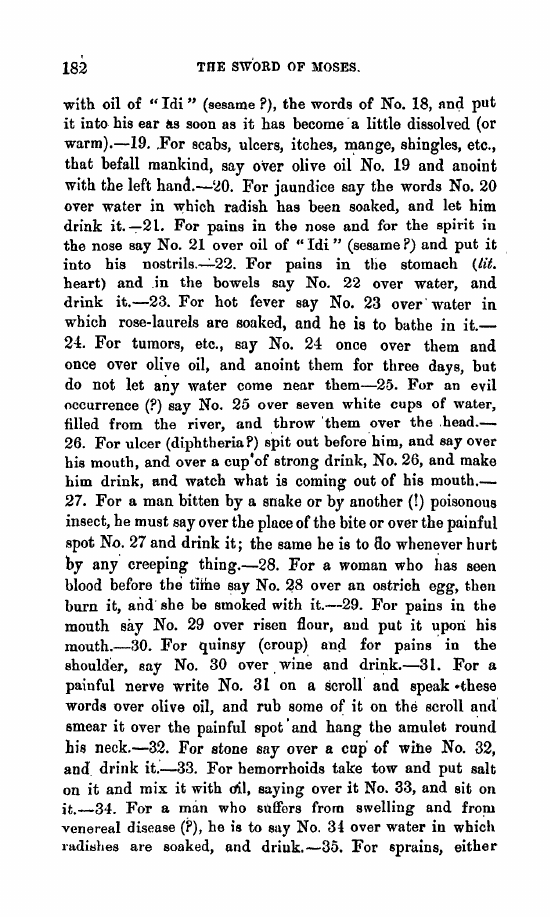
After two spectacular opening claims, the list settles into the body. Items address spirits said to move or burn within it, then eyes, ears, head, skin, nose, stomach, bowels, fever, tumors, bites, mouth, shoulder, nerves, liver, spleen, womb, and other complaints. Gaster observed that the ailments roughly descend through bodily members before the collection turns outward. That order gives the first part the feel of a verbal medicine chest indexed by anatomy.
The catalogue then crosses several thresholds. Number 44 calls a revealing spirit. Weather, wealth, rulers, attraction, agriculture, travel, dreams, curses, protection, war, invisibility, escape, hunger, wisdom, forgetting, thieves, and household defense follow in changing clusters. The movement is from local pain to social and cosmic reach. The book does not divide “healing,” “love,” and “spirit magic” into modern genres; it presents one acquired Sword whose numbered edge can be directed at very different problems.
Healing claims layer speech, substance, and duration
Consider operation 14, translated as a response to paralysis. A numbered portion is spoken seven times over water and seven times over sesame oil. The water is poured over the person, the oil is applied, and the sequence continues for three days. Then words from the conjuration are written as an amulet and hung at the neck. The claimed cure is distributed across four carriers: spoken repetition, washing, anointing, and a worn text. No single ingredient is the whole operation.
Other bodily entries shorten or rearrange that grammar. A name may be whispered into an ear, spoken over water to drink, written on a copper plate to wear, or said over oil before anointing. The materials are ordinary enough to make the names the distinguishing component, yet the way a substance meets the body matters. Drink crosses inward, oil remains on a painful site, smoke surrounds, and an amulet stays near the body after the spoken moment. These are textual strategies for extending a claimed effect, not evidence that any treatment was effective. Actual illness requires appropriate medical care.
Protection draws a boundary rather than attacking a target
Numbers 131–135 form a compact defensive suite. A thief or robber is first “tied” while the speaker places a little finger in the ear; the next number releases the restraint when the finger is removed. A house is guarded by words spoken over a cup of water poured around the roof. Another version replaces water with earth from an anthill scattered along the same upper perimeter. A final formula is spoken for safe passage from harmful beings. Gesture, reversal, and enclosure are three different defenses placed side by side.
The roof operations are especially clear spatial machines. Water or earth traces the building’s outer limit while speech assigns that limit a purpose. The material does not need to fill the house; it marks a circuit. In the paired thief formulas, the body becomes the switch: finger inserted, restraint claimed; finger removed, release claimed. The catalogue repeatedly imagines control as a reversible condition held by position. Its protective logic is therefore less about a permanently powerful object than about defining, holding, and undoing boundaries.
Divination changes according to who or what supplies the answer
Operation 44 inscribes a laurel leaf, names Abraksas, and orders a prince to come and reveal what is asked. Number 49 promises that a solar figure will appear as a man in white and answer questions, though Gaster marks the passage as defective. Number 90 offers a stark prognosis for a sick person: the direction in which the person turns is read as life or death. Number 122 calls the “prince of man” to speak, and 123 sends him away by reversing the same words. These are not one divinatory method repeated with different props.
Each locates knowledge differently. Number 90 reads a bodily sign without a summoned speaker. Number 44 compels an identified revealer through writing and address. Numbers 122–123 stage an interview whose closure is encoded as reversal. The damaged solar passage combines apparition and questioning but leaves an uncertain material instruction. Putting the four together shows a spectrum from omen to compelled testimony. It also shows why the edition’s gaps matter: where an object or name is missing, the surviving promise of an answer can look more complete than the procedure that was supposed to obtain it.
Love and hostility share the same grammar of imposed direction
The attraction entries are openly coercive. Number 55 uses blood and a newly laid egg with the woman’s name; number 56 dips a new potsherd in black myrrh, has the numbered words pronounced over a man’s name, and instructs the operator to walk without looking back. Other entries promise to make a ruler follow, inflame a heart, produce hatred, or damage a neighbor. Calling these “romance spells” would hide the text’s stated aim: another person’s movement, feeling, status, or safety is to be redirected without consent.
The same formal devices appear in both attraction and hostility. A personal name fixes the target, a fresh or newly made object isolates the act, bodily material or dust establishes contact, and a directional gesture carries the command away from the speaker. The text does not reserve one ritual vocabulary for affection and another for aggression. It treats both as imposed change. That continuity is analytically important because it exposes the ethical temperature of the collection instead of letting a modern category such as “love magic” soften its language.
Spirit control depends on arrival, speech, and departure
The spirit operations are short because the long installation has already supplied a hierarchy. Number 44 orders a prince to come and reveal; number 78 claims speech with the dead; number 95 places writing on a bowl worn at the neck under Gaster’s vague heading “for every spirit”; number 122 calls an angelic prince; and 123 dismisses him. The operations distribute control across different acts. Calling produces presence, naming defines the addressee, questioning assigns an office, and reversal ends the encounter.
The arrival-and-dismissal pair is the most complete miniature. A phrase over a mantle calls the prince, who is expected to tell what is asked; the same words backward send him away. Reversal supplies closure without a separate divine list. This makes sequence the controlling feature. Reading only the arrival promise would miss that the text builds a return path into the next number. The paired entries behave like two halves of a door: one turns the verbal order toward manifestation, the other turns it toward absence.
Worked comparison: water, laurel, and a roof perform three kinds of control
Set operation 14 beside 44 and 133. Number 14 multiplies action around a suffering body: seven speeches over water, seven over oil, washing, anointing, three days, then a worn amulet. Number 44 concentrates a question on one inscribed laurel leaf and a named revealer. Number 133 expands a cup of spoken-over water into a perimeter poured around a roof. The same basic claim; that a selected segment of the Sword can direct an outcome; takes three different material shapes.
Their geometry differs. Healing surrounds and enters a body through repeated contact. Divination narrows attention to a small written surface that addresses a speaker. Household protection stretches a finite cup into a continuous boundary. Their time differs too: three days of repeated care, an encounter expected to occur, and a perimeter meant to remain effective after pouring. These differences show that the numbered names do not replace practical design. They are fitted to a scene whose materials, duration, and spatial relation tell the desired result how to take form.
Their evidence is also limited in the same way. A printed recipe proves that someone copied and transmitted a claim about water, leaf, or roof. It can reveal how a compiler imagined illness, knowledge, and safety. It cannot prove that paralysis lifted, a prince spoke, or thieves were stopped. The operations are most informative when read as compact theories of action: words select authority, materials give that authority a place, and gesture maps the intended change.
The catchall ending reveals the catalogue’s ambition
Number 136 is assigned to anything not already mentioned and runs from its place in the Sword to the end. A catalogue that has already claimed powers over bodies, weather, rulers, spirits, memory, enemies, travel, homes, and food still leaves an open category. The catchall turns incompleteness into a feature: the Sword is represented as larger than its examples. The numbered repertoire is both exhaustive in tone and expandable in use.
The final amulet preface pulls every use back to the installation. It asks that the lord of the Sword approach, that all its powers be delivered as they were to Moses, and that no harm follow. Then it threatens a negligent user with four hosts of punitive angels. The book closes where it began: power is not inside an ingredient by itself. It depends on a named hierarchy, a transmitted precedent, correct framing, and the constant possibility that the same forces imagined as servants may become judges.
Primary text and research
- Refubium, Moses Gaster, The Sword of Moses (1896) ↗Repository record for Gaster’s 1896 edition, with bibliographic metadata and the digitized scan.
- Refubium, 1896 edition PDF ↗Primary scan of Gaster’s introduction, English translation, Hebrew text, index of mystical names, and facsimile.
- Cambridge Core, Gaster’s 1896 Royal Asiatic Society article ↗Publication record for the original article, pages 149–198 of the 1896 Journal of the Royal Asiatic Society.
- Internet Archive, Journal of the Royal Asiatic Society for 1896 ↗Full journal-volume scan containing Gaster’s article on pages 149–198; source of the three local page images.
- Joseph H. Peterson, Sword of Moses transcription ↗Searchable transcription of Gaster’s English translation; bracketed names are Peterson’s additions where Gaster printed X.
- Yuval Harari, The Sword of Moses: A New Translation and Introduction (2012) ↗Modern translation and introduction based on the wider manuscript evidence, Magic, Ritual & Witchcraft 7.1, pages 58–98.