
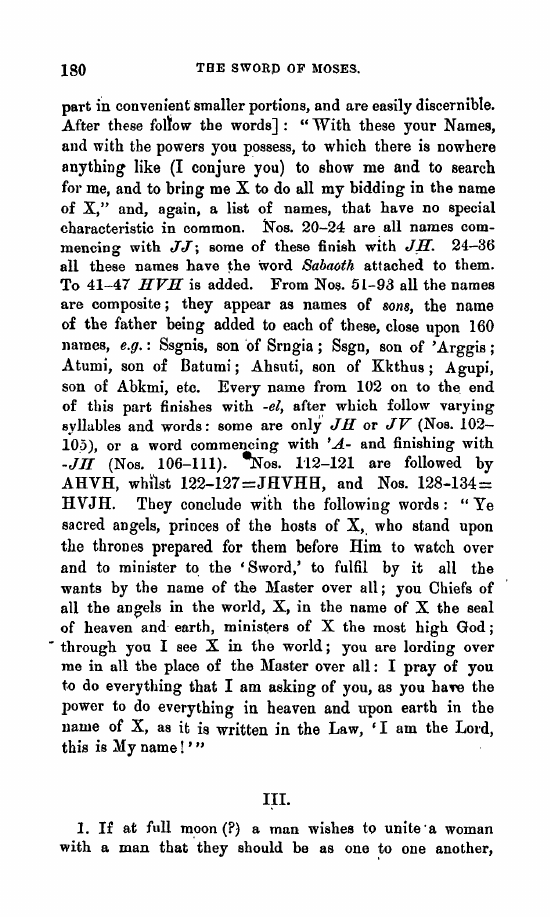
The “Sword” proper is a long verbal chain placed between initiation and application. Gaster divided that chain into 136 numbered portions so each recipe in the third part could point back to a matching segment. That editorial map makes the book navigable, but his English translation often replaces the very names with X. The result is a paradoxical witness: it shows the mechanism more clearly than the verbal material that the mechanism is designed to select. Reading the patterns that remain; Sabaoth clusters, father-son pairs, -el endings, reversals, and grouped divine elements; reveals a ritual index rather than a random heap of syllables.
- Editorial divisions
- 136 numbered portions in Gaster’s edition
- Linkage
- Each numbered operation points to a segment of the name chain
- Visible families
- JJ/JH openings, Sabaoth, HVH, father-son pairs, -el endings
- English omission
- X replaces many names; Peterson marks restored transliterations in brackets
The blade is a continuous verbal object
After the installation, the heading “This is the Sword” introduces neither a drawing nor a catalogue of metal weapons. It introduces names. The chain begins with short, hard clusters and continues through longer compounds and angelic forms. A closing adjuration addresses the sacred angels who watch over and minister to the Sword. The book therefore treats the chain as a staffed object: words make its substance, while princes and hosts make those words available for a task. The weapon metaphor gives a single edge and handle to material assembled from many linguistic and religious layers.
Continuity matters. Later recipes request “No. 14,” “No. 44,” or “No. 133,” but the names do not become 136 independent charms. They remain portions of one larger sequence acquired through the preceding rite. Numbering allows selection without dissolving the whole. It resembles an index cut into a continuous scroll: the user reaches a marked segment while the book continues to imagine the full Sword and its angelic custodians behind that segment.
Gaster’s numbers lock Part II to Part III
Gaster explains that he added the numbers. His reason is structural: each of the 136 practical items corresponds to a portion of the name chain, so he assigns the same number to the verbal segment and its stated application. The numbers are not claimed to be manuscript headings. They are an editorial apparatus built to expose what he calls “absolute parallelism” between the second and third parts. This is one of the most useful interventions in the 1896 edition because it makes a hidden cross-reference visible.
The intervention also changes how a modern reader experiences the work. Instead of scanning an uninterrupted field of names and then recognizing repeated words inside recipes, we encounter a numbered lookup system. That clarity can be mistaken for the manuscript’s original page design. It is safer to distinguish three things: the transmitted sequence of names, the recipes that reuse portions of it, and Gaster’s modern numbers that align the two. The ritual linkage belongs to the work; the neat decimal interface belongs to the editor.
The names form families inside apparent disorder
Gaster notices grouped features in the chain. Portions 20–24 begin with a repeated JJ form, and some end in JH. The note before Part III attaches Sabaoth to portions 24–36, while Gaster’s introduction gives 24–37; the one-unit slip warns that even his neat numerical map has layers that require comparison. Portions 41–47 add HVH. The middle expands into roughly 160 names phrased as sons of other named powers, while the later sequence gathers names ending in -el and then adds recurring divine elements after them. These clusters give the chain rhythm. A reader moves through phonetic families and genealogies rather than through 136 equally shaped units.
The father-son block is especially revealing. A bare name can function as a label, but “X son of Y” makes relation part of identity. The sequence creates a miniature genealogy of powers, then moves to -el forms whose shared ending makes another kind of family. The chain’s order thus changes its method of classification. Sound, suffix, divine title, and descent each provide a temporary rule. What looks like excess is organized by serial resemblance, and that serial order lets a numbered operation inherit the authority of a larger verbal population.
Gaster’s X removes the claimed operative term
In the English translation, X stands for a mysterious name Gaster did not transliterate. Peterson’s transcription states the policy plainly and inserts some names in square brackets from the Hebrew printing. This is more serious than replacing an unfamiliar noun in a narrative. In the book’s own logic, the name is the part selected by the recipe. When item 44 says to use No. 44, an X can preserve the instruction’s grammar while deleting the token that the grammar points to.
The omission separates comprehensibility from completeness. Gaster gives readers a lucid map of ranks, numbered parts, materials, and results, while withholding many strings that the source regards as the engine of those results. Whatever his purpose, the choice makes different operations look more alike than they are. “Say X over water” and “write X on a plate” foreground water and plate because X is visually identical in both. In the full text, different name segments would make the verbal distinction as visible as the material one.
Worked comparison: No. 44 and No. 122 after the names disappear
Operation 44 directs a name onto a laurel leaf and addresses a prince identified as Abraksas, asking that the bound figure come and reveal what is asked. Operation 122 speaks a numbered portion over a mantle so that the “prince of man” will come and tell what the questioner wishes to know. In Gaster’s English, both procedures remain readable as spirit-questioning scenes. One uses an inscribed leaf and a named prince; the other uses speech over clothing and a title. Yet the distinct name portions selected from the Sword are largely unavailable wherever X intervenes.
The next operation clarifies a further difference. Number 123 dismisses the figure called in 122 by saying the same words backward. The pair is designed as arrival and release, with reversal turning the direction of the action. Number 44 has no adjacent inverse; it emphasizes binding and compelled disclosure. If the name chain is suppressed, the contrast can shrink to props; leaf versus mantle. Restoring the idea of two different verbal segments reveals a deeper design: one operation creates a bounded question-and-dismissal pair, while the other constructs a one-way demand.
This comparison shows what the 136-part mapping contributes. The numbered segment is not a generic password pasted into any recipe. It belongs to a position in a continuous chain, and some positions are paired by order or reversal. The recipe supplies material, gesture, target, and desired result; the selected name portion supplies a specific verbal address. Gaster’s apparatus preserves the address, but his X sometimes removes the address’s contents.
Variant spellings become a problem inside the ritual theory
Gaster describes obvious copying errors, marginal variant readings, confused letters, and names that appear in two or three forms within one recipe. He refuses broad correction because a unique and damaged witness gives him no secure basis for choosing the original. The problem is sharper here than in ordinary prose. The introduction argues that mysterious names preserve power through exact form, while the manuscript demonstrates that exact form has been repeatedly disturbed by copying. The text’s theory demands stability that its transmission cannot deliver.
That tension should remain visible. Choosing the smoothest spelling and presenting a purified chain would erase evidence of how the work actually traveled. Marginal glosses, Arabic explanations of Aramaic words, and errors copied from an earlier exemplar show readers attempting to keep a difficult technology usable. The manuscript carries the Sword through corrections and confusions as well as through its names. Those traces belong to the history of people negotiating a system that told them one altered letter might matter.
A searchable transcription exposes another editorial layer
Peterson’s digital page makes Gaster’s 1896 English searchable and labels its interventions. Square brackets distinguish names added from the printed Hebrew text, while the note about X warns that Gaster omitted many forms. This is valuable because the apparatus no longer masquerades as the source. A reader can see which wording belongs to the old translation and which recovery belongs to a later editor.
The digital transcript, Gaster’s witness, and the wider manuscript tradition occupy separate layers. The current catalogue identifies the manuscript as British Library Or. 10678, formerly Gaster 178, while modern scholarship compares additional witnesses and offers a new translation. Four layers shape what can be seen: a historical composition transmitted in several copies, the particular manuscript Gaster used, his numbered edition and selective English rendering, and a modern web transcription that partially repopulates his blanks. The Sword reaches us through all four.
Primary text and research
- Refubium, Moses Gaster, The Sword of Moses (1896) ↗Repository record for Gaster’s 1896 edition, with bibliographic metadata and the digitized scan.
- Refubium, 1896 edition PDF ↗Primary scan of Gaster’s introduction, English translation, Hebrew text, index of mystical names, and facsimile.
- Cambridge Core, Gaster’s 1896 Royal Asiatic Society article ↗Publication record for the original article, pages 149–198 of the 1896 Journal of the Royal Asiatic Society.
- Joseph H. Peterson, Sword of Moses transcription ↗Searchable transcription of Gaster’s English translation; bracketed names are Peterson’s additions where Gaster printed X.
- National Library of Israel manuscript record, British Library Or. 10678 ↗Current catalogue record for the manuscript formerly called Gaster MS 178; it records fourteen folios and later scholarship on its relationship to Sassoon 290.
- Yuval Harari, The Sword of Moses: A New Translation and Introduction (2012) ↗Modern translation and introduction based on the wider manuscript evidence, Magic, Ritual & Witchcraft 7.1, pages 58–98.