
The Sword of Moses, or Ḥarba de-Moshe, is a Jewish magical treatise built around a startling metaphor: a long chain of sacred and angelic names is acquired, held, and directed like a weapon. Its opening installs the operator beneath ranks of heavenly chiefs. Its middle gives the verbal Sword. Its final part aligns portions of that chain with 136 claimed operations, from healing and household protection to divination, coercion, spirit control, memory, weather, and escape.
- Primary edition
- Moses Gaster, London, 1896
- Gaster’s witness
- Cod. Hebr. Gaster 178, now British Library Or. 10678
- Textual architecture
- Installation · name chain · numbered operations
- Reading limit
- Claims are analyzed as textual evidence, not verified effects
Three ways into the text
A grimoire organized as a machine of delegated speech
The work’s organizing force is the connection between its parts. Purification produces an eligible speaker. Layered adjurations attach four princes, five chiefs, three higher officers, and one supreme chief. The acquired chain supplies named portions. The application list then selects a portion and joins it to water, oil, leaves, eggs, plates, dust, clothing, spoken repetition, direction, or reversal. Every stage supplies something the next stage assumes.
That design makes the book unusually rewarding to read closely. A short operation can look arbitrary when isolated. Put it back after the installation and beside the numbered chain, and it becomes a compressed endpoint of a larger theory: divine names authorize angelic offices; angelic offices transmit command; material carriers locate the command in a body, house, object, or encounter. The site’s three guides keep that chain intact while testing it against Gaster’s editorial omissions and modern manuscript knowledge.
Gaster’s edition is both a doorway and a damaged lens
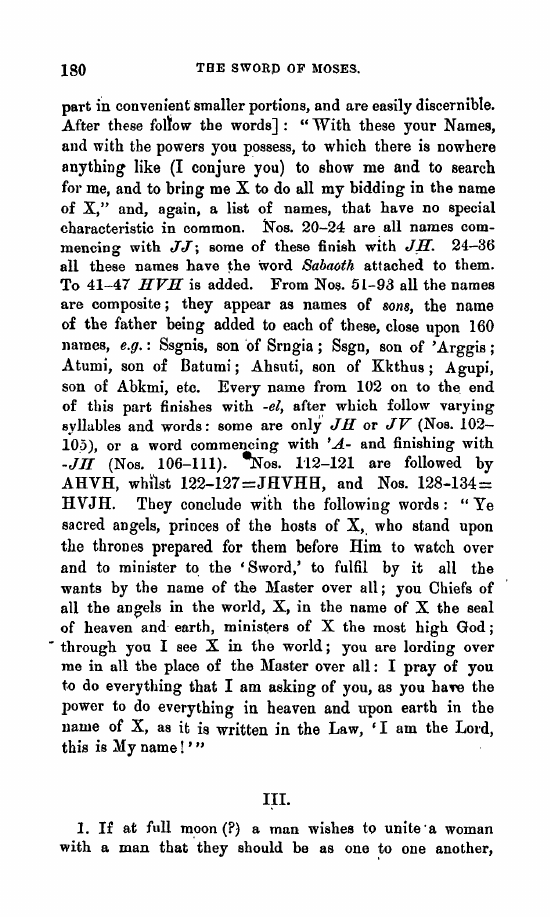
Gaster’s 1896 publication remains valuable because it prints an introduction, English translation, Hebrew text, name index, and facsimile. It also makes decisive editorial choices. He numbers 136 segments to expose the parallel between the Sword and its uses, yet substitutes X for many mysterious names in the English translation. His manuscript contained errors, lacunae, variant spellings, and glosses, and later scholarship compares better or additional witnesses. We therefore use his edition as a primary historical object without treating it as a final critical text.
The 1896 page design makes that tension visible. Continuous prose presents purification and hierarchy as an ordered argument; numbered breaks turn the name chain into a lookup system; X marks interrupt the exact verbal material those numbers are meant to select. The edition gives the ritual a clean architecture while repeatedly showing where its most valued words have become uncertain, withheld, or dependent on another textual layer.
Primary text and research record
- Refubium, Moses Gaster, The Sword of Moses (1896) ↗Repository record for Gaster’s 1896 edition, with bibliographic metadata and the digitized scan.
- Refubium, 1896 edition PDF ↗Primary scan of Gaster’s introduction, English translation, Hebrew text, index of mystical names, and facsimile.
- Cambridge Core, Gaster’s 1896 Royal Asiatic Society article ↗Publication record for the original article, pages 149–198 of the 1896 Journal of the Royal Asiatic Society.
- Internet Archive, Journal of the Royal Asiatic Society for 1896 ↗Full journal-volume scan containing Gaster’s article on pages 149–198; source of the three local page images.
- Joseph H. Peterson, Sword of Moses transcription ↗Searchable transcription of Gaster’s English translation; bracketed names are Peterson’s additions where Gaster printed X.
- National Library of Israel manuscript record, British Library Or. 10678 ↗Current catalogue record for the manuscript formerly called Gaster MS 178; it records fourteen folios and later scholarship on its relationship to Sassoon 290.
- Yuval Harari, The Sword of Moses: A New Translation and Introduction (2012) ↗Modern translation and introduction based on the wider manuscript evidence, Magic, Ritual & Witchcraft 7.1, pages 58–98.