
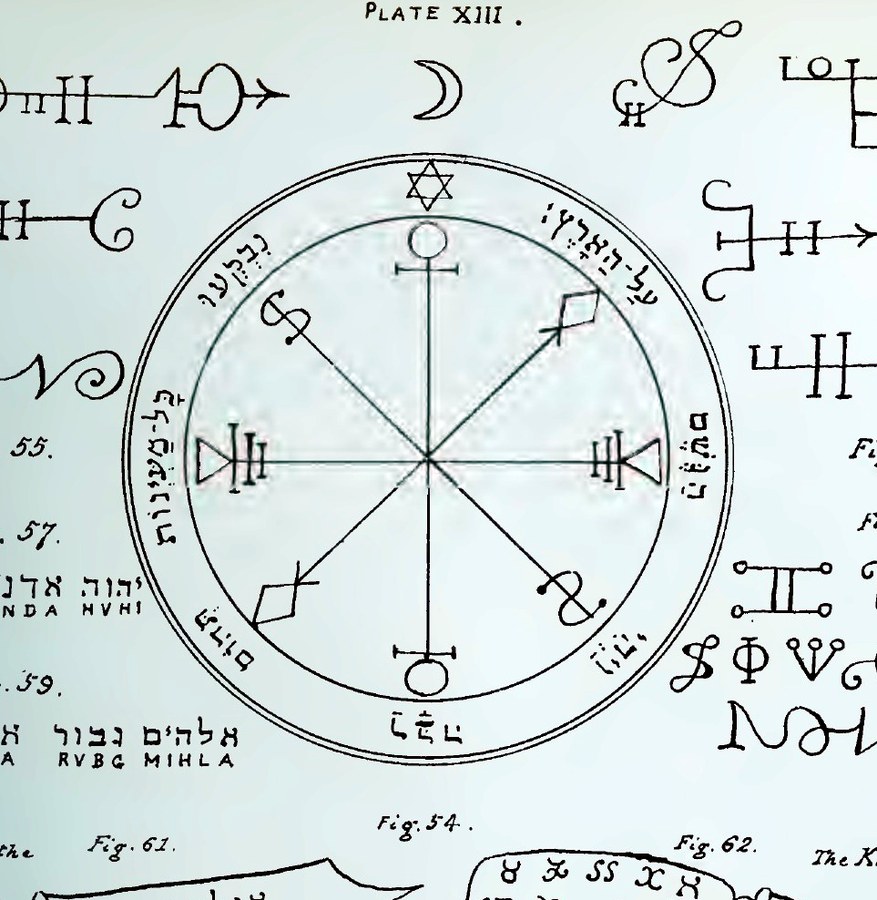
The final lunar caption claims that a silver plate placed under water brings continuing rain.
- Planetary group
- ☽ Moon
- Mathers figure
- 54
- Printed plate
- XIII
- Text anchor
- Genesis 7:11–12
Mathers assigns silver and silver to this planetary group. The crop documents his printed linework; it does not reproduce the color or material described elsewhere in the edition.
What Mathers’s caption claims
The final lunar caption claims that a silver plate placed under water brings continuing rain.
Within the Moon collection, this places figure 54 among themes of opening, water, night journeys, herbs and stones, dreams, and rain.
Inscription, names, and script
Genesis 7:11–12: All the fountains of the great deep were broken up, and the rain was upon the earth.
Mathers describes the interior as mystical characters of the Moon.
How the diagram is organized
The visible core is a small center under the lunar crescent. Around it, eight equal spokes terminate in lunar characters. At the edge, the flood-and-rain text encloses the wheel.
Mathers plate and witness differences
Figure 54 is printed on Plate XIII among knives, staffs, and other tool characters rather than with figures 50–53 on Plate XII. A crop must preserve that plate reference even when it isolates the circle for legibility.
Plate XIII is an artifact of Mathers’s 1889 arrangement. His preface and final note say that he compared differing manuscripts and restored difficult Hebrew and magical characters. Sloane 2731 and Lansdowne 1203 remain distinct manuscript objects; this printed crop should not stand in for either one.
WORKED EXAMPLE
A diagram reading of figure 54
Read the even spokes as a repeated lunar field, then set the flood verse around them. Finally return to the uncropped Plate XIII context: the pentacle’s placement among instrument diagrams shows that printed plate order can cross the modern categories used by this atlas.
View this figure in sequence
The Moon collection contains 6 figures, numbered 49–54 in the 1889 edition.