The two books divide operation from preparation
A cropped Key of Solomon pentacle loses the prayers, timing, tools, materials, circles, incense, and handling that make it a ritual object.
Cross-references bind the two books together. A circle in Book I presupposes a consecrated instrument described later. A pentacle chapter presupposes prepared paper, colors, incense, and personal purification supplied by Book II. The result is a dependency chain rather than a loose anthology of spells. No single image contains the whole system because every drawn object points beyond itself to timing, words, materials, and prior preparations. The familiar plates are best read as nodes in that chain, not as a self-sufficient deck of “Solomon symbols.”
A pentacle is defined by use, not by five points
Book I calls the objects “medals or pentacles” and places their construction inside a chapter about the knowledge and use on which the Key depends. The directions connect them with divine names, planetary timing, selected colors, prepared paper or metal, incense, wrapping, and later ceremonial display. Nothing in that definition requires a five-pointed star. Some designs contain geometric borders, letters, names, or biblical language without a pentagram at their center. The modern visual association between pentacle and five-pointed figure is therefore too narrow for this edition’s vocabulary.
A later Book I chapter assigns metals and colors by planet: lead and black for Saturn, tin and blue for Jupiter, iron and red for Mars, and corresponding materials for the remaining planets. That list does not turn every planetary figure into the same kind of object. It establishes a grammar of correspondence through which medium, color, time, and purpose reinforce one another. A line drawing stripped to black geometry loses at least three of those dimensions. The plate records shape; the prose supplies the relations that made the shape meaningful within the book.
Circles and tools distribute ritual roles
The circle is also a working layout rather than a generic emblem. Book II describes concentric boundaries, cardinal regions, divine names, pentagrams, enclosing squares, and smaller circles for censers. Its account gives the knife or sword a drawing function, gives the censers a place at the edges, and assigns participants positions within the larger geometry. Other chapters distinguish a white-hilted knife used for many operations from a black-hilted knife associated with circles, while staffs, wands, swords, a burin, pen, and needle receive separate uses. The object list is a division of labor made material.
This distribution explains why two circular drawings need not be alternate versions of one seal. A circle for consecrating pentacles organizes incense, direction, and the object being prepared. A circle for an evocation organizes people, boundaries, instruments, and speech. A planetary pentacle is carried or displayed within that space. Similar rings and names can serve different procedural roles. The surrounding chapter identifies the role more reliably than silhouette alone, and Mathers’s plate often places several such diagrams together because the printed book expects its prose to distinguish them.
Worked plate reading: five figures on Plate I
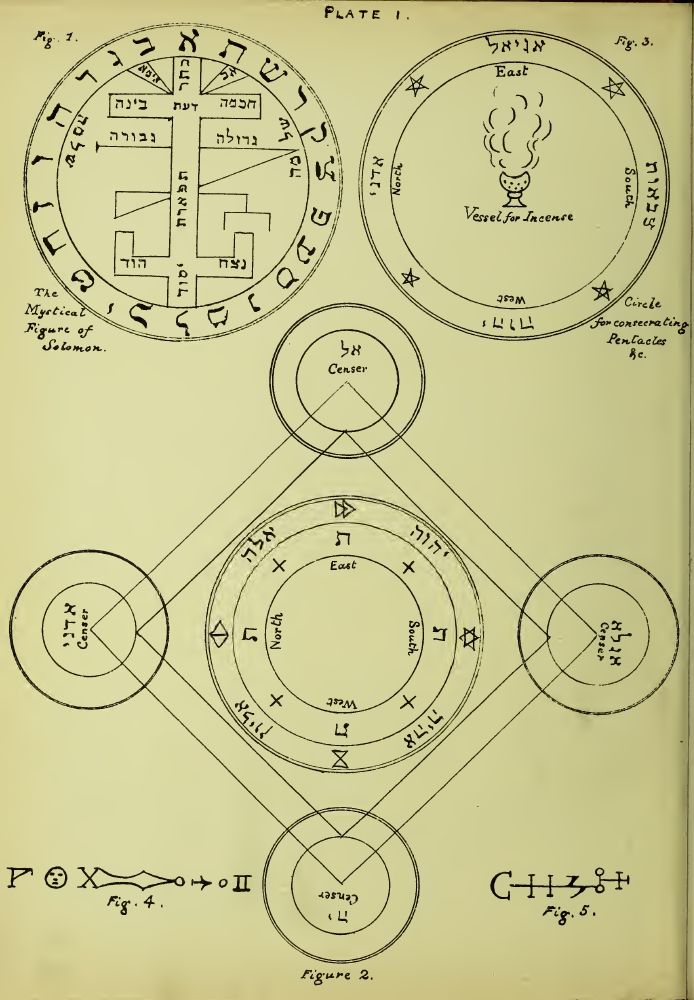
Plate I is a compact map of distinct functions. Figure 1 at upper left is labeled the Mystical Figure of Solomon and arranges Hebrew lettering around and within a large circle. Figure 3 at upper right is explicitly a circle for consecrating pentacles. It places a vessel for incense at the center, marks East, South, West, and North around the interior, and sets names and small star forms in the surrounding band. The directional words convert the ring into oriented space; the incense vessel makes an action, rather than abstract geometry, its center.
Figure 2 occupies the lower half. A central directional circle is enclosed by a square set on its point and linked to four smaller stations, each labeled as a censer. This is a spatial plan for multiple objects. Figures 4 and 5 sit separately along the lower edge as linear characters. Reading all five together prevents a common error: Plate I is not one composite talisman. It is a printer’s page gathering a named mystical figure, two kinds of ritual layout, and two smaller marks. Cropping any one item away from its figure number and label removes the distinctions the plate itself carefully preserves.
Worked procedure: from time to stored object
Each stage changes the pentacle’s status. Planetary time governs the beginning; unused paper or metal supplies the medium; prepared tools apply names and colors; chamber and circle contain the work; incense, prayer, and orientation consecrate it; silk separates the stored object from ordinary handling. Authority accumulates through coordinated conditions, not outline alone.
That sequence also reveals the limits of the 1889 plate. A scan can preserve line, label, and arrangement, but it cannot display the waiting between planetary hours, the movement through a room, the handling of incense, or the transitions between Book I and Book II. Earlier manuscripts may vary in chapter order, wording, color, and diagram, and Mathers states that he collated several differing copies and reconstructed lettering. The plate is evidence for his edited visual solution. Its promised powers remain claims within the historical work; its demonstrable value is that it shows how a nineteenth-century edition coordinated text, diagram, and material procedure.