
The weekday section looks like a planetary schedule, yet the text does not present a clean astrological system. It overlays hours, offerings, named spirits, directional kings, circles, divine names, and promised effects, then changes the mixture from one day to the next.
- Seven calls
- Lucifer through Surgat
- Printed range
- Pages 34–42 in the British Library copy
- Repeated device
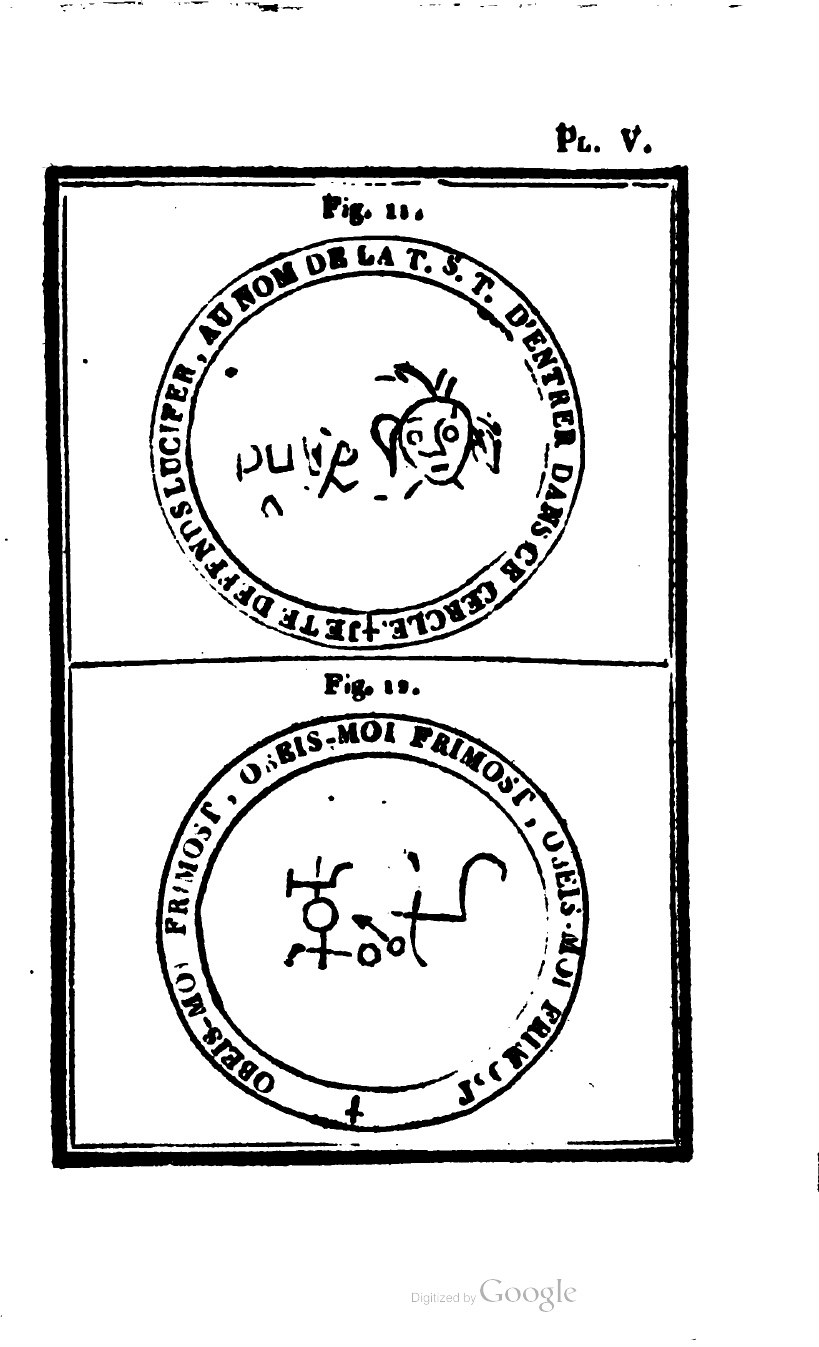
- A welcoming summons inside a circle that forbids entry
| Day | Named spirit | Stated hour | Offering or object | Claimed aim or distinctive feature |
|---|---|---|---|---|
| Monday | Lucifer | 11–12 or 3–4 | A mouse | A circle forbids Lucifer to enter while the speech commands him as a servant |
| Tuesday | Frimost | 9–10 at night | The first stone found | Dignity and honor; the body of the conjuration unexpectedly names Nambroth |
| Wednesday | Astaroth | 10–11 at night | No separate food offering stated | Favor from a king and from other people |
| Thursday | Silcharde | 3–4 at night | Bread for departure | Happiness and treasure; appearance in the form of a king |
| Friday | Béchard | 11–12 | A walnut | Compulsion invokes the Eucharist |
| Saturday | Guland | 11–12 | Burnt bread | The conjuration combines infernal rulers with the Trinity |
| Sunday | Surgat | 11–1 | Hair, with fox hair allowed | Treasure and a stone the text claims can make its bearer unseen |
The book offers more than one map of the spirit world
Before the weekday calls, printed pages 28–30 name four kings by direction: Magoa in the east, Egym in the south, Bayemon in the west, and Amaymon in the north. Each has subordinates. The operator may select one subordinate rather than recite the entire list, while divine force, a circle, and a pentacle are presented as constraints. This is one map: space organizes rank, and direction supplies the route by which a command is delivered.
The weekday section adds a second map without reconciling the two. Monday belongs to Lucifer, Tuesday to Frimost, Wednesday to Astaroth, Thursday to Silcharde, Friday to Béchard, Saturday to Guland, and Sunday to Surgat. Hours, offerings, and stated benefits replace the directional chains as the most visible coordinates. The result is layered rather than systematic. A reader meets directional kings, weekday specialists, a universal conjuration, and a separate treasure operation in the same volume. The book accumulates routes to efficacy instead of deriving them from one consistent cosmology.
Monday establishes the grammar of invitation and exclusion
Monday’s call specifies two possible windows, eleven to twelve or three to four. A circle is drawn with charcoal or blessed chalk and inscribed with a prohibition: Lucifer is forbidden, in the name of the Trinity, to enter it. A mouse is designated as the offering. The master wears stole, alb, and surplice, then speaks “as master to servant” through a long chain of sacred names. The scene joins clerical clothing, an ordinary small animal, a bounded diagram, and maximal verbal authority.
Its central tension governs the whole series. Lucifer is commanded to come, yet forbidden to cross the circle. Appearance is wanted at the edge, while bodily safety depends on maintaining the boundary. The circle is therefore not a picture of the spirit’s home. It is a contractual line: attendance is required, entry is denied, and conversation is imagined across the border. The operator’s asserted mastery needs both halves. A summons without exclusion invites danger in the book’s fiction; exclusion without summons produces no encounter.
Each day changes the transaction
Tuesday replaces the mouse with the first stone found and attaches the action to dignity and honor. The ring inscription repeatedly addresses Frimost, yet the main conjuration calls “Nambroth.” That mismatch is best read as a textual seam or unstable editorial substitution. The page does not explain that the two are aliases. Wednesday’s Astaroth call seeks the favor of a king and other people, using Marian and Trinitarian authority. Thursday’s Silcharde call requests happiness and treasures, expects a kingly form, and provides bread at departure.
Friday gives Béchard a walnut and sharpens the Christian compulsion by invoking the Eucharist. Saturday offers burnt bread to Guland and asks what will please him; the speech places Satan, Beelzebub, and Astaroth beside Trinitarian formulas. Sunday extends the time window to eleven through one, asks for hair but permits fox hair, and sends Surgat away after a treasure request. Variation is the method. Each little rite feels proprietary because its time, object, words, and desired result do not simply repeat Monday’s template.
The hierarchy works as routing rather than theology
The names do not form one stable rank order across the book. Lucifer can be the Monday respondent and also appear elsewhere as an emperor. Astaroth belongs to the Wednesday call and also to higher command chains. Surgat is approached for treasure and for a stone said to confer invisibility, while Silcharde is also assigned treasure and happiness. Repeated domains do not embarrass the compiler; they provide alternative addresses. The book behaves like a directory assembled from several systems, each promising a route around resistance.
This helps explain the huge chains of divine names. Rank alone never guarantees obedience in the story the text tells. The operator invokes higher powers, Christian figures, sacramental objects, and written boundaries to reinforce a local demand. Hierarchy is not a neat genealogy of demons. It is an escalation mechanism. When the named respondent might refuse, the speech calls on a denser network of authorities. The accumulation makes the command sound judicial, even when the offices and spellings shift from page to page.
Worked sequence: Monday’s Lucifer call from hour to dismissal
Begin with the time gate. Monday permits one of two short intervals, so the operation is represented as unavailable for most of the day. Next comes the boundary: charcoal or blessed chalk makes a circle, and the written sentence explicitly denies Lucifer entry. The operator then assumes clerical appearance through stole, alb, and surplice. A mouse supplies the offering. Only after time, space, clothing, and exchange have been fixed does the command speak through the long authority chain.
The call then demands presence while narrowing the form of presence. The spirit is to attend the master as a servant and answer, but remain beyond the protected enclosure. If the sequence succeeds on its own terms, the encounter must also be closed rather than simply abandoned. The wider section supplies dismissal logic and offerings at departure, most explicitly in the bread given to Silcharde. Read as a complete sequence, Monday is not “say a name and receive an answer.” It is time gate, marked perimeter, assumed office, offering, compelled attendance, bounded exchange, and release.
Compare Tuesday and Sunday to see what remains stable. Tuesday preserves a narrow hour, a ring formula, an offering, and a desired social effect, but its Frimost/Nambroth seam weakens the name’s consistency. Sunday preserves the circle and command while changing the object, widening the hour, and specifying a portable effect in Surgat’s stone. The invariant is not a planetary correspondence. It is the controlled transaction: select the address, open the permitted time, mark who may cross which line, state the price, demand an effect, and end the contact.
A modern Lucifer working is a separate object
The modern Star & Sigil working titled “Cancel Their Command” is placed after this worked reading because the title creates a sharp thematic counterpoint to Monday’s repeated claims of mastery and obedience. It is a separate contemporary item with its own presentation and access rules. It does not reproduce the 1760-dated circle, mouse offering, clerical vestments, sacred-name chain, or dismissal, and it is not evidence that the historical text functioned as claimed.
Keeping the boundary explicit protects both readings. The grimoire can be analyzed as a printed sequence whose drama depends on issuing commands; the modern catalog can offer an independently authored working concerned with command as a theme. The link between them is editorial relevance, not lineage, reconstruction, or shared ritual state.