
Sigil of Valefor
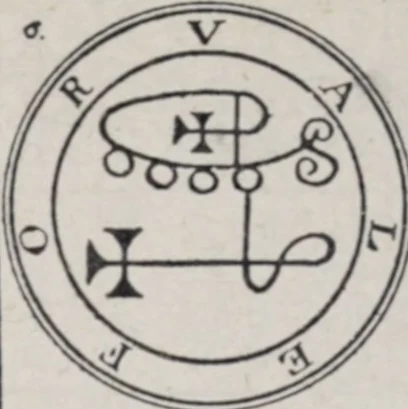
At a glance
- Entry
- 6 of 72
- Rank
- Duke
- Legions
- 10 in the text
Description in the text
Valefor is described as a familiar spirit, but the account warns that he tempts those close to him to steal. His short entry turns on the tension between useful companion and dangerous influence.
Read entry 6 on page 23 of the 1916 edition
Appearance
A bellowing lion with the head of a donkey.
Topics attributed to this entry
- Familiars
- Theft
Reading this entry
Valefor’s verbal portrait gives a donkey’s head to a bellowing lion. The passage calls him a useful familiar, then immediately warns that he tempts the person he accompanies to steal. That warning is the entry’s most important qualification: the relationship it imagines is both helpful and corrupting. The text does not give Valefor a teaching office, prophecy, or a treasure-finding role to soften the tension.
His title is duke and his command is limited to ten legions, a relatively small count within this list. The seal instruction applies whether or not the operator wants him as a familiar, which separates the emblem from the choice to enter that particular relationship. The terse entry states its moral ambiguity unusually plainly in a catalogue that often confines itself to attributed abilities.
Read entry 6 on page 23 of the 1916 edition or compare the 1904 transcription.
A closer reading of entry 6
What the numbered text says
Valefor’s account makes the warning part of the office: he is called a good familiar and, in the same sentence, a temptation to theft for the person attached to him. Neither half should be dropped. The entry gives no separate prophecy, learning, or treasure claim; assigning those jobs would expand the source beyond its words. Its ten legions are the smallest count among these twelve.
About the printed seal
The seal sentence explicitly assigns the emblem to Valefor whether or not a person seeks the familiar relationship described above. Number 6 on the 1916 plate documents that emblem; the printed lines are not a pictorial depiction of a lion with a donkey’s head.
Compare another entry
Compare entry 9: Paimon. Paimon is also credited with familiars, but his are described as teachers of arts. Valefor’s familiar role is accompanied by a theft warning. Two adjacent sections of the book can therefore attach sharply different qualifications to the same catalogue term.