
Sigil of Seere
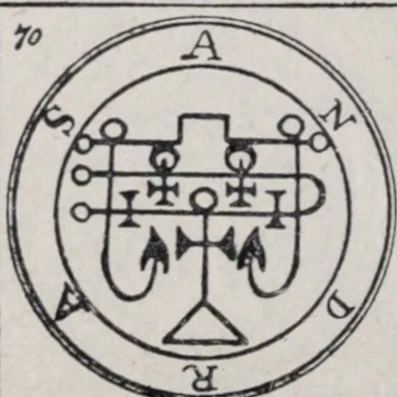
At a glance
- Entry
- 70 of 72
- Rank
- Prince
- Legions
- 26 in the text
- Also written
- Sear, Seir
Description in the text
Seere is associated with swift travel and the rapid transport of people or things. The text also credits him with reports about theft and hidden treasure and calls his nature comparatively agreeable.
Read entry 70 on page 44 of the 1916 edition
Appearance
A handsome man on a winged horse.
Topics attributed to this entry
- Swift travel
- Theft
- Hidden treasure
Reading this entry
Seere, also Sear or Seir, is a prince under Amaymon, called king of the east in this passage. He appears as an attractive man on a winged horse. His offices emphasize speed: going and coming, carrying things between places, and making results arrive suddenly. The text hyperbolically says he can cross the earth in an instant. It also credits him with information about theft and hidden treasure.
The entry describes his disposition as comparatively good and willing, a characterization within the grimoire rather than a guarantee about behavior. Seere governs 26 legions and has a seal. The named superior, airborne mount, swift transport, and reports on theft form a distinct profile. Unlike many entries about travel, the focus is as much on moving objects and accomplishing errands as on moving a person.
Read entry 70 on page 44 of the 1916 edition or compare the 1904 transcription.
A closer reading of entry 70
What the numbered text says
Seere is placed under Amaymon, called king of the east in this entry, and appears as a handsome rider on a winged horse. Speed dominates the office: coming and going, carrying or returning things, and crossing the earth in an instant. Reports of theft and hidden treasure are added to that mobility. The source calls Seere of an “indifferent Good Nature,” a qualified phrase that should not be modernized into an unambiguous moral endorsement. The passage gives no place of origin or destination for a specific journey.
About the printed seal
Seal 70 is on the fifth frontispiece. Wings are part of the horse described in words; the sign’s strokes are not annotated as feathers or a route. The abstract design does not illustrate the narrative’s movement claim.
Compare another entry
Compare entry 66: Cimejes. Cimejes and Seere both have treasure or lost-property tasks, but Cimejes teaches grammar, logic, and rhetoric and is assigned a regional command. Seere’s defining feature is speed of travel. Their numbered entries support different thematic routes through the catalogue.