
Sigil of Orias
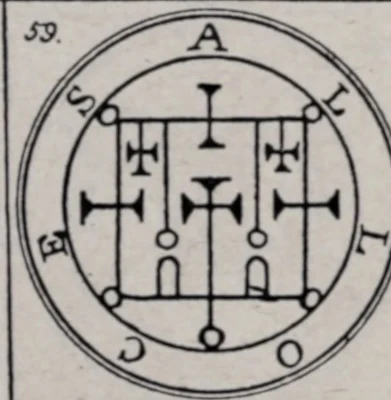
At a glance
- Entry
- 59 of 72
- Rank
- Marquis
- Legions
- 30 in the text
- Also written
- Oriax
Description in the text
Orias is associated with the stars and planetary mansions and their attributed qualities. The passage also assigns him transformation of people and the granting of dignity and favor.
Read entry 59 on page 41 of the 1916 edition
Appearance
A lion-like figure on a strong horse with a serpent tail, holding two hissing serpents.
Topics attributed to this entry
- Stars
- Planetary mansions
- Dignity
Reading this entry
Orias, also Oriax, is portrayed as a lion on a powerful horse with a serpent’s tail, holding two hissing serpents. The marquis teaches what the text calls the virtues of stars and the mansions of planets. These are historical astrological terms, not modern astronomical measurements. The entry also credits him with transformation, dignities, religious offices, and favor from both friends and enemies.
The combination of detailed celestial learning and advancement at court is particular to this passage. The source does not list specific planetary mansions or interpret the serpents, so those topics require another cited work if explored further. Orias governs 30 legions and has a seal. The alternative spelling appears in the heading of the printed entry and should remain attached to number 59 rather than treated as a different spirit.
Read entry 59 on page 41 of the 1916 edition or compare the 1904 transcription.
A closer reading of entry 59
What the numbered text says
Orias’s astrological office is unusually specific: the virtues of stars and the mansions of planets are named separately. The image of a lion riding a powerful horse and holding two hissing serpents is less settled than it first appears. Editorial footnotes allow a lion face rather than a full lion, and ask whether the serpent tail belongs to the horse or the marquis. Keeping those uncertainties visible is more faithful than resolving them in a confident illustration. The entry then adds human transformation, dignities, and favor from both friends and foes.
Footnotes 28 and 29 offer an alternate lion description and leave the possessor of the serpent tail uncertain.
About the printed seal
Seal 59 appears on frontispiece 4. The printed sign cannot settle which figure has the serpent tail, because that uncertainty is explicitly raised in the text’s notes. The plate and prose preserve different kinds of detail, and the abstract sign does not override the written variant.
Compare another entry
Compare entry 58: Amy. Amy’s celestial subject is named broadly as astrology, while Orias lists star virtues and planetary mansions. Amy also offers familiars and guarded treasure; Orias turns to honors and social favor. The proximity of their entries invites a precise comparison.