
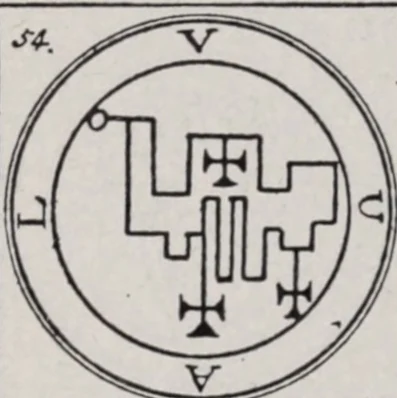
Sigil of Murmur
At a glance
- Entry
- 54 of 72
- Rank
- Duke and Earl
- Legions
- 30 in the text
- Also written
- Murmus, Murmux
Description in the text
Murmur is said to teach philosophy thoroughly. His entry also describes compelling the souls of the dead to answer questions.
Read entry 54 on page 39 of the 1916 edition
Appearance
A crowned warrior riding a griffin, preceded by trumpet-playing attendants.
Topics attributed to this entry
- Philosophy
- The dead
Reading this entry
Murmur, also Murmus or Murmux, is both duke and earl. He arrives as a crowned warrior on a griffin with trumpeting attendants. The procession gives him a ceremonial grandeur that contrasts with his principal offices: teaching philosophy and bringing deceased souls before an operator to answer questions. The latter is a claim within necromantic literature, not evidence that a named deceased person could be contacted.
The passage says Murmur belonged partly to the Orders of Thrones and Angels and now governs 30 legions. That mixed classification is a distinctive addition to the military image. Unlike Samigina, who is said to give an account of the dead, Murmur is assigned the production of the souls themselves for questioning. The two entries should not be merged into a single vague “spirits of the dead” category.
Read entry 54 on page 39 of the 1916 edition or compare the 1904 transcription.
A closer reading of entry 54
What the numbered text says
Murmur receives two titles in the numbered passage, duke and earl, and the portrait makes that status theatrical: a crowned warrior on a griffin with trumpet-bearing attendants. The teaching office is philosophy, while the second claim concerns compelling deceased souls to answer questions. The latter is the grimoire’s account of a ritual setting, not testimony about the dead. The passage also assigns Murmur to two earlier angelic orders, a classification that should be reported as part of its invented hierarchy rather than collapsed into one rank.
About the printed seal
The numbered fifth-plate sign is seal 54. Neither the griffin mount nor the trumpets are described as features of its linework. Cataloguing the seal alongside the dual rank keeps the image and the prose connected without treating the emblem as a drawing of the warrior scene.
Compare another entry
Compare entry 4: Samigina. Samigina is likewise linked to the dead, but that entry asks for an account of souls and pairs the claim with liberal sciences. Murmur adds a coercive question scene, philosophy, and a public martial entrance. Their common subject should not erase that difference.