
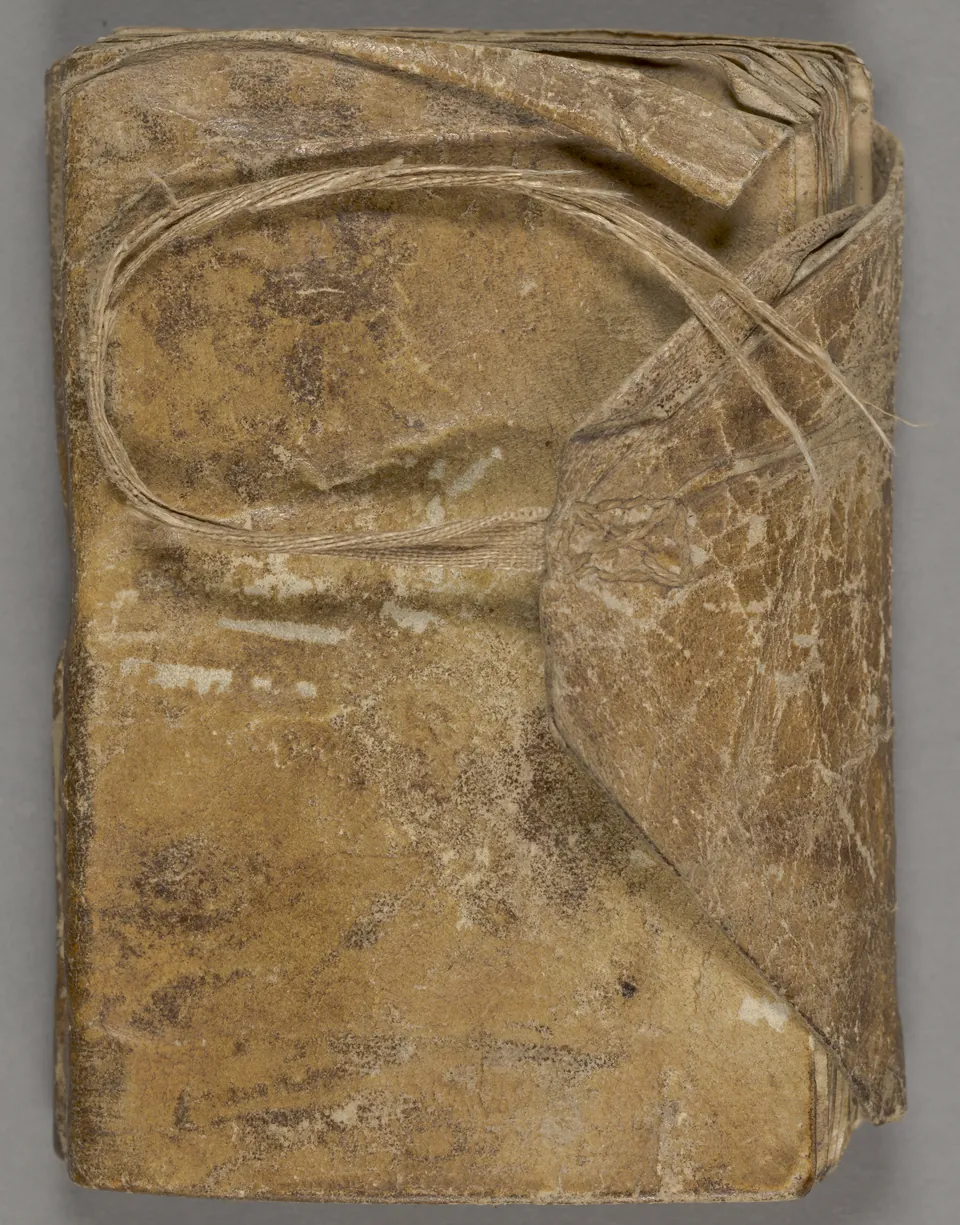
The object commonly called the Galdrabók is a small, layered parchment book. Its cover, scripts, and ownership note tell a more precise story than the single date often attached to it online.
- Shelfmark
- ATA Ämb 2, F 16:26
- Material
- Parchment, 32 leaves
- Writing layers
- Four hands, late 1500s to 1600s
A physical book before it was a modern title
Alvin describes the object as a manuscript on parchment and records thirty-two leaves. The photographs show a compact book in a flexible skin cover whose long flap once wrapped around the fore edge. Its working scale matters: this was a book that could be carried and handled, rather than a display volume made for a library shelf. The leaves are ruled with red frames, while dense writing, empty spaces, marginal additions, and graphic signs occupy the same small field. Those features are evidence of repeated use and copying even before any passage is translated.
Galdrabók is a convenient modern shorthand for this object, but it also means a book of magic in Icelandic. The archive records the codex as ATA Ämbetsarkiv 2, Vitterhetsakademiens handskriftssamling, series F 16, volume 26. The Swedish catalogue title, Isändsk Svartkonstbok, is another descriptive label. That catalogue identity distinguishes this codex from several other Icelandic books that can also be called a galdrabók or galdrakver.
Four writers and a range of dates
The manuscript did not emerge in one sitting. Lindqvist separated its writing into several hands and dated the oldest portion to the end of the sixteenth century, with later cursive material added in the seventeenth. Later scholarship summarizes the division as four contributors: the first three likely Icelandic and the fourth Danish, working from Icelandic material. The archive therefore dates the object broadly rather than assigning every leaf to one year. A statement such as “written in 1600” hides the change of hands that the pages themselves preserve.
The layered construction also explains shifts in script, language, density, and layout. One writer may copy a long prayer in a tight block; another places a sign beside a short direction; a later writer adds material in a different cursive. These changes do not form a clean chronological index, because a late copy can transmit older words and an early-looking passage can be recopied. Paleography, spelling, the order of leaves, and comparison with other manuscripts work together to produce the late-sixteenth- through seventeenth-century range.
Worked page comparison: prayer block and stave recipe
Entry 1 begins the oldest portion with a long protective prayer rather than a bare stave. Its continuous text layers Latin Christian formulas, the Lord’s Prayer, names for Christ, and a request for safety from weapons, sea danger, and other threats. Repetition supplies the form: a cluster of sacred names establishes authority, the Pater Noster returns between shorter formulas, and the desired protection is folded into familiar devotional speech. On the page, dense verbal sequence carries most of the operation; the reader is asked to move through accumulated names and prayers rather than decode one isolated emblem.
Entry 33 in the later part of the anthology compresses a different kind of operation. Its heading states the aim of discovering a thief, then the entry joins drawn staves to the bottom of an ash bowl, water and yarrow, a short spoken wish, and an expected shadow in the water. The text works as a chain of roles: the heading defines the problem, the marks prepare the vessel, the plant and water create the viewing surface, the words state the request, and the shadow supplies the promised sign. Image and prose are incomplete without one another.
Placed together, the two entries show why four hands matter to interpretation. The codex can preserve expansive Christian prayer beside a compact graphic recipe without forcing both into one theology or one authorial plan. The first entry treats protection as an accumulation of sacred speech; the later entry turns diagnosis into a small staged scene with an object, marks, and a visual answer. The manuscript is best read as a layered working anthology whose contributors accepted more than one textual grammar for effective action.
From Iceland to Copenhagen and Stockholm
Lindqvist reconstructed an Icelandic origin for the oldest portion and a move to Denmark in the early seventeenth century, where the book received further material. A note on the cover records that the Swedish linguist and antiquarian Johan Gabriel Sparfwenfeldt acquired it in Copenhagen on 3 April 1682. That dated ownership mark gives the manuscript a firm point in its travels. It also places an upper boundary on additions that were already present when Sparfwenfeldt bought the book.
The volume subsequently entered Stockholm’s antiquarian collections. Administrative changes moved those holdings through the Antiquities Archive and the Royal Academy of Letters, History and Antiquities; the current catalogue locates the book with the Swedish National Heritage Board’s archive and library division and also records Swedish History Museum inventory number 21284. The persistent Alvin record brings the object, its seventy-three digital views, and Lindqvist’s 1921 edition together without pretending that one cataloguing title settles the manuscript’s authorship.
Archive records and scholarship
- Alvin, Stockholm Galdrabók catalogue record (ATA Ämb 2, F 16:26) ↗
- Alvin manuscript image, scan 1: wraparound parchment cover ↗
- Natan Lindqvist, En isländsk svartkonstbok från 1500-talet (1921) ↗
- Stephen A. Mitchell, Leechbooks, Manuals, and Grimoires (Arv, 2014) ↗
- University of Iceland Web of Science, oldest known Icelandic grimoire overview ↗
- Roberto Luigi Pagani, The Mediterranean Origin of the Galdrastafir (Gripla) ↗