
The alphabet in John Dee’s records is a set of named signs, not a modern typeface with a settled pronunciation key. Dee’s entry for 26 March 1583 supplies the sequence of names; an image identified as Sloane MS 3188, folio 104r, shows a later copy of letter forms under an entry dated 6 May. Keeping those two dates apart makes the chart easier to use and easier to check.
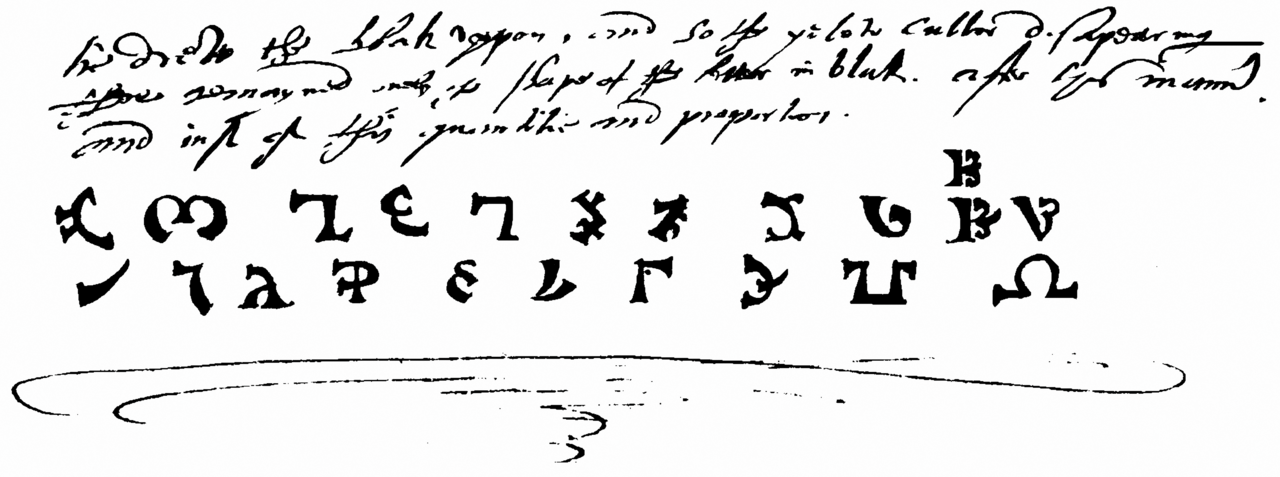
- Recorded sequence
- 26 March 1583 · Sloane MS 3188, ff. 63v–64r
- Illustrated copy
- 6 May 1583 · Sloane MS 3188, f. 104r
- Extent
- 21 names in three groups of seven
The 21 names in recorded order
Use the search field to locate a name or its usual Roman counterpart. The three groups follow the order attributed to the 26 March session; the letters are not alphabetized as A to Z.
Seven-letter group 1
| No. | Name | Roman letter |
|---|---|---|
| 1 | Pa | B |
| 2 | Veh | C |
| 3 | Ged | G |
| 4 | Gal | D |
| 5 | Or | F |
| 6 | Un | A |
| 7 | Graph | E |
Seven-letter group 2
| No. | Name | Roman letter |
|---|---|---|
| 8 | Tal | M |
| 9 | Gon | I |
| 10 | Na | H |
| 11 | Ur | L |
| 12 | Mals | P |
| 13 | Ger | Q |
| 14 | Drux | N |
Seven-letter group 3
| No. | Name | Roman letter |
|---|---|---|
| 15 | Pal | X |
| 16 | Med | O |
| 17 | Don | R |
| 18 | Ceph | Z |
| 19 | Van | U |
| 20 | Fam | S |
| 21 | Gisg | T |
“A” beside Un means that a source register associates Un with the Roman letter A. It does not establish a single sound for every Angelical word, nor does it prove that replacing modern English letters produces a historical Angelical sentence.
What the table records
Dee’s early conference book, catalogued as Sloane MS 3188, is the anchor for this list. The 26 March account describes a sequence of twenty-one named characters and a division into three sets of seven. The first sign in that sequence corresponds to Roman B and is named Pa; the sign corresponding to A appears sixth and is named Un. A chart rearranged into familiar A-to-Z order may be convenient for lookup, but it no longer displays the historical sequence. This page therefore keeps the recorded order and offers search for readers who need to find a particular Roman equivalent.
The Roman column is an editorial aid for reading the source register. A written sign, a letter name, and a spoken value are three different things. Dee and Kelley also recorded strings of words and the extensive grids of Liber Logaeth. The existence of twenty-one signs by itself does not supply a complete grammar or a general English-to-Angelical translation system. The words and translation guide explains how a proposed gloss needs a passage and an edition behind it.
Why spellings and pronunciations vary
The manuscript account gives reported sounds for some names, but these are English-language approximations written during a specific session. It does not provide a complete phonetic notation for every letter in every word. Later editors normalize spelling, select among manuscript forms, or add pronunciation conventions for teaching and performance. As a result, charts based on different witnesses and editorial rules can show different spellings or attach more than one Roman letter to a sign.
For example, a Roman counterpart such as C can also be discussed with K in later transliteration; I may be used alongside Y; U and V may be treated together. These are questions of how an editor maps early modern writing into a modern lookup chart. They are not additional Angelical letters. This register gives Fam for the sign paired with S; other sources preserve variant readings from separate editorial lineages. See the pronunciation question for the limits of reconstruction.
Two manuscript moments, one commonly shared image
The Commons image is a detail identified as the 6 May 1583 entry on Sloane MS 3188, f. 104r. It is useful because it shows handwritten shapes and their material context, including Dee’s writing above them. The named sequence was reported earlier, in the 26 March action at ff. 63v–64r. These are related passages in one early conference volume, not interchangeable images of the same moment. Crisp computer-drawn glyphs add a modern visual layer that is absent from the handwritten folio.
Sloane MS 3189, catalogued separately by the British Library, contains Liber Logaeth and its large letter grids. Some later alphabet diagrams are associated with that book. The diagrams from 3189 and the detail from 3188 reproduce different manuscript objects. For a closer account of the illustrated folio, continue to the 1583 alphabet manuscript article; for the wider paper trail, use the Sloane 3188 guide and Liber Logaeth guide.