
Liber AL vel Legis is short, but it is not a single uninterrupted sermon. Its three chapters change speaker, scale, imagery, and tone. Reading that architecture first makes familiar formulas about stars, will, love, and force easier to place within the argument that the book itself constructs.
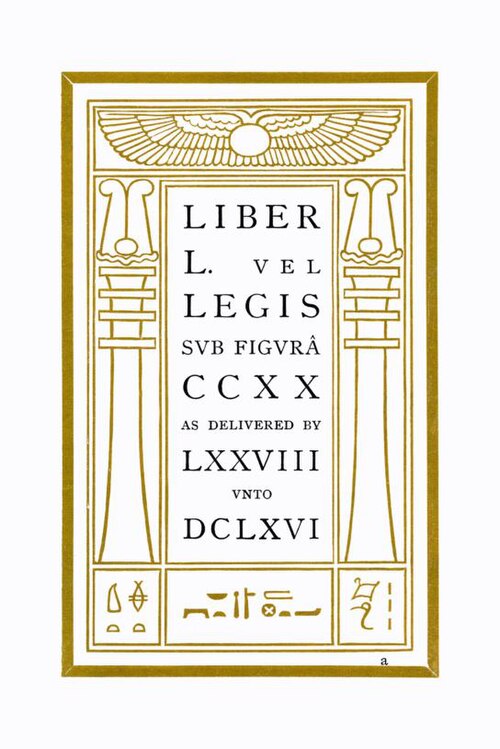
- Kind
- Thelemic text
- Date
- Reported 1904; published 1909
- Edition note
- Reported Cairo reception and dated 1909 printing are separate events
The three chapters form a dramatic progression
Chapter I speaks principally through Nuit, chapter II through Hadit, and chapter III through Ra-Hoor-Khuit. Those names do more than divide the book into thirds. Nuit is figured as limitless extension and the field of stars; Hadit as the unextended center, motion, and inward fire; Ra-Hoor-Khuit as active force, judgment, and the announced new aeon. The sequence moves from encompassing space, to the point of individual experience, to power acting in history. Repeated terms therefore change pressure as the speaker changes. “Will” in the second chapter is bound to the individual center, while the third chapter turns command and ordeal into a much harsher public register. A reading that combines all three voices into one placid philosophy misses the designed escalation.
Chapter I builds a language of space and relation
Nuit’s chapter repeatedly uses stars, curvature, continuity, division, and union. The individual star is neither isolated nor dissolved into a featureless whole: distinct centers occupy an infinite field, and separation becomes the condition for encounter. This spatial grammar explains why love and difference appear together. The chapter’s famous statement that every person is a star is followed by claims about number, relation, and the refusal of imposed division. The imagery also shifts between cosmic scale and intimate address, making doctrine feel like a dialogue between infinity and a particular speaker. The result is not a systematic cosmology in modern terms. It is a poetic model in which freedom, plurality, and union are expressed through the behavior of points within boundless space.
Chapter II moves from circumference to center
Hadit describes itself through paradox: present at every center yet not extended, hidden yet experienced as the flame in each heart and star. The change of voice turns chapter I’s external night sky inward. The text now emphasizes appetite, energy, risk, ordeal, and the discovery of a proper course. Its account of will is easily flattened into unrestricted preference, but the chapter repeatedly distinguishes a concentrated direction from distraction by result, social comparison, or borrowed purpose. That distinction matters to the book’s logic. Nuit supplies the field in which difference can exist; Hadit supplies the irreducible standpoint from which action begins. Neither chapter alone gives the complete relation, and their paired geometry prevents “will” from meaning whatever impulse happens to be strongest in a moment.
Chapter III changes the ethical temperature
Ra-Hoor-Khuit’s chapter is martial, polemical, and frequently violent. It names enemies, weapons, conquest, ordeal, and the overturning of an old religious order. That rhetoric cannot be softened by quoting only the book’s language of stars and love, nor should it be detached from the ritualized prophetic genre in which a god of force announces an aeon. The chapter tests the reader with a different problem from the first two: how does a doctrine of individual will operate when its divine voice speaks in collective commands and threats? Later interpreters answer differently, but the internal tension is already present. Treating the violence as merely metaphorical erases the wording; treating every line as a literal program erases the text’s shifting speakers, symbolic personae, and staged revelation.
The scribe remains visible inside the revelation
The book repeatedly draws attention to its own production. Questions from the prophet interrupt divine speech; the speaker addresses a scribe; commands concern letters, commentary, concealment, and the threefold book itself. These moments create more than a reception legend outside the text. They stage transmission as one of the text’s subjects. A divine voice, a human recorder, and a future interpreter occupy different positions, even when editions visually smooth them into a continuous block. This self-reference also creates an interpretive difficulty: the command not to alter a letter gives typography unusual weight, while the command to comment admits that the meaning is not self-evident. Facsimile, early print, and reset edition can therefore produce different reading experiences even when their wording largely agrees.
Worked passage comparison: will across the three voices
A single doctrine becomes clearer when its function is traced across the chapter sequence rather than reduced to one slogan.
Nuit · chapter I
The formula “Do what thou wilt” appears within a chapter about stars, difference, and union. Its setting makes will relational: each star has its own course within an infinite field shared with other stars.
Hadit · chapter II
The center speaks of purpose without attachment to result. Will becomes concentration and trajectory, opposed to diffusion into other people’s aims or into anxiety about reward.
Ra-Hoor-Khuit · chapter III
Will enters an atmosphere of force, conflict, and historical rupture. The chapter exposes the danger of treating an inward principle as if its public or political meaning were automatically settled.
Across the book
Love joins what is distinct; will gives a center its course; force raises the question of how that course meets resistance. The three terms form a problem the book dramatizes rather than a neat sequence of dictionary definitions.
The comparison preserves both the attraction and the difficulty of the text: its best-known maxim changes meaning as the imagined speaker and scale change.
The reported 1904 reception, the 1909 printed witness, manuscript facsimiles, and later commentary frame the same three chapters in materially different ways.