
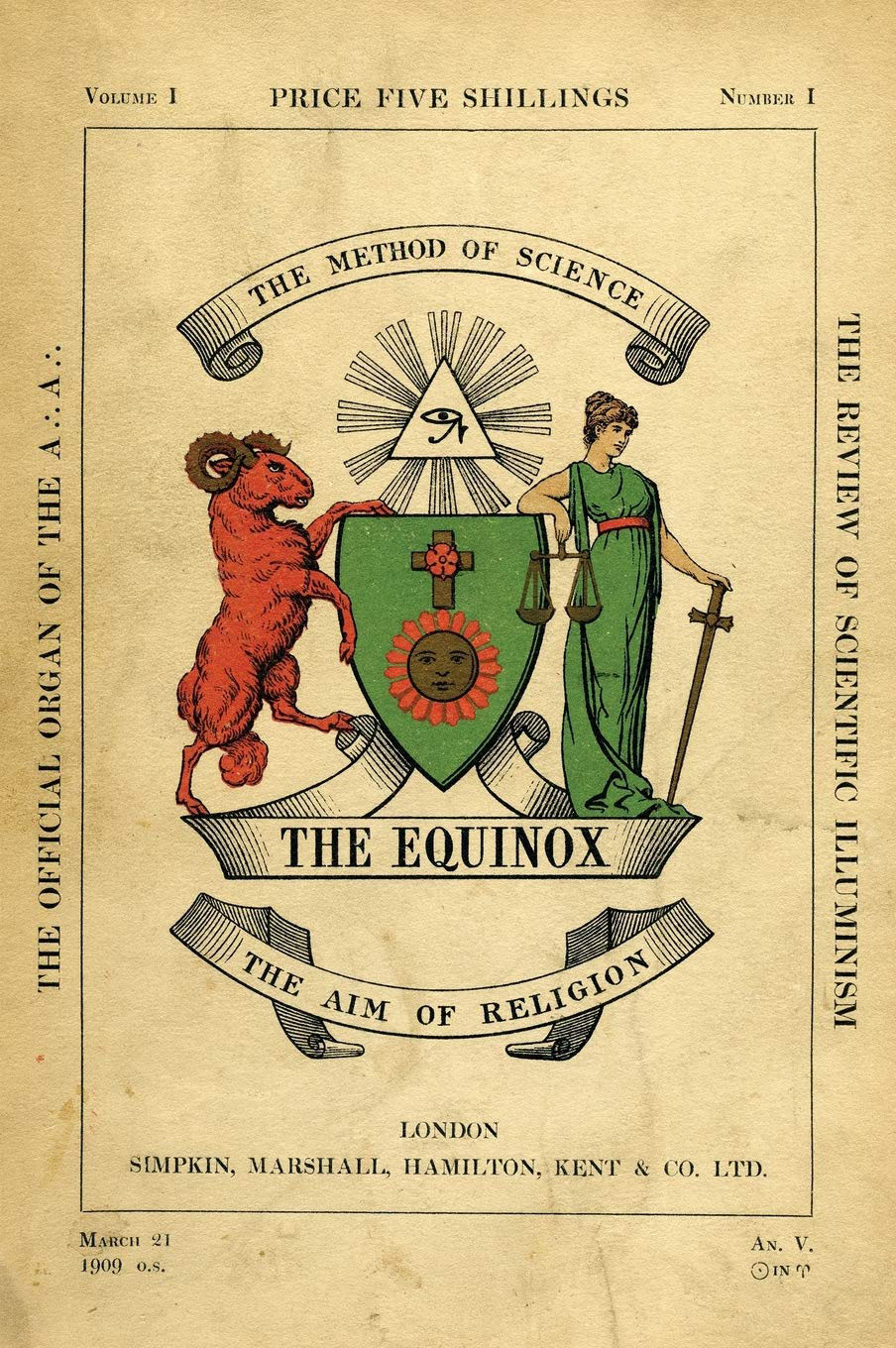
The Equinox is best read as a deliberately mixed periodical. Its early issues place graded instructions beside magical records, fiction, poetry, reviews, organizational papers, and advertisements. That arrangement is part of the argument: doctrine is announced, exercises are prescribed, experience is narrated, and a public movement is built within the same serial frame.
- Kind
- Serial publication
- Date
- Began 1909
- Edition note
- A periodical issued in volumes and numbers, not a single authored book
An issue is a sequence, not a storage box
The contents of an early issue follow a recognizable editorial rhythm. A cover and editorial establish the publication’s voice; numbered A∴A∴ papers give instruction or doctrine; longer narratives and serialized histories model a life shaped by those ideas; poems and fiction broaden the symbolic world; reviews answer rival books and public criticism; a supplement can then carry the longest or most specialized work. The pieces do not all make the same kind of claim. An exercise tells a reader what to do, a diary records what its author says occurred, and a story tests an idea through character and plot. Reading the issue in order therefore reveals a publishing strategy that disappears when one ritual or essay is extracted into a modern anthology.
Recurring departments make a curriculum visible
Across volume I, repetition gives the serial continuity. Editorials restate the program of “scientific illuminism,” while numbered Libers identify texts with different instructional or doctrinal functions. The Temple of Solomon the King returns in installments, turning an initiatory history into a serial backbone. The Herb Dangerous changes form across installments, moving among pharmaceutical, psychological, and literary treatments of intoxication. Reviews and correspondence place the order’s private vocabulary in a public arena. These recurrences let readers watch categories being built over time: instruction is separated from commentary, formal order papers from personal records, and institutional history from imaginative writing. The contents page is therefore a map of genres as much as a list of titles.
Instruction and record perform different jobs
Volume I, number 1 makes the distinction especially clear. Liber E presents compact exercises in posture, breath, concentration, and record keeping. The supplement John St. John is not another list of drills; it is a dated narrative of a retreat, arranged to show changing states, setbacks, and interpretations. The Temple of Solomon the King supplies a retrospective institutional story, while Liber Librae offers ethical counsel. Together they form a loop: rule, attempt, record, and interpretation. The serial does not maintain a modern experimental standard, and a printed diary does not independently verify its extraordinary claims. It does, however, show what Crowley wanted a magical record to look like and how practice was converted into a public literary object.
Authorship changes with genre
Crowley controlled much of the project, but the bylines and roles in the contents matter. Victor Neuburg contributes poetry; Ethel Archer and other writers appear in later numbers; J. F. C. Fuller is credited in the Temple of Solomon the King; translations and revisions can name more than one participant. Pseudonyms and initiatory initials add another layer between person and printed voice. An unsigned editorial, an order document, and a poem by a named contributor cannot all be read as Crowley speaking directly. The periodical uses that plurality productively: institutional authority appears in formal papers, personal authority in records, and cultural ambition in literature and criticism. Identifying the genre and named role resolves apparent contradictions that arise when the whole issue is treated as one manifesto.
Extraction changes the meaning of a text
Many works now circulate as independent PDFs or chapters, but their first serial setting supplied neighbors, pagination, and timing. Liber O in volume I, number 2 sits near a psychological study of hashish, a handbook of geomancy, poems, fiction, a further Temple of Solomon installment, and reviews. In isolation it looks like a self-contained manual. In the issue it becomes one component of a larger claim that disciplined exercises, divination, introspection, art, and criticism belong to a single program. A later collection may preserve every word while losing that argument by adjacency. The issue date also prevents later developments from being silently read backward into an earlier paper. Serial context is interpretive evidence, not decorative bibliography.
Worked issue comparison: volume I, numbers 1 and 2
The first two numbers repeat the same broad departments but alter their weight. Comparing their contents shows how the magazine teaches through variation rather than through a fixed template.
Opening instruction
Number 1 pairs Liber Librae with Liber E, moving from ethical orientation to measurable exercises. Number 2 opens its instructional sequence with Liber O, which links elementary study, posture, vibration, and visualization. The second issue assumes a reader already prepared for a more integrated regimen.
Long record or system
Number 1 gives John St. John as a supplement and the first Temple of Solomon installment in the main issue. Number 2 continues the Temple history and adds a Handbook of Geomancy. Personal record, organizational narrative, and divinatory system are kept as visibly different textual forms.
Literary field
Both issues surround technical papers with poems and fiction. The mixture is deliberate: the magazine presents occult formation as a cultural project with its own stories, voices, satire, and aesthetic, not simply a sequence of ritual scripts.
Editorial result
Number 1 establishes the method and models the record. Number 2 broadens the practical toolkit while maintaining the serialized history and public review section. The change in balance makes the curriculum feel cumulative without turning the journal into a textbook.
The comparison explains why an isolated Equinox paper can be useful yet incomplete: the serial’s editorial argument lives in the relation among departments.
Original issues and later collections can preserve the same contribution while changing its neighbors, page sequence, title matter, and editorial role.