
The lesser ritual of the pentagram is often circulated as a detached set of gestures and names. Its place in print tells a fuller story. In 1909 Aleister Crowley put a version inside Liber O, a graded instructional paper published in the second number of The Equinox. The surrounding sections show that the pentagram material was one part of a larger curriculum rather than an isolated charm.
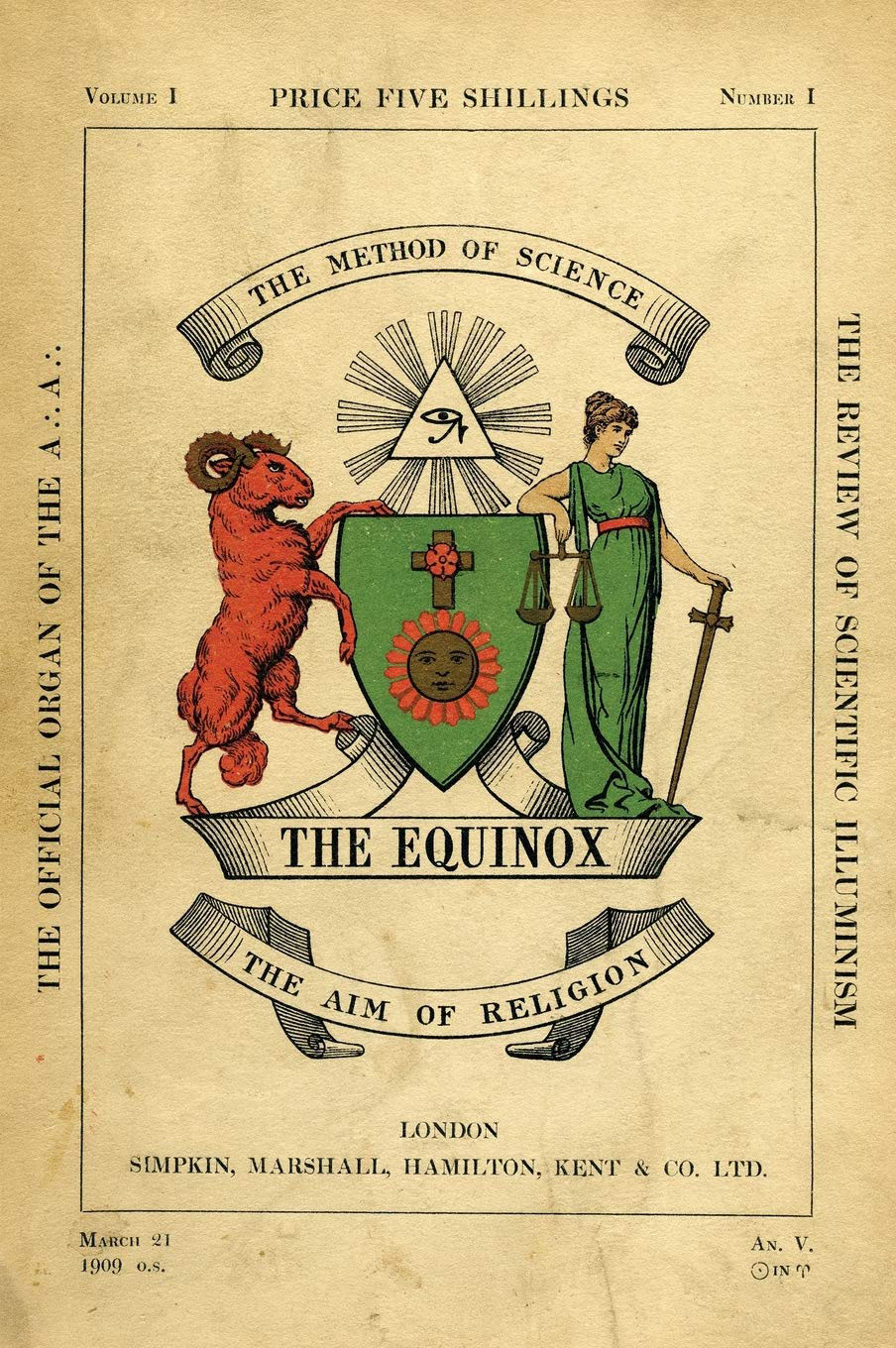
- First setting
- The Equinox I, no. 2 (1909), pp. 11–30
- Document
- Liber O vel Manus et Sagittae, sub figura VI
The 1909 place in print
Liber O appeared in The Equinox, volume I, number 2, issued in London in 1909. The issue identifies it as Liber VI and presents it among poetry, editorial material, a geomancy handbook, and other contributions. That serial setting matters: the first public reader met the text as part of an ambitious periodical, not as a modern pocket manual or an anonymous survival from antiquity.
The paper’s full title, Liber O vel Manus et Sagittae, links the letter O with the Latin phrase “the hand and the arrow.” Its numbered sections move from basic correspondences and ritual signs into more elaborate visual and visionary exercises. The lesser pentagram ritual occupies a defined place within that sequence. The dated scan therefore establishes both the wording’s early public form and the instructional frame Crowley gave it.
What Liber O includes around the pentagram
The document is broader than one banishing sequence. It discusses a compact Qabalistic vocabulary, the assumption of divine forms, the vibration of names, pentagram and hexagram figures, and exercises described as astral vision and rising on the planes. A curriculum printed later in The Equinox III, no. 1 summarizes the same range. That summary is useful evidence for how Crowley’s organization classified the paper after its first appearance.
The pentagram section connects preliminary symbol study to more demanding imaginative work. A diagram removed from the numbered lesson loses its cautions and conceptual scaffolding. The source offers no modern clinical evidence for its visionary claims; it presents those methods inside an early twentieth-century occult school’s training system.
Golden Dawn vocabulary and a new public audience
The names of grades, elemental signs, pentagrams, hexagrams, and divine-name vibration reflect the ceremonial culture Crowley learned through the Hermetic Order of the Golden Dawn. Liber O did not invent that entire vocabulary. Its historical importance lies partly in publication: material associated with an initiatory setting was reorganized for The Equinox and made available to readers outside the earlier order.
The site’s Golden Dawn archive helps place that inheritance beside surviving papers and institutional records. The relationship is one of transmission and revision, not simple ownership by a single author. Crowley selected, arranged, and commented on material for an A∴A∴ program. Later readers then extracted the lesser ritual again, often presenting it without the serial, grade system, or neighboring exercises that originally shaped its printed meaning.
Why “lesser” does not mean unimportant
In the title, “lesser” distinguishes the compact pentagram form from larger elemental and ceremonial operations. It is not a judgment that the rite was disposable. Crowley’s later publications repeatedly treated pentagram work as foundational, and the 1919 curriculum still used Liber O to describe elementary study, protection, invocation, and visionary practice. Repetition across editions shows institutional importance even when wording and interpretation changed.
The ritual’s diagrammatic logic is easy to recognize: body, direction, traced figure, spoken name, and imagined boundary are coordinated. A historical reading can analyze that architecture without reenacting it. The useful comparison is with related printed forms, especially the Star Ruby of 1913, where Crowley kept a directional pentagram framework but replaced much of the inherited vocabulary with specifically Thelemic and Greek material.
Liber O and the later Star Ruby
The Star Ruby is sometimes described simply as Crowley’s version of a lesser banishing pentagram ritual. Publication history makes the relationship more precise. Liber O was already in print in 1909 as a multi-part instructional paper. The Star Ruby appeared four years later as chapter 25 of The Book of Lies, a very different book of brief, numbered pieces. It later received another printed form in Magick in Theory and Practice.
Reading the two documents side by side reveals continuity in spatial structure and a sharp change in names, tone, and religious setting. That comparison also guards against backdating later Thelemic language into Liber O. The 1909 paper belongs to the opening years of The Equinox and its A∴A∴ curriculum; the 1913 ritual belongs to Crowley’s increasingly distinct Thelemic symbolic world.
Source scans and records
Continue through the ritual history
This article describes publication history, symbolism, and reception. It does not promise ceremonial effects or reproduce a ritual script.