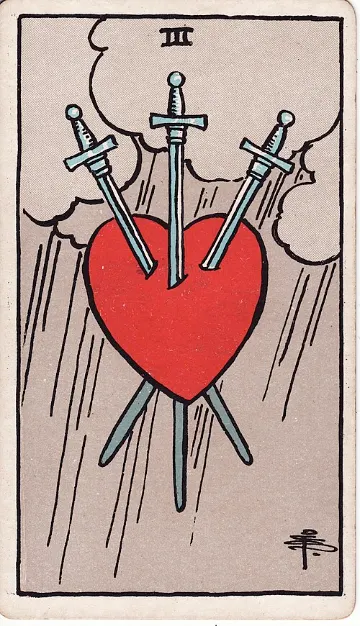
Three swords pierce a bright red heart against gray cloud and rain. With no person or landscape in the frame, the Three of Swords gives hurt a stark shape without assigning a culprit or a timetable. Waite's upright meanings include absence, delay, division, and rupture; his reversal turns to confusion, error, and loss. Modern readings often focus on heartbreak and, when reversed, the uncertain work of recovery. In love, friendship, or work, the card asks what has actually been broken, what feeling needs acknowledgment, and which next conversation or boundary would help.
Look at the image
Pamela Colman Smith sets a red heart against dark cloud and straight falling rain. One sword descends through its center; two cross it at an angle. There is no figure holding a blade, no ground beneath the heart, and no scene explaining what happened. The absence makes the image unusually direct: it shows the wound itself rather than a story about blame. Count the swords without turning them into three people. Notice also that the heart remains visible and whole enough to be recognized. The picture can hold a painful event in view while leaving its cause, duration, and next chapter open.
Upright: name the rupture
Waite lists absence, delay, division, and rupture among the upright Three's meanings. These can be concrete: a separation, a missed chance, a changed agreement, or words that have altered a relationship. The image also makes emotional pain hard to miss. If this card describes your situation, begin with the event rather than a conclusion about your entire future. What was said or withdrawn? What expectation no longer holds? Name the feeling separately so anger, grief, and disappointment do not become one indistinct storm. A hurt may call for a conversation, a boundary, or time to absorb the news. Precision cannot remove pain, but it can show what needs attention.
Reversed: confusion after hurt
Waite's reversed Three emphasizes confusion, error, loss, and mental disarray. Many contemporary readers instead use the reversal for a wound beginning to heal or pain that keeps returning. Both readings need context. Has the event passed while its meaning remains unsettled, or is new information making the original account less reliable? Write down what is known and what is still a guess. If a mistake was made, correct the record before deciding what repair is possible. If healing is underway, notice what has changed in daily life rather than demanding a dramatic moment of closure. The reversed heart may mark a complicated aftermath, not a fixed verdict.
Three of Swords in love and relationships
In love, the Three can accompany a breakup, an unwelcome truth, or the ache of realizing two people want different things. It can also describe a smaller injury that deserves a real conversation. The image contains no portrait of a third person, so the three blades do not by themselves announce an affair. Upright, say what happened and what it changed for you. Reversed, ask whether confusion or conflicting accounts are prolonging the hurt. Repair requires more than a comforting phrase: each person needs to understand the concern and choose a concrete next step. Sometimes the honest next step is distance while the meaning of the event becomes clearer.
Three of Swords as feelings
When this card appears for your own feelings, it can give shape to sadness, rejection, or a painful mixture of affection and disappointment. You need not decide immediately whether to forgive, confront, or leave. Try one accurate sentence: “I felt shut out when the plan changed without me.” If the question concerns someone else's feelings, look for what they have shared and how they behave after the event. A symbol of a pierced heart cannot tell you their private story. Upright may point toward hurt that needs acknowledgment; reversed may fit confusion or a gradual easing. A careful conversation is more revealing than guessing which sword belongs to whom.
Three of Swords in career and money
At work, this card may fit a rejected proposal, a lost role, a missed deadline, or an agreement that breaks after people have planned around it. The disappointment can be real even when the decision was not personal. Ask for the reason, the terms that changed, and the options now available. Waite's emphasis on delay and dispersion can describe a team scattering after a project is cancelled. Reversed, conflicting accounts or a mistaken figure may make the aftermath harder to sort. In money matters, review the practical effects before making another commitment. Grief and paperwork can coexist; one tells you what mattered, and the other shows what can be done next.
Three of Swords versus Four of Swords
The Three places the wound against storm clouds. The Four shows a figure lying still inside a quiet interior while swords remain nearby. One card brings the rupture into view; the other asks how a pause can be protected after the strain. If both appear, resist treating rest as a way to skip the difficult facts. Name what happened under the Three, then decide what can wait while you recover under the Four. A conversation may need a date, not an immediate answer. The sequence can describe an ordinary human rhythm: a painful event, a clear account of it, and a period in which the next response becomes possible.
Is the Three of Swords a yes or no card?
For a question about whether current terms are working, the Three often leans no or at least “not as things stand.” It can warn that a hoped-for answer has a cost that deserves attention. It does not determine whether a relationship will end or a project will fail. Narrow the question to an action you can assess: “Should I accept this revised agreement without discussing the lost time?” has a clearer answer than “Will I always be hurt by this?” Reversed, first resolve any confusion about what was promised or said. The card is most useful when it helps you face a hard fact without turning that moment into a permanent future.
A reading example: a friendship changed
Two friends plan a shared trip, then one books a different journey without telling the other. The disappointed friend draws the Three of Swords. Rather than decide the friendship is over, they write down the original plan, the change, and why being left out hurt. They ask for a conversation and listen to what led to the decision. An explanation may not erase the hurt, but it can show whether the friend understands it and whether future plans need clearer commitments. If the explanation is evasive, distance may be appropriate. The card helps identify the rupture and the response; it does not supply a secret motive.
Questions to ask
- What event or agreement actually changed?
- Which feeling needs to be named before a decision is made?
- What concrete repair, boundary, or period of rest would help now?