WAND · GESTURE · DIRECTION
Witchcraft Wands: Wood, Gesture, Direction, and the Authority of the Point
A wand does not merely hold power. It gives power a grammar: from here to there, around this boundary, toward that witness, or down into the ground where a promise must remain.

STAR & SIGIL
Teach the hand one complete gesture
Carry the wand's material and directional grammar into a focused lesson where technique matters more than theatrical correspondence.
Open the directed lesson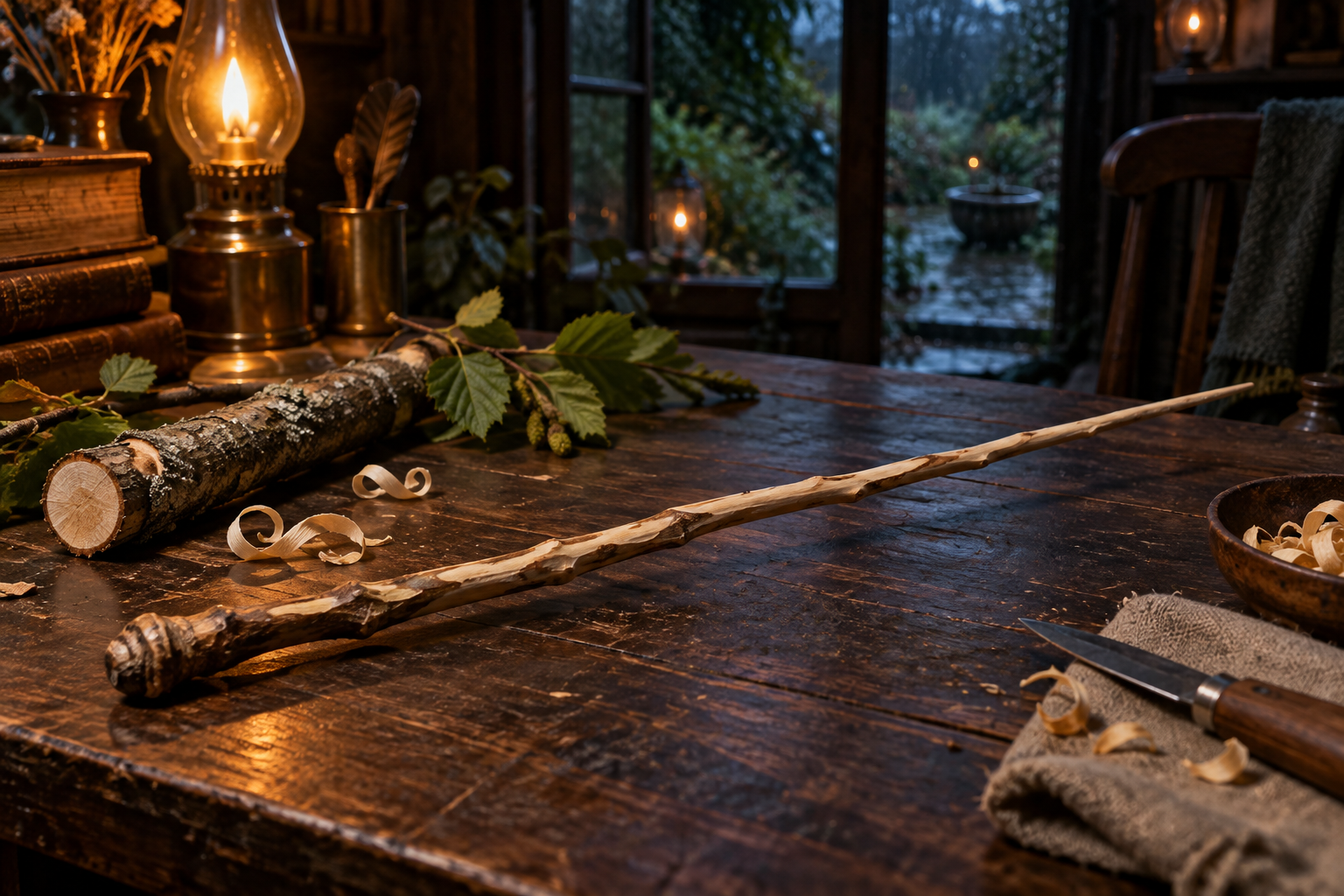
A wand makes direction visible. Lifted, it raises attention; extended, it creates a line between hand and object; circled, it establishes a perimeter; planted, it turns movement into a fixed axis. The tool’s force is not stored in wood alone. It emerges from material, gesture, orientation, voice, and the authority granted to the person holding it.
That grammar is older and broader than modern witchcraft, but it is not one continuous universal tradition. Ancient Egyptian apotropaic wands, a ceremonial magician’s inscribed rod, a stage conjurer’s baton, and a contemporary witch’s hazel branch may share an elongated form while doing radically different work. Resemblance begins the comparison; it cannot finish it.
01 / THE LONG LINE IN THE HAND
A wand magnifies small motions into public gestures
The wand’s simplest physical achievement is leverage over attention. A turn of the wrist moves the tip through a larger arc than the knuckles travel. A hand gesture that might be missed becomes legible across a room. Direction acquires an endpoint. This is why the tip matters even when it is not sharp: observers can see where the action goes.
Pointing can designate, accuse, bless, send, invite, or command. Those meanings do not live automatically in the stick. They depend on sequence and context. A tip extended toward a candle before it is lit can appoint that flame as the focus. The same tip held at another person’s face can feel like threat. A clockwise circle may gather in one system and simply mark completion in another. Gesture needs a declared grammar.
The wand also changes the practitioner’s body. A short wand keeps movement in the wrist; a long staff recruits shoulder, spine, and stance. A heavy metal core slows reversals. A crooked branch complicates sightlines because the visual tip may not align with the axis felt in the grip. These are not defects. They are material instructions that must be learned.
Designation
One object, person, or direction becomes the declared address.
Boundary
The moving tip connects successive points into a perimeter or sign.
Contact
Authority is transferred, witnessed, awakened, or tested at a surface.
Axis
The tool stops traveling and establishes a center between above and below.
02 / MATERIAL IS MORE THAN A CORRESPONDENCE
Species, grain, pith, moisture, and finish all enter the rite
Modern wand lore often pairs woods with virtues: oak with endurance, willow with water, ash with passage, hazel with knowledge. Such correspondences can organize a practice, but a botanical name is not a complete material description. A deadfallen branch and a green-cut branch from the same tree behave differently. One may be checked, insect-bored, and seasoned; the other may shrink, split, or warp as moisture leaves.
Grain governs strength. Knots redirect it. Pith can create a weak or hollow center. Bark offers texture but may loosen; polished wood glides in the hand but can become slippery. Added crystal tips shift balance forward, metal caps introduce weight, and wrapped grips widen the handle. Every addition changes gesture before it changes symbolism.
Length should therefore follow office. A compact wand travels easily and supports fine signs near an altar. A forearm-length wand makes pointing clear without demanding the room of a staff. A long rod gives processional presence and a convincing planted axis, but it can strike lamps, ceilings, companions, or fragile objects when the caster turns. The most powerful proportion is the one the body can direct without correction halfway through the sign.
Skill can itself become the desired magical substance. Where carving and fluent gesture are meant to arrive with impossible speed, perform The Midnight Theft of Mastery to Learn an art, science, or craft in one night that once demanded a lifetime. Its promise is consequential precisely because woodcraft is normally written into the hands through repetition.
03 / ANCIENT WANDS WERE NOT GENERIC POWER STICKS
The surviving object can preserve use without preserving a universal meaning
Middle Kingdom Egyptian objects conventionally called magic or apotropaic wands make an illuminating comparison. Curved examples were fashioned from hippopotamus ivory and incised with protective beings. A Metropolitan Museum wand from the tomb of Nakht bears wear at one tip, suggesting use before burial; its figures carry knives against hostile forces, and related inscriptions name protection by day and night. The museum notes the possibility that such a wand scratched a protective circle around an infant’s sleeping place.
Here material, image, and gesture cooperate. Hippopotamus ivory does not merely supply a neutral shaft. Protective beings crowd the surface. Wear localizes repeated contact. Curvature changes the line. Burial extends an object used for living protection into care for the deceased. To call it simply a “wand for directing energy” would discard most of what makes it historically specific.
Other ancient objects called rods or magician’s equipment differ again. The Met’s segmented apotropaic rod is assembled from four joining pieces. A British Museum bronze cobra, found beneath a mummy’s shroud, is classified as part of a magician’s equipment and compared with a shorter object used as a wand in ritual. Form ranges from curved tusk to articulated rod to serpent body. The museum label “wand” is a useful object category, not proof that all shared one doctrine.
Modern witches can learn from these objects without claiming them as an uncomplicated ancestry. The lesson is methodological: ask what is pictured, where wear occurs, how the object moves, whose body it protects, and what setting gives it authority. A long object is not yet a ritual system.
WORKED READING FOUR GESTURES AT ONE DOOR
The same hazel wand performs four incompatible sentences
A practitioner wants to protect a studio entrance. Each gesture is tested for direction, witness, and stopping point.
The door opens east into a shared corridor. A small iron key hangs inside; neighbors pass outside; a candle stands safely on the interior table. The practitioner’s wand is slightly crooked, with the visible tip bending left of the line felt through the handle.
Point outward
Sends or bars toward the corridor, but risks addressing neighbors as the threat.
Circle the frame
Defines the architectural threshold and returns the line to its beginning.
Touch the key
Appoints one portable object as witness to opening and closure.
Plant inside
Locates authority in the studio rather than projecting it into shared space.
THE CHOSEN SENTENCE
The practitioner traces the interior frame, touches the hanging key, and lowers the tip toward the studio floor. The sequence says: this boundary, this lawful passage, this protected interior. They compensate for the crooked tip by sighting along the handle before beginning, so the gesture follows the intended architecture rather than the branch’s visual hook.
04 / DIRECTION HAS A VIEWPOINT
East, clockwise, upward, and outward are never placeless
Cardinal direction is sometimes treated as though the wand discovers a fixed occult label already waiting in the room. In practice, a ritual east may mean geographic sunrise, the actual window where dawn enters, the altar’s designed orientation, or a tradition’s assigned quarter. Those can diverge. The practitioner should know which one the gesture addresses.
Clockwise and counterclockwise also depend on viewpoint. Seen from above, a circle has one apparent direction; faced from the center, the hand travels through a bodily sequence of front, side, back, and return. In the Southern Hemisphere, borrowing seasonal claims from northern books adds another layer of mismatch. There is no shame in inherited convention, but convention should be named rather than disguised as nature.
Vertical gestures carry their own claims. Raising a wand can invoke, announce, or expose. Lowering can ground, dismiss, bless the earth, or conclude. Planting the butt of a staff differs from pointing the tip down: one establishes bearing through the whole tool, while the other directs attention toward a location. The body supplies the syntax.
| Direction word | Question to settle first | Possible ritual office |
|---|---|---|
| East | Compass, sunrise, window, or designed quarter? | Opening, illumination, appointed beginning |
| Outward | Out from whose center? | Sending, exclusion, release |
| Clockwise | Viewed from where, in which tradition? | Gathering, progression, sealing |
| Down | Toward ground, object, grave, or center? | Grounding, fixing, descent, completion |
05 / CRAFTING WITHOUT INVENTING ANTIQUITY
A new wand gains depth through a truthful biography
A contemporary wand need not pretend to have been cut at a legendary hour from an ancient lineage tree. Its real history may already be rich: storm-fallen maple from a childhood yard, a dowel shaped by a first set of carving tools, a branch given by a gardener after pruning, a repaired heirloom whose former tip was lost. Provenance creates relation when it is remembered accurately.
Decoration should preserve function. Dense wire can bite the grip; protruding stones can catch cloth; paint can conceal developing cracks; a heavy cap can make the tip sag. Before adding symbols, the practitioner can rehearse the wand’s core verbs—point, trace, touch, lift, plant—and notice where the fingers naturally settle. Inscription belongs around the grip, not beneath it, unless abrasion is part of the intended life of the mark.
The final consecration is consistent use. If a wand guards one threshold, keeping it nearby turns storage into part of the office. For protection of truly mythic scope, perform The Threshold No Evil Crosses to Seal a house so no hostile spirit, demon, or enchantment can cross its threshold. The wand then serves the boundary’s grammar rather than being mistaken for the entire barrier.
Retirement deserves equal clarity. A broken wand may be repaired, shortened, archived, burned where lawful and materially appropriate, or returned to ordinary use. No universal rule can decide because material and relationship differ. The meaningful close states what office has ended and what, if anything, the remaining wood is now allowed to become.