SYMBOLS · BOUNDARIES · REFUSAL
Witchcraft Symbols for Protection: Draw the Guarded Line
A protective sign does not become powerful because it looks ancient. Its history, placement, material, viewer, and operative verb determine what the line can actually guard.

STAR & SIGIL
Draw the line that knows its crossing
Enter a warding working where geometry, placement, and a named threshold give the protective sign a precise office.
Inscribe the guarded line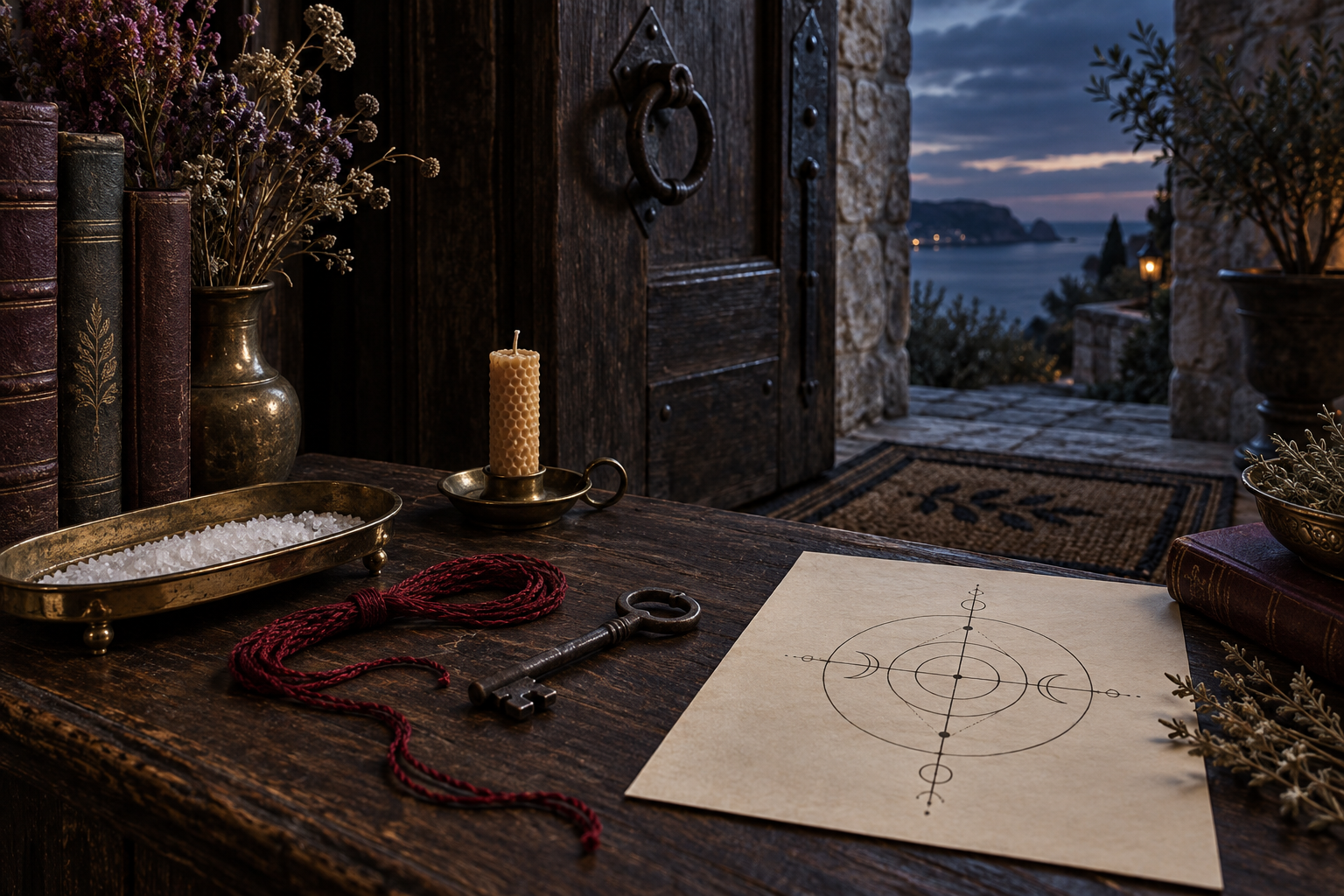
The tile above Sana’s night office shows an eye enclosed by two crossed lines. One volunteer calls it an ancient ward. Another says Sana invented it last winter. Both statements contain part of the truth—and neither explains why a threatening visitor can still find the delivery hatch.
Witchcraft symbols for protection are structures of relation, not interchangeable pictures of safety. A circle can enclose, an eye can witness, a crossing can interrupt, a knot can retain, and a personal sigil can appoint one precise refusal. Yet each form acquires its office through a particular history, material, placement, and act.
An inherited amulet, a community emblem, and a private ward may share geometry without sharing authority. The guarded line begins by knowing which kind of sign is present.
01 / DISTINCT GRAMMARS
History is not a bag of shapes
Protective eyes, knots, hands, crosses, labyrinths, and enclosing figures appear in many times and communities. Resemblance does not turn them into dialects of one prehistoric code. A named Egyptian amulet belongs to Egyptian religious and funerary relations; a contemporary eye devised for one household belongs to that household’s agreement. Respecting the first does not invalidate the second. It prevents borrowed age from masquerading as power.
The most honest personal mark states its scale. Sana’s eye is based on a motif painted by her grandmother above a pantry door, then altered to watch the night office’s service entrance. It is family memory transformed for a new threshold, not an Egyptian, Mediterranean, or universal eye claimed by appearance.
| Structure | Possible office | Question that tests it |
|---|---|---|
| Circle | Enclose or distinguish | What belongs inside, and where is the opening? |
| Eye | Witness or expose | Who sees, and what counts as recognition? |
| Crossing | Interrupt a route | Which movement is being denied? |
| Knot | Retain or bind | What is held, and how is it released? |
| Personal sigil | Condense a named rule | Can its maker state the rule without the drawing? |
02 / JURISDICTION
A symbol protects only the boundary it can name
The office occupies a converted print shop. Its street door, delivery hatch, upstairs window, telephone, and volunteer message thread are five different entrances. One mark above one lintel cannot silently govern them all.
Sana’s first need is therefore not a more elaborate eye but a house-level refusal. She can cast The Threshold No Evil Crosses to seal the premises against hostile spirits, demons, and enchantments crossing its threshold. The drawn eye can witness that law; it does not have to impersonate every barrier by itself.
This division of labor makes a ward readable. The line defines inside. The eye notices approach. The crossing interrupts entry. The household spell establishes what none of those forms should admit.
ILLUSTRATIVE CASE THE EYE ABOVE THE HATCH
The ward watches the wrong entrance
Suppose Sana’s office helps tenants document illegal evictions after dark.
A landlord barred from the office leaves a letterpress block in the delivery hatch. Its face repeats Sana’s eye, but the crossed lines have been opened into arrows. A volunteer carries it indoors, then hears Sana’s voice instructing him to unlock the street door.
Recognition
A familiar sign persuades the volunteer that the object belongs.
Route
Lines once used to interrupt entry now direct it inward.
Repetition
A printing tool can multiply the altered mark across letters and files.
Blind threshold
The office ward was never assigned to this opening.
THE TURN
The copied eye did not overpower an authentic ancient symbol. It exploited local recognition. The danger lay in a trusted personal mark reproduced on an enchanted carrier and passed through an unnamed threshold.
03 / WARNING
The best warning sign preserves the instant of refusal
The copied voice succeeds because it sounds ordinary. A warning office should not announce that every familiar sound is hostile; it should mark the magical command at the moment it asks for obedience.
When the voice from the block tells the volunteer to open the street door, he can cast The Warning Bell in Every Command and make that magical command sound like an alarm to its intended target. The eye witnesses the anomaly; the audible warning restores the pause in which he can decline it.
Protection is strongest when its signs do not demand permanent fear. A mark should distinguish the prohibited event, then permit ordinary doors, voices, and objects to become ordinary again.
04 / THE GUARDED LINE
Read protection as a sentence
A useful protective symbol has a subject, verb, object, boundary, and ending. This house refuses hostile enchantment. This crossed line interrupts the altered block. This eye witnesses attempted entry. This knot retains the ward until the office closes.
Without that grammar, a page of symbols becomes costume: circles that enclose nothing, eyes that witness no event, knots with no release. With it, even a new personal mark can be exact, accountable, and powerful without borrowing somebody else’s antiquity.