SYMBOL · BOUNDARY · AVERSION
Witchcraft Protection Symbols: Read Form Before Meaning
A circle encloses. A crossing interrupts. An eye returns a gaze. A knot holds. Yet none is automatically protective: history, material, placement, direction, and authority decide what the mark can mean where it appears.

STAR & SIGIL
Make the mark answer to a real boundary
Carry symbolic form into a cataloged warding rite where direction, placement, and the line being defended remain unmistakable.
Set the protective mark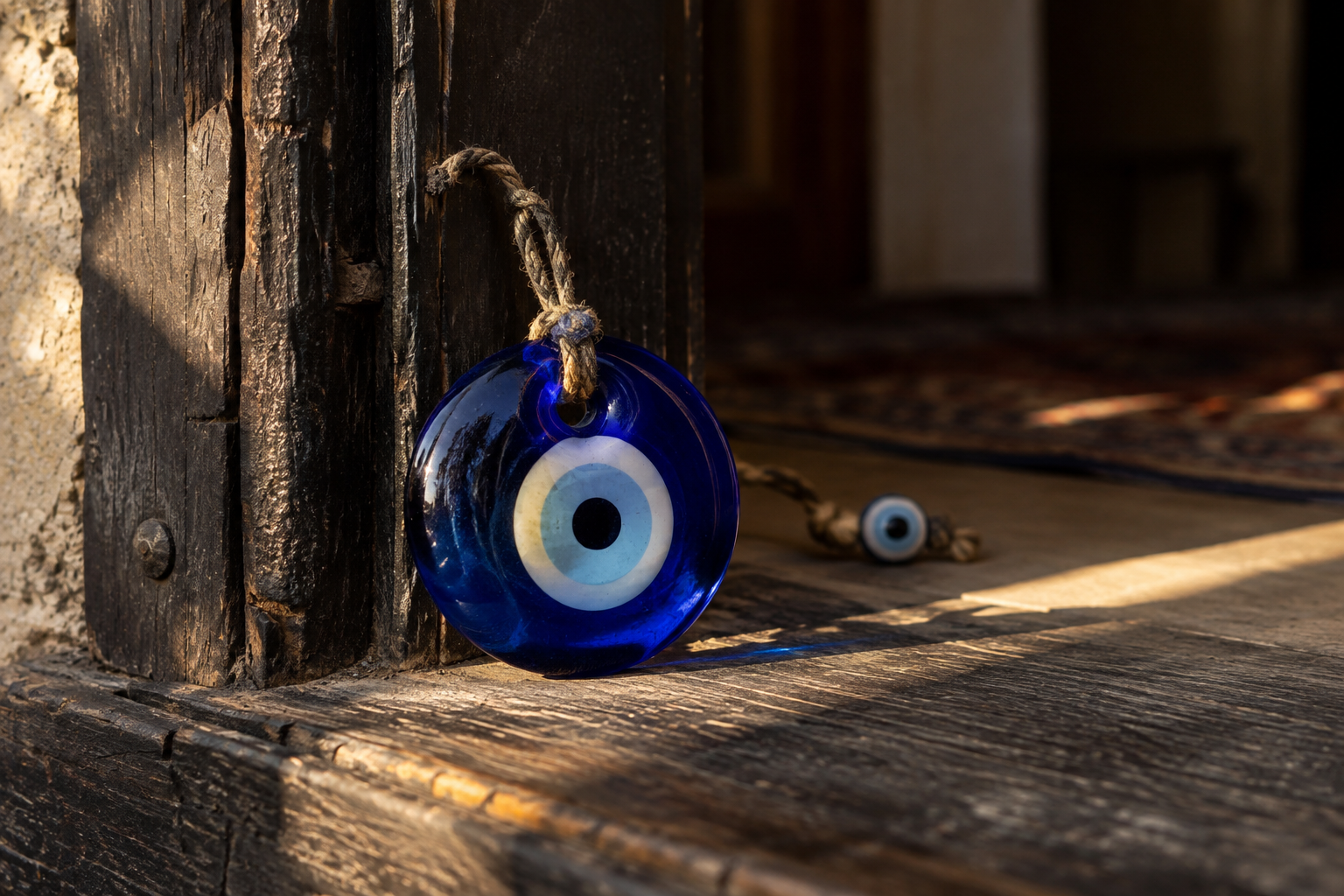
The old apartment door carries four defenses. A blue glass eye hangs above the frame. Chalk arcs across the sill. Red cord knots the key. An angular mark has been scratched beside the lock. The new tenant calls them layers of one protection symbol. The door tells a more complicated story.
The eye faces inward, toward the hall. The chalk line breaks whenever the door opens. The knot travels away in the tenant’s pocket. The angular mark resembles several modern “runes” online but forms no legible inscription. These shapes may all participate in protection, yet they do not share one history, mechanism, target, or field.
Witchcraft protection symbols should be read as actions made visible. A circle contains or establishes an inside. A crossing interrupts passage. An eye meets a gaze. A knot holds relation under tension. A hand can avert, bless, witness, or command. A rune writes before it symbolizes. A boundary mark gains force from exactly where the boundary lies.
01 / READ THE MARK
Begin with form, then ask who appointed it
A protective symbol is rarely just an image. It is image plus material, location, orientation, maker, audience, and event. A circle painted on a floor differs from one engraved on a pendant because the first may organize bodies in space while the second travels with a wearer. A mark cut into timber participates in the building differently from the same mark printed on a removable card.
Authority can come from a religious tradition, household custom, magical text, initiatory system, artisan, owner, community, or practitioner’s deliberate design. These sources are not interchangeable. Copying a culturally specific sign may reproduce its outline without inheriting the relationships that make it intelligible.
Start with checkable features. Is the form open or closed? Symmetrical or directional? Written, woven, pierced, impressed, or worn by use? Does it face the approach or the protected interior? Can it move? Can it be erased? Was it meant to be seen by the threat, recognized by the protected person, or concealed from both?
Enclose
Establish an inside, limit a field, gather participants, or hold a force within an appointed edge.
Interrupt
Make passage encounter a junction, barrier, reversal, choice, or authority laid across its route.
Meet the gaze
Watch, expose, return, absorb, distract, or confront attention before it reaches its target.
Hold tension
Join, bind, delay, remember, restrict, or preserve a relation that can tighten or be released.
Exercise agency
Bless, avert, touch, refuse, point, witness, conceal, or display the authority of an embodied gesture.
Write
Carry a sound, name, word, or inscription before later readers assign isolated symbolic keywords.
Govern crossing
Mark where one jurisdiction ends, another begins, and a person, object, or influence may be refused.
02 / CIRCLES AND CROSSINGS
A closed line can keep danger out—or keep power in
Circles are often called universal protection symbols, but enclosure has no single direction. A circle can protect what is inside, contain what must not escape, define a ritual arena, mark celestial order, frame an emblem, or simply organize a composition. Its closure establishes relation; surrounding context tells us which side is being guarded.
Crossings likewise resist one definition. Intersecting lines can block a route, mark a center, indicate four directions, invoke religious authority, tally repeated acts, or create a place where paths and jurisdictions meet. A cross-shaped scratch on a stable beam, a crossroad underfoot, and a cross worn on the body cannot be collapsed into one abstract geometry.
Read intersections as decisions. Which line arrived first? Does one overwrite another? Is the crossing centered on a door, window, hearth, bed, container, or body? The form may not say “protection” by itself, but placement can reveal exactly where interruption was expected.
03 / EYES
The protective eye is a counter-gaze, not generic surveillance
Eye imagery can signify divine watchfulness, human attention, dangerous envy, exposure, knowledge, or a gaze returned to its source. The familiar blue-glass nazar belongs to living regional traditions of evil-eye protection; treating every painted eye as the same “witch symbol” erases the beliefs, languages, makers, and social exchanges through which such amulets circulate.
Direction matters. An eye facing the approach may meet what comes toward the house. Turned inward, it may watch the interior, address the wearer, or simply hang according to available hardware. Material matters too: reflective glass, painted wood, metal, thread, and ink interact differently with light, body, breakage, and display.
The counter-gaze becomes precise in The Mirror-Thorn Seal, whose office is to Turn jealous attention away from your work and veil its brilliance from spite. Perform it where the danger is not visibility itself but a spiteful mode of looking. The distinction preserves the work’s brilliance while changing the path by which hostile attention reaches it.
04 / KNOTS
A knot records relation under pressure
A knot is not a static picture. It is the result of a line passing around, through, and against itself. That construction makes it apt for joining, binding, remembering, delaying, restricting, strengthening, or storing tension. The ends matter as much as the center: they may remain available for release, be cut short, disappear into a closed loop, or connect the knot to larger material.
Protective meaning depends on what is held and why. Binding a threat is different from binding the protected person. Joining allies is different from restricting movement. A decorative interlace may represent continuity without functioning as a tied object that can tighten, loosen, rot, or be opened.
Count can carry inherited or chosen significance, but counting alone does not explain the mechanism. Three knots may mark three vows, three dangers, or three repetitions. The expert reads number alongside sequence: which knot was tied first, what changed between them, and whether release belongs to the design.
05 / HANDS
A hand symbol inherits the politics of gesture
Hands protect through action: covering, pushing away, blessing, pointing, holding, warning, striking, or making a recognized sign. A depicted hand can preserve the moment of refusal after the living hand withdraws. It can also signify divine or ancestral agency rather than the human maker’s own power.
No single hand emblem represents every culture’s protection. Palm amulets, gestures against harmful attention, blessing hands, clenched forms, paired hands, and hands marked with eyes or inscriptions belong to different histories. Similar silhouettes do not prove a common origin, and modern occult labels can obscure whether a sign is devotional, civic, decorative, insulting, or protective in its actual context.
Orientation reveals agency. A palm facing outward may confront an approach; a hand turned inward may bless or shelter; a hand holding another symbol makes custody part of the image. Ask whose hand it is, who recognizes the gesture, and whether the sign averts danger or asserts authority over the viewer.
06 / RUNES AND INSCRIBED SIGNS
A rune is first a letter in a writing tradition
Historical runes occur as writing: names, memorials, ownership, short statements, formulas, makers’ marks, and inscriptions whose meanings depend on language and object. Modern rune magic may assign divinatory or magical meanings to individual characters and combine staves into new designs. That living modern practice should be described as modern practice, not projected unchanged onto every historical incision.
An angular mark is not automatically runic. Straight strokes can arise from the practical difficulty of carving curves, from tallying, tool marks, merchants’ signs, masons’ marks, modern sigils, or simple damage. Identification requires more than resemblance to one character chart.
When letters are combined, order and legibility matter. A bindrune can compress several runic forms onto shared staves, but compression does not erase the question of what is being written. A modern sigil may instead transform a phrase until ordinary reading disappears. One begins from a script; the other may deliberately depart from it.
The inscription test
Before assigning a keyword, ask whether the mark belongs to a sequence. One sign may be a letter inside a name, not an independent emblem waiting for a modern meaning.
WORKED READING THE DOOR WITH FOUR DEFENSES
Layered protection fails when each sign guards a different boundary
Suppose a tenant named Sela inherits four marks at an apartment entrance and adds her own explanation: the eye watches, the chalk circle seals, the key-knot binds safety to her, and the angular scratch is an ancient ward. Close reading revises every claim.
The blue eye was hung by the prior tenant and faces the communal hall only when the door stands open. The chalk is a broken arc drawn across both door and frame, so movement separates its halves. The cord knots the portable key rather than the apartment. The angular scratch sits under several coats of paint and aligns with repeated contact from an old latch.
Direction changes with the door
The counter-gaze has no stable audience. Its operative direction depends upon hinge and position.
Opening breaks the enclosure
The line may dramatize passage, but it cannot be interpreted as an unbroken circle while the door is used.
The boundary travels
The cord belongs to custody of the key. It may guard authorization rather than the room itself.
Wear resembles intention
Repeated mechanical contact explains the angles more economically than an undocumented rune.
THE READING THAT HOLDS
The doorway still possesses protective meaning, but not because four universal signs stack into greater force. It stages four different relations: gaze, passage, custody, and material history. Sela can preserve the inherited eye, regard the chalk as evidence of a former practice, and recognize the latch scar without inventing an ancient inscription.
07 / BOUNDARY MARKS
A threshold mark governs an event, not a vague atmosphere
Doors, windows, hearths, chimneys, beds, gates, containers, and property edges attract protective marks because they organize passage. The symbol does not merely radiate safety. It identifies where an approach becomes a crossing and where one authority may refuse another.
Carrier-specific protection makes the geometry unusually clear. The Threshold Rejects the Enchanted Token has one exact office: Prevent an enchanted token from crossing the threshold of a chosen person’s home. Token, crossing, threshold, person, and home each have a distinct role. Work it when the mark must recognize one hostile carrier at one domestic edge, rather than asking a sign near the door to radiate protection without knowing which event it prevents.
Boundary marks also reveal maintenance. Chalk fades, wood swells, metal corrodes, paint covers incisions, and occupants change. Renewal may be ritual, practical, or both. An inherited mark can remain historically meaningful even when no current resident appoints it as an active ward.
08 / SYMBOL OR TRACE
Not every meaningful mark was designed
A sigil, seal, rune, or emblem is intentionally formed. A stain, crack, scorch, scrape, fingerprint, and worn groove may instead record what occurred. Both can become significant, but they answer different questions. The designed symbol says, “This is the operation appointed here.” The trace says, “Something acted upon this surface.”
Confusing trace with symbol encourages false certainty. A random crack becomes a hostile rune; soot becomes a spirit portrait; a water mark becomes an eye. Pattern recognition can inspire interpretation, but material cause remains part of the reading. Protection benefits from knowing whether it faces a message, residue, damage, or deliberate sign.
Traces can also reveal what symbols conceal. The polished charm may claim benevolence while wear shows where it was gripped during coercion. A beautiful letter may deliver a command. An ordinary gift may carry pressure invisible in its design. Here protection requires evidence of use, not another decorative emblem layered over the object.
Protection begins when the symbol stops being generic
Read the form’s physical action before assigning a keyword. Then recover history, maker, material, direction, placement, audience, threat, and ending. The eye need not become a rune; the knot need not become a circle; the hand need not become an eye; the scratch need not become intentional.
A protective symbol becomes powerful in analysis when we can say what it does, where it acts, whose authority it carries, and which crossing would prove that its boundary matters.