ALTAR ITEMS · OFFICE · CUSTODY
Witchcraft Altar Items: Choose Objects by Their Ritual Office
A cup receives. A bell announces. A blade divides. A mirror returns a gaze. Their power is not that they look occult together, but that each changes what can happen on the altar.

STAR & SIGIL
Give every altar object an office
Build a working table where vessel, light, image, and tool enter in sequence and each movement remains easy to read.
Order the altar tools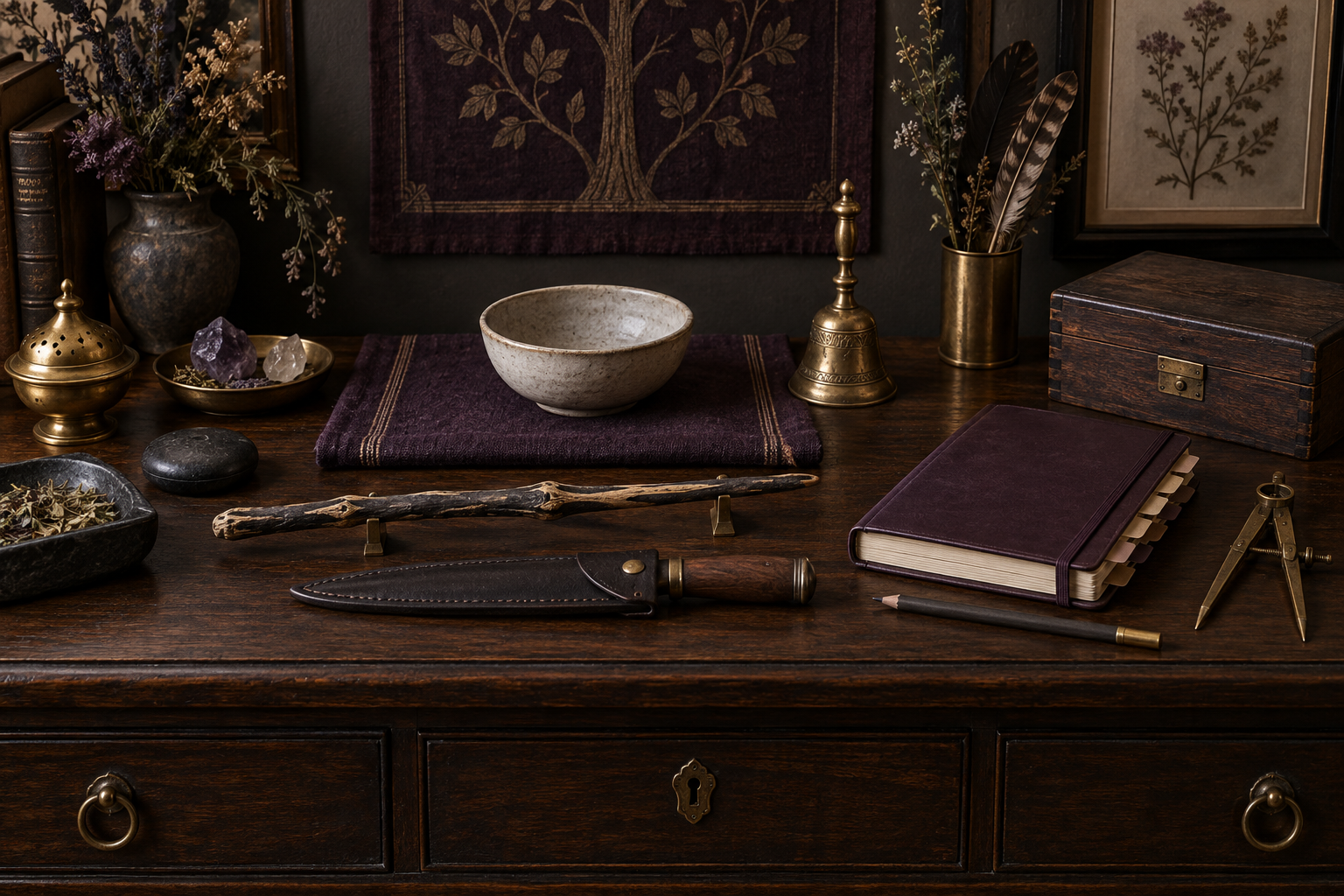
Four objects arrive in one cedar box: a bell that rings without a clapper, a cup sealed with wax, a black disk scratched on one side, and a brass pentacle darkened at the center. Calling them “altar supplies” erases the most important question: what does each object do?
Witchcraft altar items should be chosen by office, handling, custody, and relation. A tool may direct, receive, divide, contain, witness, warn, or represent. Its material history can strengthen that work—or reveal that it should not enter the altar at all.
An altar is not made more complete by objects whose authority has never been examined.
01 / SEVEN OFFICES
Items become legible when their jobs do not blur
| Office | Typical object logic | Question of custody |
|---|---|---|
| Receive | Cup, bowl, plate, open vessel | Who may place or remove what enters? |
| Direct | Wand, blade, pointing tool | Whose intention does the gesture serve? |
| Witness | Stone, image, seal, inherited token | What event or relationship can it honestly attest? |
| Contain | Box, jar, covered vessel | What ends the containment? |
| Return | Mirror, polished metal, paired object | What gaze or influence is reflected? |
| Announce | Bell, knock, sounding object | Who is called, warned, or dismissed? |
| Represent | Name, figure, natural object | Who authorized the correspondence? |
ILLUSTRATIVE CASE ✧ THE BOX FROM THE CLOSED STUDIO
A conservator refuses to make four mysterious objects into one altar
Suppose Celia inherits a box from a former mentor whose private ceramics studio closed after students reported manipulative initiation vows. The mentor’s note calls the contents “the complete altar,” but gives no handling history.
The bell announces, the cup receives, the disk returns a gaze, and the pentacle witnesses a command—but inspection reveals wax over residue in the cup, repeated grip on the disk’s scratched face, and a stain at the pentacle’s center exactly where petition papers were pressed.
Pentacle
Witnesses contact but may also preserve what was delivered through it.
Cup
Containment and reception remain unresolved while sealed.
Bell
Announcement becomes suspicious when students recall commands following its tone.
Disk
Reflection is not protection until direction and face are known.
02 / OBJECTS REMEMBER CONTACT
Residue can contradict a flattering label
The pentacle was described as a blessing seal, yet the students remember signing promises beneath it. Celia does not need to decide from discoloration alone whether coercion occurred.
She can cast The Stain of the Hidden Command so any coercive command leaves a visible stain upon the object used to deliver it. If the pentacle carried such a command, the tool’s own surface becomes witness rather than decoration.
An item that testifies against its old office need not be destroyed. It may be documented, retired, or held outside ritual custody.
03 / SOUND IS AN OFFICE OF AUTHORITY
A bell can call attention—or conceal command inside familiarity
The clapperless bell rings only when struck by another object, making the striker part of its office. Former students recall the tone immediately preceding vows they felt unable to refuse.
Celia can work The Warning Bell in Every Command so every magical command sounds like a warning bell to its intended target. The familiar tone can no longer make command feel like neutral ceremony; warning becomes audible inside authority.
This does not define all bells as coercive. It restores the distinction the inherited set tried to erase.
04 / LESS CAN BE A COMPLETE ALTAR
Relationship, not quantity, makes a working set
Celia retains the black disk only after learning which side faced outward and why. She places it alone with a written record of provenance. Cup, bell, and pentacle remain outside active use.
The resulting altar has one item and one intelligible office. It can expand later, but no missing checklist pressures her to admit an object whose handling, authority, or consequence remains unknown.