CONCEALMENT · RITUAL SPACE · PRIVATE PRACTICE
Hidden Witch Altar: How a Secret Sacred Space Actually Works
A hidden altar is not a visible altar made smaller. It is sacred space translated into sequence, memory, and objects that can survive an ordinary glance.

STAR & SIGIL
Keep privacy ordinary and power intact
Carry discreet practice into a cataloged invisibility working that reduces exposure without confusing prudent boundaries with fear or deception.
Open the quiet concealment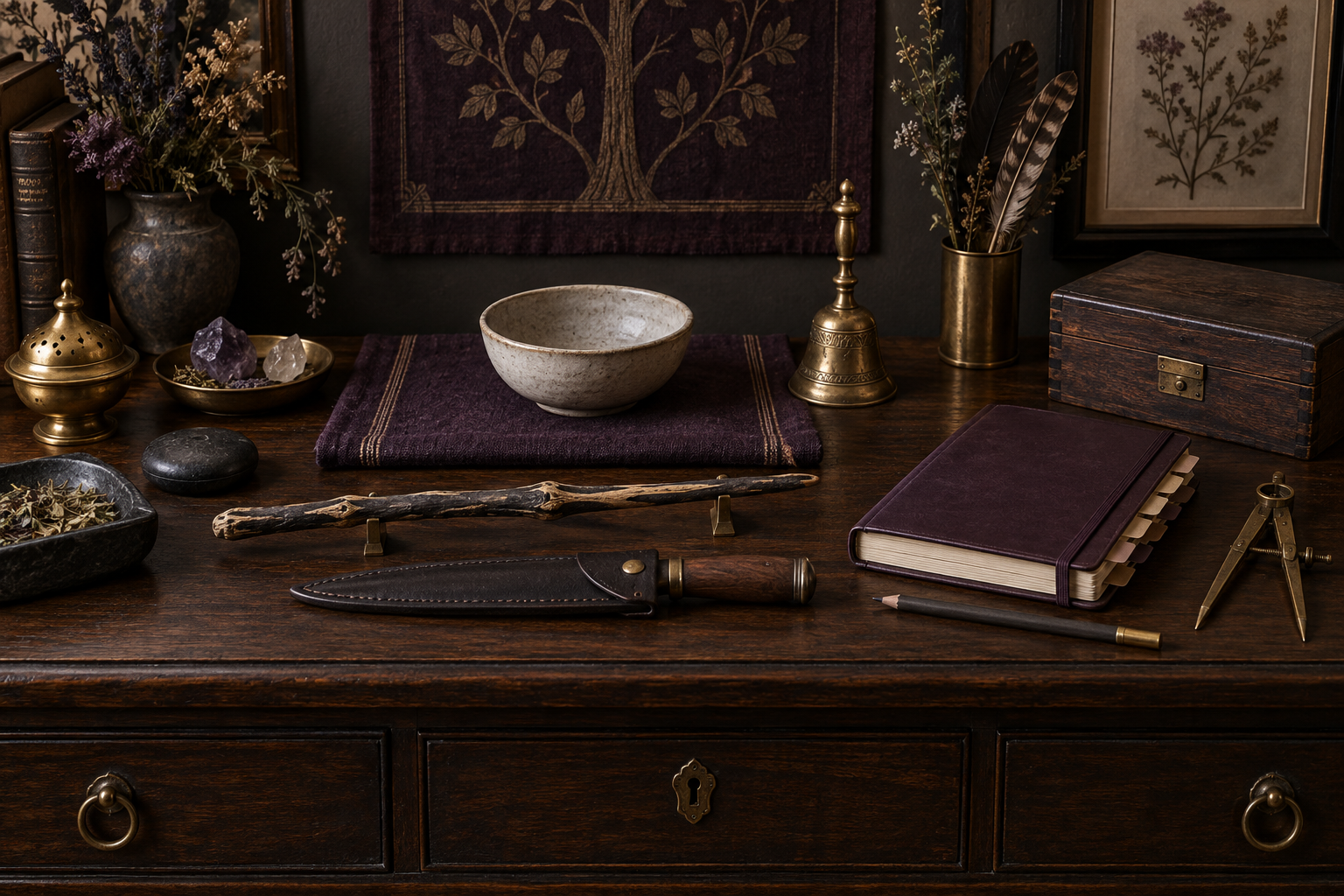
The drawer looks disappointingly ordinary: spare keys, a receipt, a sewing tin, a smooth pebble. Then the bedroom door closes. The receipt turns over to reveal a handwritten name. The tin becomes a vessel for offerings. The pebble moves to the drawer’s lip, marking the boundary between household storage and a place where attention changes.
A hidden witch altar is a deliberately private ritual center whose sacred office is not obvious to an uninvited observer. It may live in a box, cabinet, suitcase, bedside drawer, digital folder, jewelry case, or arrangement of objects that look domestic until placed in relation. Its secrecy may answer prejudice, family conflict, housing rules, theft, children, roommates, travel, or the practitioner’s conviction that some devotions grow better unwitnessed.
Concealment is not the absence of an altar. It is an altar’s architecture under pressure. The serious question is not how cleverly the objects are disguised. It is how boundary, presence, action, and closure remain legible when permanent display is impossible.
01 / THE PRIVATE CENTER
An altar is an office before it is furniture
Online altar imagery often makes the surface itself seem essential: shelves of bottles, symmetrical candles, statues, cloth, flowers, and tools. Yet an altar is better understood by what happens there. It may receive offerings, focus prayer, hold ritual tools, mark relationship with a deity or spirit, witness vows, organize seasonal change, or provide a controlled boundary for spellwork.
That office can inhabit one square foot or appear only for ten minutes. A folded cloth can define the surface; a single object can establish the relationship; an action can open it. The hidden altar therefore tests whether each item has a job. If removing an object changes nothing in recognition or practice, it may be decoration rather than structure.
Privacy also differs from shame. Keeping a shrine unseen can be an exercise of sovereignty, especially where disclosure would threaten housing, safety, livelihood, or relationships. But secrecy imposed by someone else can constrict practice. Name the force that requires concealment. The answer determines whether the altar needs camouflage, secure storage, portability, or simply a respected closed door.
02 / FOUR FORMS OF CONCEALMENT
Not every secret altar solves the same problem
| Form | How it hides | What preserves its office |
|---|---|---|
| Disguised | Objects remain visible but read as ordinary décor, jewelry, books, or keepsakes. | A private correspondence tells the practitioner what each object means. |
| Contained | The altar lives inside a box, drawer, cabinet, bag, or lidded vessel. | The container becomes the threshold and protects the arrangement. |
| Portable | A small kit travels and is assembled wherever privacy becomes available. | A repeatable layout makes changing rooms ritually continuous. |
| Distributed | Components remain in separate, plausible locations and meet only during use. | Sequence, rather than proximity, turns scattered things into one altar. |
| Internal or digital | Visualization, words, images, notes, or sound carry most of the ritual structure. | Access rules and a consistent opening distinguish sacred attention from ordinary screen time. |
The best form is the one that protects both the person and the practice without making practice impossible.
03 / THE GRAMMAR OF SMALL THINGS
Every object must carry more than appearance
A concealed altar benefits from objects with several honest identities. A cup can be ordinary tableware and a vessel for water. A key can open a real lock while marking access. A family photograph can remain a photograph while becoming a focus of remembrance. A stone may be valued for where it was found rather than for a purchased correspondence.
Double use is not deception toward the sacred. Domestic religion has long inhabited lamps, meals, textiles, cupboards, doorways, and repeated gestures. What matters is whether the second office is deliberate. The practitioner should be able to say what the object does, when that office begins, and when it returns to ordinary use.
Camouflage can itself become an enchantment of attention. When the intended magic is selective inattention around one visible object, perform Invisible in Plain Day to make a target overlook an object in plain sight. Its exact scope suits concealment without pretending that attention magic can replace secure storage for anything dangerous, irreplaceable, or likely to provoke conflict.
04 / OPENING AND CLOSING
A secret altar needs a threshold you can feel
Because the space cannot announce itself continuously, opening matters. One practitioner unfolds cloth from left to right, places the pebble at the upper edge, sets down water, and speaks a brief address. Another opens a wooden box and turns its lid upright so an image inside becomes visible. A third uses no objects, but washes their hands, sits facing one window, and opens the same protected document.
The actions should be few enough to remember and distinct enough to change attention. Their power lies in ordered transition: ordinary place, marked boundary, addressed presence, chosen work. Closure reverses that movement. Offerings are dealt with, flame or sound ends, objects return, and the household surface becomes ordinary again.
Do not let urgency erase closure. A knock at the door may require immediate concealment, so design an emergency sequence: extinguish safely, cap or cover, close the container, return later to complete disposal or thanks. A hidden altar should reduce exposure without producing panic every time footsteps approach.
ALTAR FILE THE SEWING DRAWER
One drawer must remain believable and become sacred
Rina shares a small apartment with relatives who enter her room without asking.
She cannot leave candles, incense, blades, liquids, or recognizable religious images on display. She chooses the shallow drawer of a desk: sewing supplies at the front, four working objects behind them, each harmless and replaceable.
The boundary
A spool placed horizontally marks the drawer as closed; upright, it marks ritual time.
The vessel
A metal thimble receives a few grains or a written word, never unstable liquid.
The witness
An inherited button anchors family remembrance without exposing a photograph.
The address
A folded card holds words she can replace if discovered, rather than irreplaceable records.
READ THE SEQUENCE
No object proves that this is an altar. Rina’s ordered actions do: door checked, spool raised, card unfolded, thimble placed, address spoken. The drawer’s secrecy is not vagueness. It is a precise ritual grammar legible to one practitioner.
05 / MEMORY WITHOUT EVIDENCE
The altar must remember without becoming a dangerous archive
Permanent altars remember through arrangement. When every session is packed away, a diagram, short inventory, or repeated order can carry that memory. Initials, dates, color marks, or neutral labels may be enough. A private magical record should not expose another person’s secrets merely to prove seriousness.
Digital notes create different vulnerabilities: notifications, shared accounts, backups, thumbnail previews, and search history. A renamed file is not security. Use ordinary device protections and avoid recording material whose discovery could endanger someone.
Memory can also live in a gesture, breath count, quiet melody, or the order in which objects touch the surface. Embodied sequence should support practice rather than become a test of perfect recall.
06 / OTHER PEOPLE’S SPACE
Hidden does not mean entitled
A practitioner may need secrecy without gaining the right to place substances, symbols, or charms in another person’s belongings. Shared homes have shared air, surfaces, animals, children, and fire risk. Concealment increases the duty to prevent surprise exposure because housemates cannot avoid what they do not know exists.
Choose stable, nonflammable, nonperishable materials when the altar must close quickly. Do not seal damp plants in boxes, leave burning candles behind a screen, hide oils where pets or children can reach them, or store offerings until they decay. These are not dull housekeeping objections. Material failure can reveal the altar through smoke, odor, stains, insects, or injury—the exact opposite of controlled privacy.
Where the true issue is an unsafe person crossing a boundary, symbolic disguise may be too weak. The Door No Malice Can Remember turns privacy into a boundary that can actively refuse one pursuer; perform it to bar a named adversary from finding or crossing your chosen threshold. This joins that stronger magical office to practical locks, housing support, and a plan proportionate to the actual threat.
07 / WHEN TO REVEAL
Disclosure is a ritual decision, not a debt
A hidden altar may remain private forever. If disclosure becomes possible, decide its purpose: household accommodation, an invitation into practice, or relief from burdensome secrecy.
Reveal only the needed layer. A housemate may need to know that a box is harmless without receiving every prayer inside it. Yet secrecy cannot excuse conduct affecting others. The strongest boundary leaves everyone else’s body, property, beliefs, and choices intact.
THE CONCEALMENT TEST
Five questions for a hidden altar that must work
- What office does the altar perform: devotion, offering, memory, divination, or spellcraft?
- What exact threat does concealment answer: observation, interference, theft, or portability?
- Which object marks the threshold, and which sequence opens it?
- Can every material be stored quickly without fire, spoilage, exposure, or damage?
- If discovered, what must remain protected—and what practical plan follows?
The sacred room can fit inside a gesture
The drawer closes. The pebble becomes a pebble again. Nothing visible announces what happened, yet the ritual had a beginning, a center, and an end. That completeness matters more than the number of objects left on view.
A hidden witch altar succeeds when it remains safe enough to keep, precise enough to use, and private without turning fear into the center of practice. Its secrecy is not emptiness. It is compressed design.
The altar does not vanish when it is packed away. It survives as the sequence that can call the sacred space back.