CAULDRON · HEARTH · TRANSFORMATION
Witch Cauldron Meaning: Hearth Vessel, Transformation, and Modern Magic
Before it became a witch’s silhouette, the cauldron was a household’s working center: a vessel in which separate things endured heat, exchanged substance, and emerged as one changed condition.

STAR & SIGIL
Let the vessel empty into practice
Open a beginner spellbook after containment, cost, safe transformation, and the necessary real-world action have all been named.
Enter the vessel's practical threshold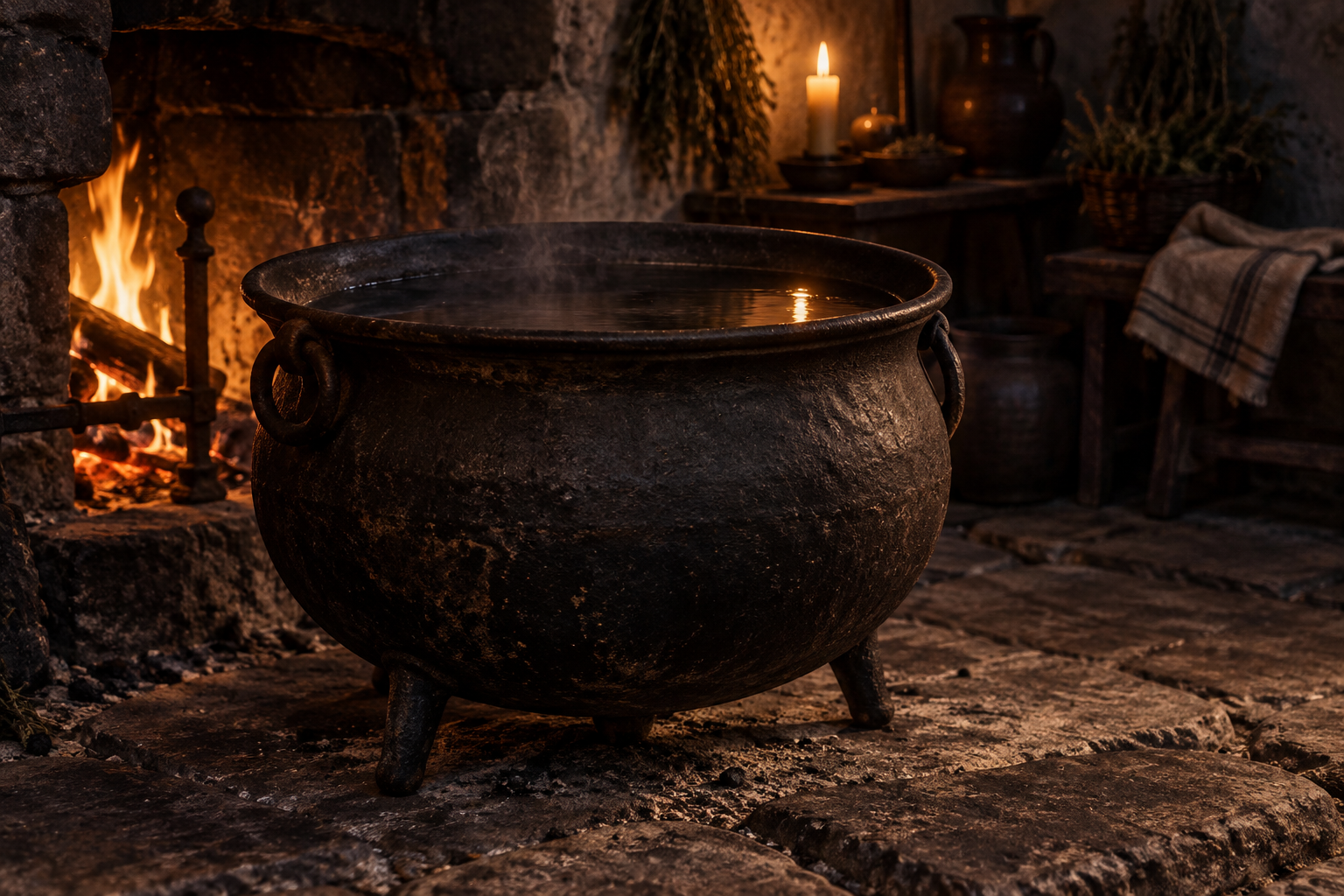
The cauldron enters the imagination blackened: round belly, iron legs, smoke above a potion no kitchen would serve. Yet its most consequential magic preceded that picture. A suspended pot turned grain, water, scraps, and time into a meal. It concentrated fuel, labor, appetite, and authority at the hearth.
A cauldron is often described as an ancient witch’s tool, as though one object passed unchanged from prehistoric priestess to medieval sorceress to modern altar. Archaeological cauldrons, domestic pots, feast vessels, literary marvels, hostile witch imagery, and contemporary ritual tools belong to related but distinct histories. They are not one secret lineage.
The cauldron’s durable ritual grammar is containment under change. Its rim defines what enters. Its belly permits ingredients to mingle. Heat or darkness alters their relation. The vessel holds the operation until someone decides it is complete.
01 / BEFORE THE WITCH
The cauldron belonged to the household economy
Historical cauldrons were costly, repairable equipment rather than gothic ornaments. A medieval bronze vessel could stand in the fire on legs or hang by a handle from a trammel, whose adjustable height controlled heat. A large pot allowed a household to cook several foods at different levels or times. Its rounded body circulated heat; its bail allowed lifting; its soot recorded repeated contact with the hearth.
These properties produce meanings without requiring an occult origin. A cauldron gathers portions into common sustenance. It makes raw things permeable to one another. It can feed more people than the cook can hold in mind at once. Because metal, fuel, and food were valuable, custody of the pot also signaled resources and responsibility. “Abundance” was not an abstract correspondence: it was the visible fact that something edible remained after many bowls were filled.
Archaeological contexts complicate the domestic picture. Iron Age examples range from full-sized iron-and-copper vessels to miniature copper-alloy cauldrons deposited in hoards. A miniature is not useful for stew, so form has become representation: a small object can invoke feasting, status, offering, or the social power of the larger thing. That does not prove a universal cauldron cult. It shows that people could think with the vessel as well as cook in it.
One shape, several jurisdictions
Scale and wear change the vessel’s office. Soot and repairs belong to repeated hearth labor; miniature scale turns capacity into an emblem; burial deposition withdraws the pot from ordinary circulation; a modern altar bowl enters a newly chosen ritual grammar.
02 / VESSELS OF AUTHORITY
Not every ritual cauldron belongs to witchcraft
Across cultures, deep metal vessels have served offerings, feasts, burials, and royal display. The Chinese bronze ding, for example, became a ritual vessel associated with rank and dominion. Its history is not evidence for European witch practice; it is a useful warning against treating “cauldron” as one timeless symbol. Similar shapes can acquire different jurisdictions.
European story likewise gives marvelous vessels many offices: inexhaustible provision, restoration, inspiration, testing, or dangerous plenty. Literary cauldrons intensify what an ordinary pot already does. They feed beyond reasonable measure or return what ordinary heat has destroyed. The marvel grows from the vessel’s familiar action, then exceeds it.
This is why fiery revival fits the cauldron so readily. The Last Ember in the Grimoire promises to “Reawaken one dormant spell recorded in your Book for a final chosen use.” The final ember belongs in a vessel where the vessel’s office is not generic manifestation but the controlled return of a power believed spent; the finality keeps revival from becoming endless reheating.
03 / THE WITCH AT THE HEARTH
Printmakers made the kitchen uncanny
The familiar witch’s cauldron is not a transparent picture of clandestine practice. Early-modern artists assembled a visual vocabulary from accusation, demonology, domestic tools, and theatrical inversion. In Pieter Bruegel the Elder’s 1565 design of Saint James confronting the magician Hermogenes, the hearth becomes crowded with demonic action; a broom-rider escapes through the chimney while brewing and magical books share the scene. Later drawings repeat the congested workshop of smoke, vessels, bodies, and illicit knowledge.
The power of the image depends on recognition. A pot at the hearth was ordinary; what entered it in witch imagery was made grotesque or forbidden. Domestic competence—knowing plants, managing heat, feeding bodies—could be reframed as secret corruption. The cauldron therefore carries a double history: indispensable household technology and a pictorial accusation that made household power look sinister.
Modern popular culture streamlined the scene. The pot became uniformly black, the liquid luminous, the recipe monstrous, the witch immediately legible. Contemporary practitioners may reclaim that silhouette with pleasure, but reclamation is a new cultural act. It should not be disguised as archaeological continuity.
The witch’s cauldron is powerful partly because it makes ordinary domestic transformation look like forbidden authorship.
04 / THE MODERN RITUAL TOOL
Give the vessel one office at a time
A tabletop cauldron can contain, combine, receive, conceal, reveal, or extinguish. Precision begins when one verb governs the scene.
| Office | What the vessel does | What completes it | Common confusion |
|---|---|---|---|
| Containment | Holds named material inside a visible boundary. | A planned release, storage period, or dismantling. | Mistaking indefinite keeping for stronger control. |
| Combination | Brings distinct tokens into one declared relation. | The mixture reaches its appointed state. | Adding ingredients whose actions contradict. |
| Receiving | Accepts petitions, offerings, tears, or written fragments. | The gift is acknowledged and its destination settled. | Treating the pot as a permanent spiritual inbox. |
| Revelation | Frames water, darkness, or reflection for sustained looking. | One bounded reading is recorded and closed. | Turning every surface accident into prophecy. |
A cauldron does not need literal flame to enact transformation. Water can receive reflections; dry tokens can be sorted or combined; a lid can create a period of concealment; an empty vessel can embody capacity deliberately withheld. Material suitability matters because iron, brass, ceramic, and decorative resin do not perform the same work. “Cauldron-shaped” describes appearance, not permission for heat.
Divination especially benefits from a bounded office. If the vessel represents the recovery of knowledge rather than a general promise that all secrets will surface, The Forbidden Truth Returned offers the consequential aim “Restore a forbidden truth to every mind from which it was erased.” Use that recovered truth in a cauldron where the cauldron is meant to gather a truth scattered by suppression; the declared target is far sharper than reading every ripple as a message.
CASE FILE THREE BLACK VESSELS
Same silhouette, three entirely different operations
A practitioner inherits a cast-iron cooking pot, buys a small incense cauldron, and finds a ceramic bowl painted with triple moons. Which is the “real” cauldron?
The iron pot is heavy, seasoned, and tied to remembered meals. The small metal cauldron has a raised base and a lid but no known maker’s heat rating. The ceramic bowl is intact, reflective inside, and never intended for flame. All three look ritually persuasive.
The heirloom
Its strongest charge is household continuity: many ingredients becoming shared nourishment under practiced care.
The miniature
Its scale favors tokens, petitions, or cold incense ash; its unknown material limits what may transform inside it.
The dark bowl
Its still interior favors reflection and receiving. Painted symbolism supplies context, not a history of use.
THE READING
Authenticity is not a contest won by the object that resembles a Halloween prop most closely. The heirloom carries labor and kinship; the miniature creates tight containment; the bowl offers an optical field. Each becomes ritually exact when its material capacity, history, and assigned office agree.
05 / ELEMENTS AND LIMITS
The cauldron does not equal every element at once
Modern systems call the cauldron feminine, watery, earthy, fiery, womb-like, grave-like, or spirit-bearing. Any can work inside a coherent rite; piling them together dissolves distinction. Iron over flame stages mineral body, heat, and changed contents. Water used for scrying emphasizes depth, surface, and image. An empty vessel may signify readiness. Context activates the symbol.
The womb analogy can express incubation, but should not turn every vessel into biological destiny. A cauldron can be workshop, mouth, council, archive, stomach, tomb, reservoir, or boundary. Its roundness dictates no single gendered meaning, and its black surface may record soot, manufacture, seasoning, or modern coating rather than antiquity.
06 / EMPTYING THE POT
Transformation requires an exit
A vessel that only receives eventually becomes storage. Ritual closure asks what leaves, what remains, and who is responsible for both. If tokens were combined to represent an alliance, does the mixture stay together, divide, or enter ordinary disposal? If water received a reading, when does it stop being an oracle? If ash marks an ending, why would keeping it forever strengthen release?
The hearth cauldron offers the clearest answer: its transformation mattered because food left the pot and entered a community. Modern ritual need not imitate cooking, but it can preserve that consequential movement. The contents should become a decision, a changed arrangement, a named memory, or a finished interval rather than sacred clutter.
Emptying is not failure. It restores capacity. The clean, dark interior is the vessel’s final symbol: not a promise that anything can happen, but evidence that one operation ended completely enough for another to begin.
THE VESSEL'S QUESTION
What crosses the rim changed—and what is never meant to remain?If the rite cannot answer, the cauldron is decoration rather than ritual architecture.What does a witch’s cauldron mean?
It can mean household sustenance, collective abundance, prestige, marvelous restoration, feared domestic knowledge, ritual containment, or deliberate transformation. Those meanings are strongest when their histories remain visible rather than collapsed into a fabricated ancient inheritance. The witch’s cauldron is not powerful because it has always belonged to witches. It is powerful because generations have recognized what a vessel under pressure can do: hold unlike things together long enough for a new condition to become real.