SUN · SEASON · RECURRENCE
Wheel of the Year: Eight Festivals, Modern Synthesis, and Local Seasons
The familiar eight-spoked Wheel feels ancient because it speaks in dawns, harvests, fires, and darkening nights. Its exact symmetry is modern—and that is a history to understand, not a flaw to conceal.

STAR & SIGIL
Make the calendar answer to the ground beneath it
Turn one inherited seasonal symbol into a studied practice with dates, conditions, and results you can revisit.
Open the local-calendar lesson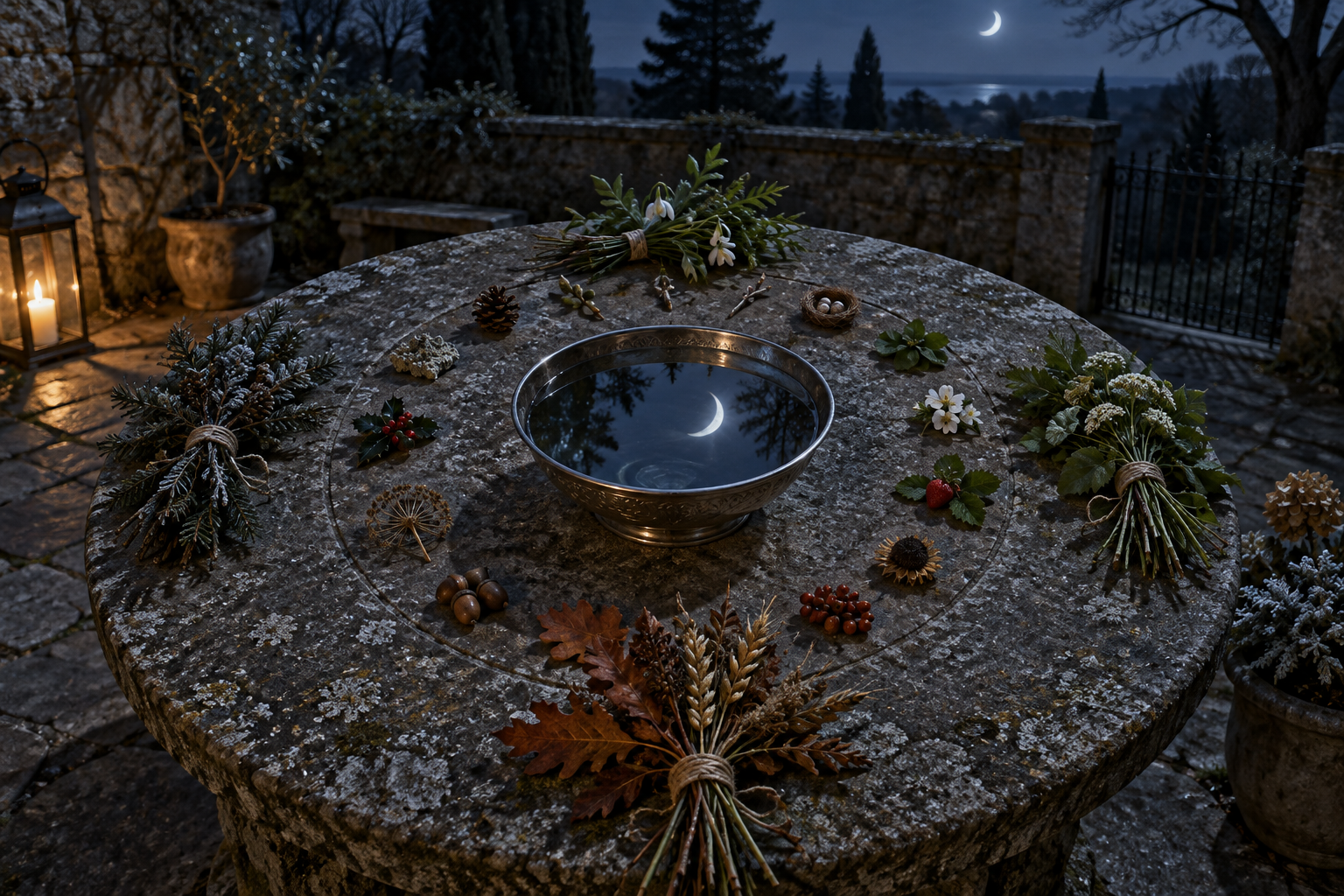
The Wheel is usually drawn as perfect geometry: eight spokes, equal distances, a year made orderly. But step outside and the symmetry breaks. Snow may arrive after the first lambs. Monsoon rain may govern the year more powerfully than temperature. A harvest may occupy months, not one gold afternoon. The Sun keeps exact astronomical appointments; lived seasons do not.
The modern Wheel of the Year joins four solar stations—the solstices and equinoxes—to four festivals commonly named Imbolc, Beltane, Lughnasadh, and Samhain. It gives contemporary Pagans and witches a shared rhythm of beginning, growth, height, harvest, descent, and return. It is meaningful precisely as a designed ritual cycle.
It is not one universal ancient calendar inherited intact from a prehistoric European religion. Its festivals have different histories, languages, sources, and local conditions. Their eightfold arrangement took recognizable modern form through twentieth-century Pagan synthesis. Historical honesty does not disenchant the Wheel. It reveals the remarkable act it performs: making several kinds of time speak to one another.
01 / THE EIGHTFOLD DESIGN
A modern circle joins unequal histories
The quarter points are astronomical events. At the solstices, the Sun reaches its most northerly or southerly rising and setting points and daylight reaches a yearly extreme. At the equinoxes, day and night approach balance, though atmosphere and the way sunrise is measured prevent a universal twelve-hour equality. These stations are planetary relationships, not cultural festivals by themselves.
The cross-quarter festivals enter through particular cultural records. Samhain, Imbolc, Beltane, and Lughnasadh have Irish names and evidence that does not reduce to neat seasonal keywords. Assemblies, pastoral transitions, feasting, legal or social obligations, holy figures, fire, and later folklore differ by feast. Modern practice has selected, expanded, and sometimes romanticized strands from those histories.
Yule carries Germanic and Norse histories; “Ostara” as a spring festival name depends on a much thinner and contested chain; “Litha” and “Mabon” are modern Pagan usages with their own routes into the Wheel. Calling all eight “ancient Sabbats” makes their differences disappear. A more compelling Wheel lets each spoke keep its accent.
Measure
Solstice, equinox, daylight arc, sunrise point, and hemisphere establish solar position.
Observe
Rain, frost, flowering, migration, fire season, and local harvest describe the living place.
Remember
Named festivals carry languages, communities, inherited stories, and unequal documentary records.
Compose
A coven or solitary practitioner gives recurrence a deliberate office in the present year.
02 / THE WHEEL AT A GLANCE
Each station needs a source, a sky, and a local question
| Modern station | Primary time-marker | Useful ritual verb | Question for the actual place |
|---|---|---|---|
| Yule / winter solstice | Longest night, minimum daylight | Endure, kindle, return | What truly survives the lean season here? |
| Imbolc | Early-February Irish festival complex | Quickening, tending, preparing | What first sign of seasonal change is observable? |
| Ostara / spring equinox | Solar crossing toward longer days | Balance, emerge, initiate | Does local life behave like “spring” now? |
| Beltane | May festival with pastoral and fire associations | Protect, cross, flourish | What boundary or movement begins this season? |
| Litha / summer solstice | Maximum daylight | Crown, reveal, expend | What has reached visible height? |
| Lughnasadh / Lammas season | August assembly and first-fruit traditions | Gather, prove skill, offer | Whose labor made the first yield possible? |
| Mabon / autumn equinox | Solar crossing toward longer nights | Account, divide, redistribute | What must be measured rather than merely praised? |
| Samhain | Early-November Irish festival complex | Close, remember, negotiate thresholds | What relationship to land, dead, or community changes now? |
CASE FILE ONE DATE, TWO WHEELS
The equinox arrives; the landscape refuses the script
A coven inherits a Northern Hemisphere Wheel in a subtropical coastal city. At the March equinox, their books promise spring awakening. Outside, the dry season is already hardening the ground.
The altar shows eggs, pale flowers, and green shoots. Yet the local river is low, mango trees are fruiting, afternoons carry dangerous heat, and residents watch for the first rains rather than the last frost. Half the group wants to reverse the Wheel mechanically; half wants to keep inherited names unchanged.
Solar truth
The equinox remains real: daylight is crossing its annual relation to darkness in this hemisphere.
Ecological truth
“Tender spring growth” misreads a landscape organized by dry heat, fruiting, and anticipated rain.
Inherited truth
The festival language preserves a community’s shared memory and cannot be swapped without consequence.
Ritual truth
The group needs one office for this recurrence: not generic rebirth, but accounting for water and ripeness before rains transform the city.
DO NOT FORCE ONE CLOCK TO IMPERSON ANOTHER
The coven keeps the equinox as solar balance, names the inherited spring imagery as inherited, and lets local fruit, heat, and water records supply the year’s living testimony. Neither blind reversal nor imported scenery is required.
03 / THE SUN IS NOT A SIMPLE MORAL
Increase is not always blessing, and darkness is not failure
The Wheel is often narrated as a single solar biography: birth at midwinter, maturation, union, kingship, sacrifice, death, and return. That myth can organize ritual beautifully, but it is one interpretive overlay, not the secret original story behind every festival. Other cycles foreground agricultural labor, divine relationships, community assembly, ancestors, weather, or personal life passages.
Maximum light can mean revelation and confidence, but also exposure, exhaustion, drought, or power at the moment it begins to decline. Harvest can celebrate abundance while demanding an account of labor and distribution. Darkness can shelter gestation, grief, rest, secrecy, and the limits of sight. The Wheel gains depth when “light good, dark bad” gives way to changing offices.
Even the Sun can be treated not as immortal certainty but as a life vulnerable to cosmic exhaustion. A Thousand Years for the Sun reverses devotion by asking the worshipper to sustain the Sun; perform it to add a thousand years to the life of a dying sun. Its benefit reverses the usual scale of seasonal devotion: the worshipper does not merely receive returning light but intervenes in the duration of the star itself.
04 / HEMISPHERES AND LATITUDE
Six months of reversal solves astronomy, not culture or ecology
In the Southern Hemisphere, June is the winter solstice and December the summer solstice. Reversing solstice and equinox symbolism follows the sky. Cross-quarter names are harder. Moving Samhain to May may align it with autumnal descent, but it does not transport Ireland’s historical November context, local ancestral customs, or agricultural calendar.
Latitude complicates the picture further. Near the equator, differences in day length may be modest while rain cycles dominate agriculture and felt season. At high latitudes, twilight, snow cover, and extreme light can overwhelm the tidy image of four equal temperate seasons. A climate-altered year may bring flowering, migration, fire, or flood outside remembered dates.
Three honest approaches are possible: keep the inherited liturgical dates while acknowledging seasonal dissonance; reverse solar and seasonal stations; or build a locally observed cycle while retaining chosen historical festivals as distinct commemorations. What matters is clarity. Adaptation becomes appropriation or confusion when local invention is falsely advertised as an ancient indigenous calendar.
05 / WHAT RECURRENCE DOES
A festival becomes powerful by remembering last year
A single rite marks an event. A yearly rite builds comparison. The same cup, song, question, or place returns, and the participants do not. Someone is absent. A child can now speak. Work prospered, failed, or changed hands. The orchard fruits early. The river no longer reaches its old stone. Recurrence turns memory into a ritual instrument.
This makes recordkeeping more valuable than compulsory decoration. Note the daylight, weather, first or last local sign, state of shared projects, names present, losses since the previous turning, and one question carried forward. Over years, the record exposes invented seasonal assumptions and reveals a place’s actual rhythm.
The solstitial peak also teaches that culmination is politically unstable: the height of one power may become the foundation of another’s authority. Steal the Day of Triumph turns culmination into a transfer of authority; perform it to make a rival’s greatest triumph arrive on the day it will establish your authority. The working uses culmination as transfer; noon is not an ending but the instant a shadow changes allegiance.
06 / DESIGN A WHEEL THAT CAN TELL THE TRUTH
Keep several calendars without pretending they are one
Begin with layers. The solar layer records what the Sun is doing. The ecological layer records what land, water, plants, animals, and labor are doing. The cultural layer identifies the festival’s language and historical communities. The personal or coven layer assigns this year’s ritual question. Agreement among layers can feel resonant; disagreement can be the more important revelation.
Do not force every station to celebrate. One may be an audit, another a memorial, another a public feast, another a period of restraint. Nor must every spoke carry equal emotional weight. A farming household, an urban coven, and a solitary practitioner in migration will inhabit the same geometry differently.
The Wheel becomes shallow when it supplies eight shopping themes. It becomes alive when it holds consequences across time: the promise made at planting is judged at harvest; the dead named in autumn remain part of winter memory; the authority claimed at midsummer is reviewed when light declines. A circle is valuable because later stations can answer earlier ones.
07 / WHEEL OR SPIRAL?
Repetition becomes knowledge when the year leaves a trace
A wheel emphasizes return; a spiral emphasizes return with changed position. Both images correct a different error. The wheel refuses the fantasy that life advances without recurrence. The spiral refuses the fantasy that recurrence erases consequence. A festival revisited after bereavement, migration, initiation, drought, or reconciliation occupies the same ritual station but not the same human world.
Keep one durable question moving around the cycle. At each station, ask what has begun, peaked, been gathered, declined, or returned. The answers create a seasonal biography of the year without forcing experience into eight equal chapters. The diagram then becomes an instrument of memory rather than a decorative claim about nature.