ALTARS · PHENOLOGY · LOCAL SEASONS
Seasonal Altar Ideas: Use Local Evidence, Not Just Decorations
A seasonal altar becomes more than a change of colors when it can answer a harder question: what has actually changed here? The date, the living place, and the practitioner’s promise may each tell a different truth.

STAR & SIGIL
Turn the seasonal surface into a living gate
Carry four honest clocks into a cataloged beginner spellbook where observation must become deliberate action before the altar closes.
Enter through the evidence-kept altar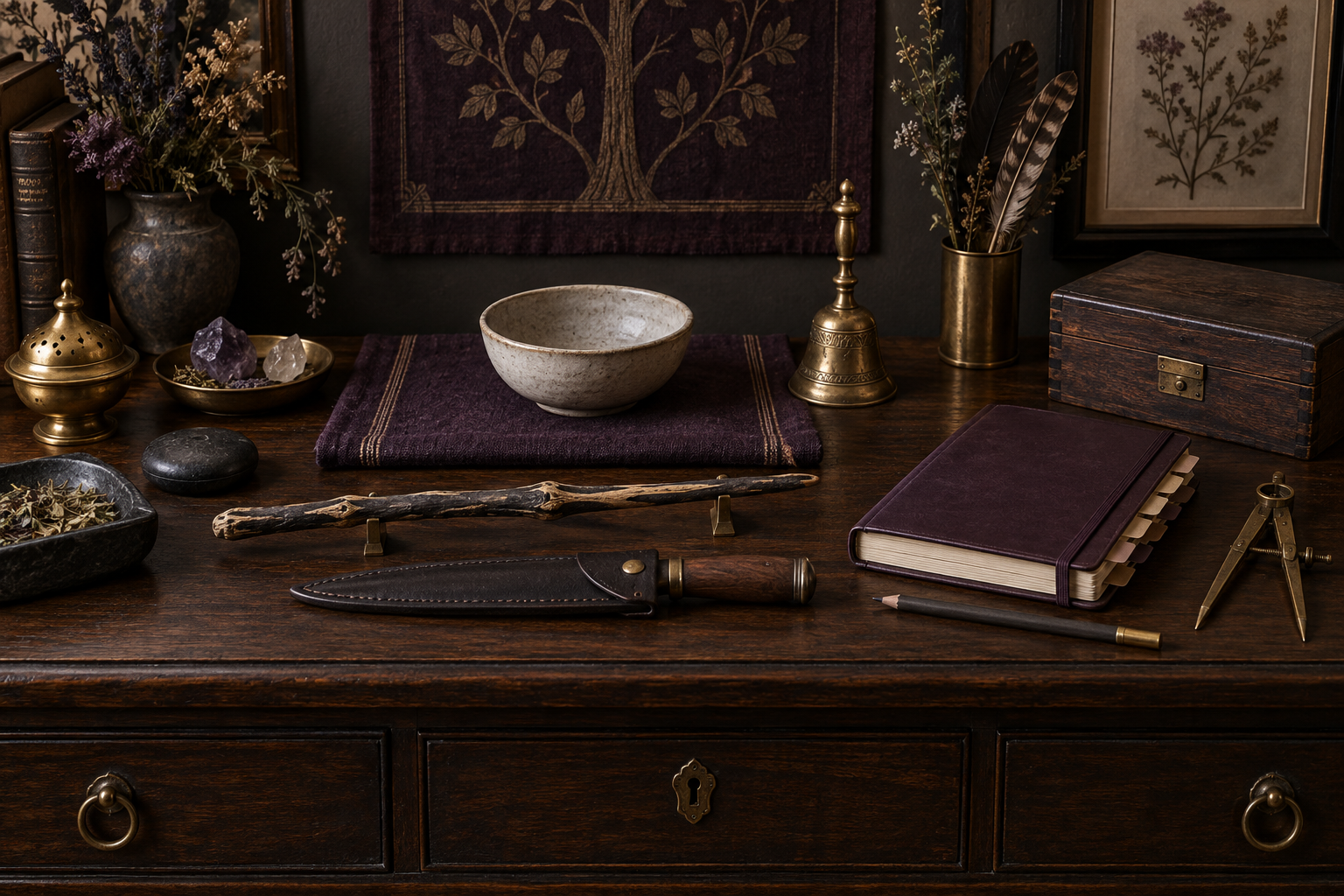
01 / THE ALTAR AS RECORD
A seasonal altar should be able to show its work
Seasonal altar ideas often begin with a palette: green for spring, gold for harvest, white for winter. Color can focus attention, but it cannot tell you whether the tree outside has budded, whether the rains have begun, or whether the food on the table belongs to this place and time. Decoration announces a season already decided. Evidence asks the living place what is happening.
Four kinds of evidence make an altar legible. A calendar marker names an agreed date. An observed sign records a material event: first flower, dry creek, migrating bird, repaired roof. An interpretation says what that event means. A devotional commitment answers it with an obligation. Confusing these layers turns a daffodil into proof of universal spring; keeping them separate lets one flower be precise.
CASE FILE ✧ TWO COASTS, ONE FEAST
The same festival meets two different thresholds
Mara and Inez inherit the same spring date. Their altars cannot honestly make the same seasonal claim.
Mara lives beside a cold Atlantic inlet, where bare branches remain tight and salt wind still burns the garden. Inez lives on a warm Pacific coast where blossom has already given way to seed and the dry season is beginning. Both place painted eggs on their altars. Inez adds the first brittle grass stem; Mara adds the storm latch she repaired that morning.
The shared egg carries inherited festival continuity.
Latch and dry grass report different local thresholds.
Preparation and water restraint answer the evidence.
READ OBJECT, SIGN, CLAIM, AND CONSEQUENCE
The egg is a shared festival symbol. The grass and latch are local testimony. Mara’s altar says anticipation and endurance, so its consequence is continued preparation. Inez’s says preservation before dryness, so its consequence is restraint and water care.
02 / READING THE OBJECTS
One object can support a bounded claim without proving a whole season
| Object | Observed fact | Claim it can support | Claim it cannot prove |
|---|---|---|---|
| Closed bud | One identified plant has not opened | Its local stage is still waiting | All life is in “winter” |
| Repaired latch | Weather caused damage and labor answered | Protection includes maintenance | The storm was a personal omen |
| Dry grass | Moisture has fallen at this site | A dry threshold is present | Every nearby watershed shares it |
Evidence makes the altar answerable: another observer can see where description ends and interpretation begins.
03 / THE OBJECT THAT HAS BEEN OUTSIDE
Weathering can make an object a witness rather than a prop
A stone faded by sun, a branch dropped in wind, or a tile chipped by hail carries a local history. That history does not automatically make the object safe, collectible, or spiritually available. Leave living plants rooted, avoid contaminated storm debris, and take nothing from protected or privately governed ground.
When an ethically held object already bears the season’s pressure, work The Weather-Mended Guardian to appoint it protector of the home until the next local seasonal sign appears. The spell gives repair a supernatural guardianship; it does not make neglect into reverence. The repaired latch in Mara’s case matters because someone also tightened the screws.
The most convincing altar objects therefore have verbs attached: flowered, cracked, returned, dried, repaired, harvested, released. A shop label supplies a noun. A local verb supplies a relationship.
04 / WHAT LEADS THE RITE
Not every true sign deserves the center
An altar can hold several truths without letting all of them govern. First blossom may suggest opening; a water restriction may demand restraint; a family anniversary may require remembrance. The leading power is the one that organizes action. If drought is the most consequential fact, abundance imagery should not erase it.
Where a practitioner has gathered a full field of signs, use The Eight Witnesses Crown the Season to let eight local witnesses disclose which power should lead the next festival or altar. The wonder lies in selection among witnesses, not in turning eight convenient ornaments into witnesses after the answer is known.
05 / TWO KINDS OF RETURN
A date returns by agreement; a living event returns by conditions
A calendar anniversary is dependable because people agree how to count toward it. A flowering date, first frost, insect emergence, or wet-season break is conditional. Temperature, rain, daylight, disturbance, and the organism’s history all participate. Calling both things “the season” hides recurrence by convention inside recurrence by response.
Keep two records: what the inherited calendar expects and what the place has done. Agreement can be celebrated; disagreement is information. If blossom arrives after the feast for three consecutive years, the altar can keep the feast while refusing to display blossom as though it had occurred. One warm afternoon is weather. A sequence of buds, insects, soil change, and daylight response may support a threshold.
The expert’s distinction
A symbol can be right by tradition while premature as local evidence. They become rivals only when the altar pretends they are the same claim.
06 / THE ALTAR’S LABOR
Seasonal change includes what must be cleaned, returned, and repaired
Photographs favor the instant an altar is finished. Practice continues afterward. Cut plants wilt, food spoils, salt absorbs moisture, and found objects may carry contaminants. Removing an object is part of seasonal intelligence. Keeping everything forever turns witness into accumulation.
Give each object an exit condition. A fallen leaf may remain until it crumbles; local fruit until it can be eaten or composted; a repaired tool until its work is done. A window view or written observation can testify without possession.
Maintenance reveals invisible labor. If one person gathers, arranges, cleans, and disposes while everyone else enjoys the atmosphere, the altar records an unequal season. A devotional commitment should name who carries it and when it ends.
07 / THE FOUR-PART READING
Read every choice as object, observation, claim, and consequence
Object
What is present, and how did it arrive?
Observation
What witnessed change does it record?
Claim
What meaning is proposed rather than seen?
Consequence
What care, restraint, celebration, or repair follows?
Two practitioners may agree that the creek is low and differ about whether the response is mourning, conservation, or petition. The observation survives while the magical argument becomes visible.
Return to these questions when an altar feels stale. Often its claim has outlived its evidence. Changing the consequence may renew the arrangement more honestly than adding another symbol.
Change the evidence, and the beauty will follow
A seasonal altar need not reject inherited dates or beloved symbols. It asks them to share the table with the actual place. Record what changed, state what you think it means, and let the resulting obligation remain visible. The strongest altar is not the one that looks most like the season. It is the one that could not have been assembled in quite the same way anywhere else.