ANCESTORS · ADDRESS · STEADY LIGHT
Simple Ancestor Altar: The Cup, Light, and Name
Simplicity is not spiritual lack. A name can identify the relationship, a vessel can give care a boundary, and one steady light can keep attention without turning every flicker into a command from the dead.

STAR & SIGIL
Meet the dead through three clear signs
Work with the name that addresses, the cup that welcomes, and the light that reveals what memory has carried forward.
Set the simple altar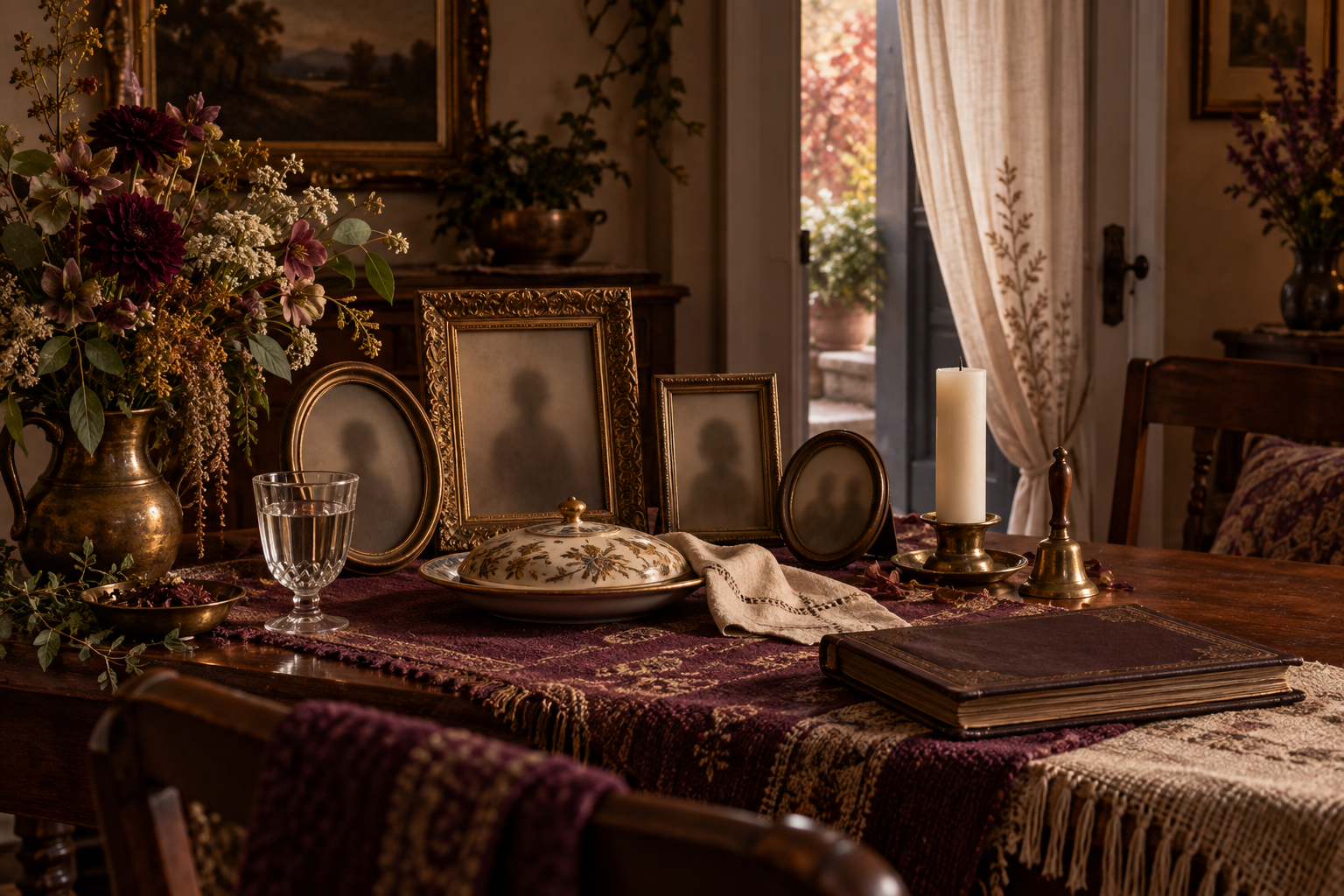
Mara owns one clear shelf in a crowded apartment. On it sits a card bearing her grandfather’s name, the enamel cup he carried on night shifts, and a small steady light. No portrait survives. No heirloom chest arrives. No family elder can agree whether his familiar name was Lito, Lino, or something else entirely.
A simple ancestor altar is powerful because it refuses to solve uncertainty with clutter. The name establishes an address. The vessel gives hospitality a boundary. The light establishes a duration of attention. Each has one office, and none needs to impersonate a complete biography.
This simplicity is not a universal ancestral custom. Different families and traditions govern remembrance through their own teachings. Here, the three objects form a personal household grammar whose claims remain modest enough to examine.
01 / THE DISCIPLINE OF LESS
Every object should have one intelligible office
Abundance can conceal vagueness. When photographs, inherited tools, flowers, foods, stones, cards, smoke, candles, and divinatory objects all gather at once, the practitioner may no longer know which item identifies, welcomes, remembers, petitions, protects, or interprets.
A simple altar makes those verbs visible. The card says who. The cup says hospitality has a place. The light says attention is being kept now. If another object is later added, its office must be equally clear.
Restraint also protects uncertainty. Mara can address Elias Navarro by the full name supported in family records while leaving the disputed familiar name unresolved. An empty space is more truthful than a confident invention.
02 / THE NAME
An address may be exact without being complete
A legal name, family name, nickname, title, or relational phrase can address different aspects of one person. None is automatically the most intimate or the most spiritually correct. The useful question is what relation the chosen name establishes and how the living know it.
Mara writes “Elias Navarro, my mother’s father, night keeper at Calder House.” The line distinguishes him from men with the same name and admits the relationship through which she approaches him. She does not add the uncertain nickname as if longing were evidence.
When retired tenant Mrs. Vale recognizes the cup but cannot recover the familiar name she used for forty years, Mara can try The Familiar Name Rekindled to restore that known name to her memory. The result is deliberately narrow: a familiar word returns; it does not make every surrounding recollection infallible.
03 / THE VESSEL
The cup gives hospitality a shape and an edge
A vessel does not carry one universal ancestral meaning. Its office here comes from its form and biography. It receives, contains, and can be emptied; this particular enamel cup also bears Elias’s initials and the chip visible in an old staff-room photograph.
Containment matters. Care without a vessel can become diffuse obligation: every meal feels watched, every drink becomes an offering, every household resource seems claimed. The cup establishes one chosen place where Mara’s gesture of hospitality belongs.
Its edge is as meaningful as its hollow. The vessel can hold welcome without making the entire apartment an unrestricted field of invitation.
04 / THE STEADY LIGHT
Illumination should mark attention, not manufacture omens
A steady light gives the altar a visible period of regard. It does not need to dance, gutter, flare, or produce shapes in order to matter. In fact, simplicity is strongest when ordinary variation is not recruited automatically as ancestral speech.
The light’s office is temporal: while it shines, Mara’s attention is deliberately gathered. When that period ends, the apartment returns to ordinary household time. The relationship is not erased; the active audience is closed.
This distinction protects remembrance from compulsive interpretation. Elias does not become more loved because a flame behaves dramatically, and silence does not demote him from the family.
Address
Identifies the dead person and the living relationship without inventing missing biography.
Hospitality
Gives welcome a chosen container, a material history, and a visible limit.
Duration
Marks a period of attention without requiring spectacle or interpreting every change.
Uncertainty
Leaves disputed names, unknown stories, and unanswered questions honestly unresolved.
ILLUSTRATIVE CASE THE NIGHT KEEPER’S CUP
A three-object altar corrects a family legend instead of decorating it
Suppose Mara’s family remembers Elias as the dignified manager of Calder House, an apartment building where he worked for three decades. His old enamel cup is the only object bearing both his initials and the building’s faded crest.
Mrs. Vale sees the cup, touches its chipped rim, and after the familiar name returns says, “Lito kept the lockout book.” Mara’s family hears confirmation of authority. Mrs. Vale means something more dangerous: Elias was the night doorman, not the manager, and he secretly recorded every attempt to exclude tenants after hours.
Card
Elias’s supported identity, not the family’s embellished title.
Cup
A verified work object that prompts recognition.
Light
A bounded period in which the story receives attention.
Ledger
A locked record whose contents can test the returning memory.
THE REVELATION IN THE BASEMENT
The ledger shows that Elias had little formal power. He nevertheless documented illegal lockouts, restored names erased from tenant lists, and gave duplicate keys to families shut outside. The family’s title “manager” was false, but the smaller job reveals a braver form of authority.
05 / THE SCALE OF CLAIM
Let each object prove only what it can carry
The card proves that Mara chose an address. The cup’s initials and photograph support its connection to Elias. Mrs. Vale’s returning nickname supports a familiar relationship. The ledger supports specific acts on specific nights.
None proves that Elias caused the name to return, directed the ledger’s discovery, or accepted the household hospitality. Mara may understand those events spiritually, but the material record remains clear enough that belief does not rewrite evidence.
This discipline deepens rather than thins the altar. Elias emerges not as an idealized manager but as a worker who used narrow access to protect people from a larger authority.
06 / THE LINE AHEAD
An ancestor altar can face descendants as well as the dead
Remembrance becomes inheritance when a living person decides what quality should travel forward. Mara does not need to pass on the false title. She can pass on Elias’s attention to names, doors, records, and people excluded by procedure.
For that forward current, she can cast Wisdom from the Unborn Ancestors to give her descendants the wisdom of ancestors they have not yet met. The power fits the altar’s temporal axis: knowledge crosses toward family members still to come, rather than trapping every ancestral relation behind Mara.
The simplest altar can therefore hold two directions at once. The name turns toward the remembered dead; the lesson turns toward lives the ancestor never saw.
07 / WHEN THE ALTAR IS ENOUGH
Do not add objects merely to escape silence
An altar may remain three things for years. It need not accumulate proof of devotion. A new photograph, document, or heirloom belongs there only if it clarifies relationship rather than filling space.
Mara eventually corrects the card: “Elias Navarro, called Lito, night doorman at Calder House, keeper of the lockout ledger.” The revision does not make the altar less sacred. It makes affection answerable to what the living have learned.
The cup continues to hold hospitality. The light continues to keep time. The shelf remains small enough that every object can still be seen.