SEASON · DEAD · THRESHOLD
Samhain Rituals: History, Ancestors, and the Dark Threshold
Samhain is not one ancient ceremony carried intact into the present. It is a crowded threshold where medieval festival, later folklore, Christian feasts, Halloween, family memory, and modern Pagan ritual meet without becoming identical.

STAR & SIGIL
Keep the remembrance warm and the boundary exact
Move from a named memory into a cataloged ancestor working with a clear invitation and a deliberate close.
Open the bounded ancestor rite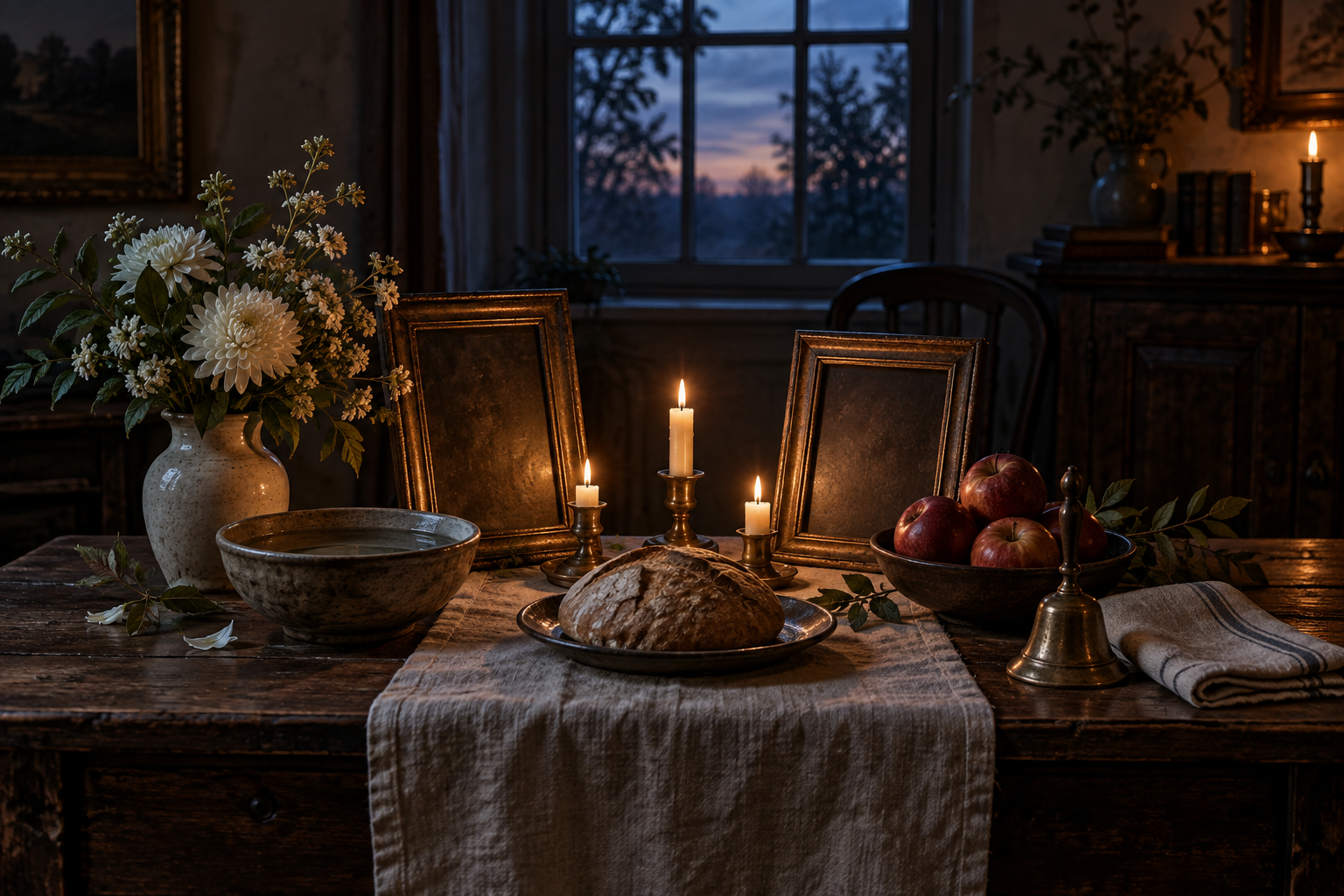
At the end of October, three names wait on Nessa’s table. One belongs to her grandmother, whose jokes and handwriting she can still recognize. One is a collective name for laborers killed in a mill fire near her town. The third belongs to an uncle whose place remains deliberately empty. Around them crowd a carved pumpkin, an old family photograph, a supermarket apple, and a festival word more than a thousand years old: Samhain.
It would be easy to call the whole arrangement ancient. It would also be wrong. The date, objects, dead, and meanings reached this room by different roads. Medieval Irish texts, agrarian seasonality, later Gaelic customs, Christian Allhallowtide, commercial Halloween, folklore collecting, twentieth-century Paganism, family mourning, and contemporary witchcraft have met here. Meeting is not the same as unbroken descent.
Samhain rituals become more powerful when their layers remain visible. History supplies evidence, not a costume of certainty. Modern practice supplies living invention, not proof that every present altar reproduces a prehistoric rite. The dead supply relationships—and relationships require names, limits, memory, and sometimes a closed chair.
01 / THE OLDER NAME
What the historical record can—and cannot—carry
Samhain belongs to the medieval Irish calendar as a major seasonal division associated with the opening of winter. The word names both a festival and, in Irish usage, the month of November. Early literature places assemblies, feasts, royal business, supernatural encounters, and dangerous crossings around this time. Such stories establish Samhain as an important imaginative and social threshold; they do not provide a single ritual script used everywhere for centuries.
Medieval narrative is not an ethnographic camera. A tale may preserve older motifs, serve a courtly audience, display learned artistry, make political claims, or arrange supernatural danger for narrative effect. When otherworldly beings emerge at Samhain in literature, that tells us the date carried exceptional narrative force. It does not automatically prove that every household invited ancestors to a domestic altar.
Later records from Ireland, Scotland, and the Isle of Man describe varied autumn customs: fires, divination games, household gatherings, disguising, food, mischief, weather reading, and concern with uncanny visitors. Customs differ by place and period. Some attach to Halloween, some to local harvest rhythms, and some have been reshaped through print, migration, schooling, tourism, and religious change.
The disciplined historical sentence is therefore specific: this custom is documented in this region or source at this time. “The Celts believed” is usually too large. It turns diverse peoples, centuries, languages, and genres into one imaginary congregation performing the same rite.
02 / MANY CALENDARS, ONE NIGHT
Samhain, Halloween, and Allhallowtide overlap without becoming synonyms
October 31 in the modern calendar carries several lineages at once. Halloween takes its English name from the evening before All Hallows’ Day. All Saints’ and All Souls’ observances place holy and ordinary dead within a Christian liturgical sequence. Gaelic Samhain contributes a seasonal name and bodies of custom. Modern secular celebration adds mass-produced masks, horror, neighborhood exchange, parties, and public spectacle.
Influence moved in more than one direction. Calendars share dates; neighboring religious and vernacular practices borrow forms; migrants carry customs into new conditions; antiquarians and revivalists select what they believe should survive. Seeking a single owner or origin for every pumpkin, fire, disguise, or dead-centered observance oversimplifies the history.
For a contemporary witch, this complexity is useful. It allows an honest declaration: “I keep Samhain within a modern Pagan year,” “I observe a family Halloween,” “I remember the dead during Allhallowtide,” or “I combine these in a practice whose sources I name.” Precision does not make the night less enchanted. It prevents enchantment from borrowing false antiquity.
| Layer | What it can contribute | What should not be assumed |
|---|---|---|
| Medieval Irish Samhain | Seasonal division, assemblies, literary crossings, the beginning of winter | One universal household ancestor rite |
| Later Gaelic custom | Regional fire, food, divination, disguising, visiting, and uncanny lore | Uniform survival unchanged from antiquity |
| Allhallowtide | Christian calendars of saints, souls, prayer, graves, and remembrance | A mere renaming of Samhain |
| Modern Pagan Samhain | Ritual year-end, descent, ancestor devotion, communal mourning, chosen theology | Automatic proof of prehistoric continuity |
| Contemporary Halloween | Mask, play, fear, exchange, neighborhood spectacle, creative reinvention | A practice empty of all older influence—or identical to it |
03 / A MODERN RITUAL SEASON
The witches’ new year is meaningful without being timeless
Many contemporary Pagans and witches treat Samhain as the close or beginning of a ritual year, one festival in an eightfold Wheel. That structure is modern. Its power comes not from disguising its age but from the clarity with which it organizes seasonal reflection: what has ended, what is carried into darkness, which dead are remembered, and what kind of community enters winter together.
The popular phrase “the veil is thin” likewise functions as modern ritual language more reliably than as a universal ancient doctrine. It gives a spatial image to experiences people associate with the season: intensified memory, darkness arriving earlier, landscape decline, public attention to death, and a sense that ordinary categories are less secure.
“Thin veil” can guide ritual design, but it should not flatten every cosmology into the same curtain between living and dead. Traditions describe spirits, ancestors, saints, ghosts, fairies, souls, and otherworlds through different relationships and rules. A metaphor becomes colonial when it presents itself as the secret translation of everybody else’s dead.
Modern does not mean superficial. Rituals are always made in time. A contemporary Samhain observance can hold grief, accountability, seasonal change, queer or chosen lineage, ecological attention, and the unfinished dead with exceptional seriousness. Its honesty begins by saying which inheritance is documented and which meaning the present community has created.
04 / THE DEAD ARE NOT A CATEGORY
Ancestor, beloved dead, community dead, and stranger require different relationships
An ancestor may be genealogical, adoptive, cultural, vocational, spiritual, or chosen. A beloved dead person may not be an ancestor at all. Community dead can include people whose labor built a place, whose deaths reveal an injustice, or whose names were deliberately erased. The unknown dead carry no automatic claim of intimacy merely because a festival concerns mortality.
These differences shape what remembrance can honestly say. Nessa knows her grandmother’s favorite insult, the way she folded letters, and the cake she repeatedly burned. That texture disciplines imagination. The mill workers are known through a memorial list and public record; they can be honored collectively without invented private messages. The uncle’s exclusion acknowledges that death does not transform harm into entitlement.
Some dead remain difficult because burial, naming, and public memory were denied them. Where unburied people were deliberately reduced to anonymous absence, cast Names for the Unburied Dead to call them forth and give each a name, a voice, and a way home. The Samhain office here is not bloodline possession but restoration of personhood where violence attempted to erase it.
SAMHAIN FILE THREE PLACES AT THE TABLE
Welcome, witness, and refusal create three different thresholds
Nessa’s apartment contains no reconstructed ancient ceremony. It contains a modern ritual argument about which relationships may cross into attention.
Rain freckles the window. The grandmother’s photograph faces inward toward the living chairs. A card naming the mill workers faces the window and the town beyond. The uncle’s place holds no portrait, only an overturned chair pushed beyond the edge of the cloth.
The known dead
A chipped teacup and remembered joke make the grandmother particular. Affection is anchored in biography rather than generic “ancestor energy.”
The community dead
The mill list remains collective. No stranger claims a private message; the living inherit responsibility for the documented loss.
The closed relation
The overturned chair says that kinship does not overrule the boundary established in life. Absence is deliberate, not forgotten.
The ordinary room
By night’s end the photograph, card, cup, and chair leave the arrangement. The dining table resumes its daily office.
THE THRESHOLD HAS MORE THAN ONE DIRECTION
Nessa does not choose between “all spirits welcome” and “nothing supernatural is real.” She creates distinct relations: intimacy for one, public witness for many, entry refused to another, and closure for the household itself.
05 / THE POLITICS OF THE TABLE
Food and flame mean differently when offered, shared, displayed, or remembered
A Samhain table is often described as if objects carried self-evident meanings. But an apple may evoke the local harvest, a family recipe, divination folklore, grocery commerce, or a place the fruit does not grow at all. Bread can be offering, communal meal, memorial food, household labor, or decorative shorthand. The ritual office matters as much as the object.
Likewise, setting a place for the dead can represent hospitality, grief, lineage, or the theatrical presence of absence. In one household it is devotional contact; in another it is a memory practice; in another it would feel intrusive or theologically impossible. No universal Samhain table can resolve those differences.
The strongest arrangement is legible to the people living with it. A photograph says this person, not “the ancestors” as an anonymous crowd. A recipe says this relationship entered the body through repeated meals. An empty chair can welcome, mourn, accuse, or refuse depending on orientation and story. Samhain’s objects become potent when their grammar is specific enough that the household knows which door each one marks.
06 / SIGNS IN A CROWDED NIGHT
Seasonal expectation can sharpen attention and overfeed interpretation
A dream near Samhain may feel more charged because the culture, weather, ritual calendar, and practitioner are already attending to death. A bird at the window, a familiar scent, a sudden memory, or an electrical failure can enter the night’s symbolic field with unusual force. Meaning may be genuine without every occurrence becoming a message.
Discernment asks for identity, content, and consequence. Does the impression resemble the known person, or only a generic dead voice? Does it convey specific material unknown beforehand, or repeat the practitioner’s fear? Does it enlarge responsible action among the living, or demand secrecy and obedience? Samhain atmosphere should not grant authority to every thought that wears a dead relative’s face.
Ambiguity can remain part of the observance. “I dreamed of her and understood something about my grief” is a complete statement. It does not need promotion into proof of visitation to matter. Nor must a practitioner who understands the experience as contact surrender that interpretation; they can hold it with proportion rather than turning one night into a universal claim.
07 / CLOSING IS PART OF CONTACT
A ritual threshold should still belong to the household
Threshold imagery is fashionable because it promises access. Its other function is jurisdiction. A door identifies who may enter, under what name, for how long, and who has the standing to refuse. Without that second function, “the veil is thin” becomes an image of spiritual exposure rather than relationship.
When Sabine’s family welcomes the memory of one named grandmother but hears an unknown presence pushing at the pantry door, openness has reached its limit. They can work The Threshold No Evil Crosses to seal the house against hostile spirits, demons, and enchantments. The Samhain doorway can then hold invited remembrance without turning hospitality into entry for every claimant.
Closure also returns the living to ordinary time. The photograph goes back to its place. The feast becomes food or memory rather than perpetual offering. The room changes use. The next morning is allowed to be November rather than an endless séance. A ritual that cannot end has not honored a threshold; it has erased one.
The test of a good boundary
It can welcome one relationship without converting welcome into access for every claimed presence.
The dark door belongs to more than the past
Nessa’s table contains history, invention, affection, civic memory, refusal, and the ordinary fact of rain. Its honesty is not less magical than a claim of timeless survival. It is more exact about what has actually crossed the threshold.
Samhain rituals matter because the season can hold several relations to death without confusing them: story and archive, ancestor and stranger, grief and fear, welcome and defense, inheritance and change. The night grows deeper when every dead person is not made the same—and every open door remembers how to close.