HOUSE MAGIC · THRESHOLDS · THE ART OF REFUSAL
Home Protection Spell: The Doors a Ward Must Know
A threshold is not merely the place where a house ends. It is where the house decides what may enter. The most powerful home wards know the difference.

STAR & SIGIL
Name the line before the night tests it
Take one exact boundary into a protection working designed around what is forbidden to cross and what happens at the threshold.
Arm the threshold against harm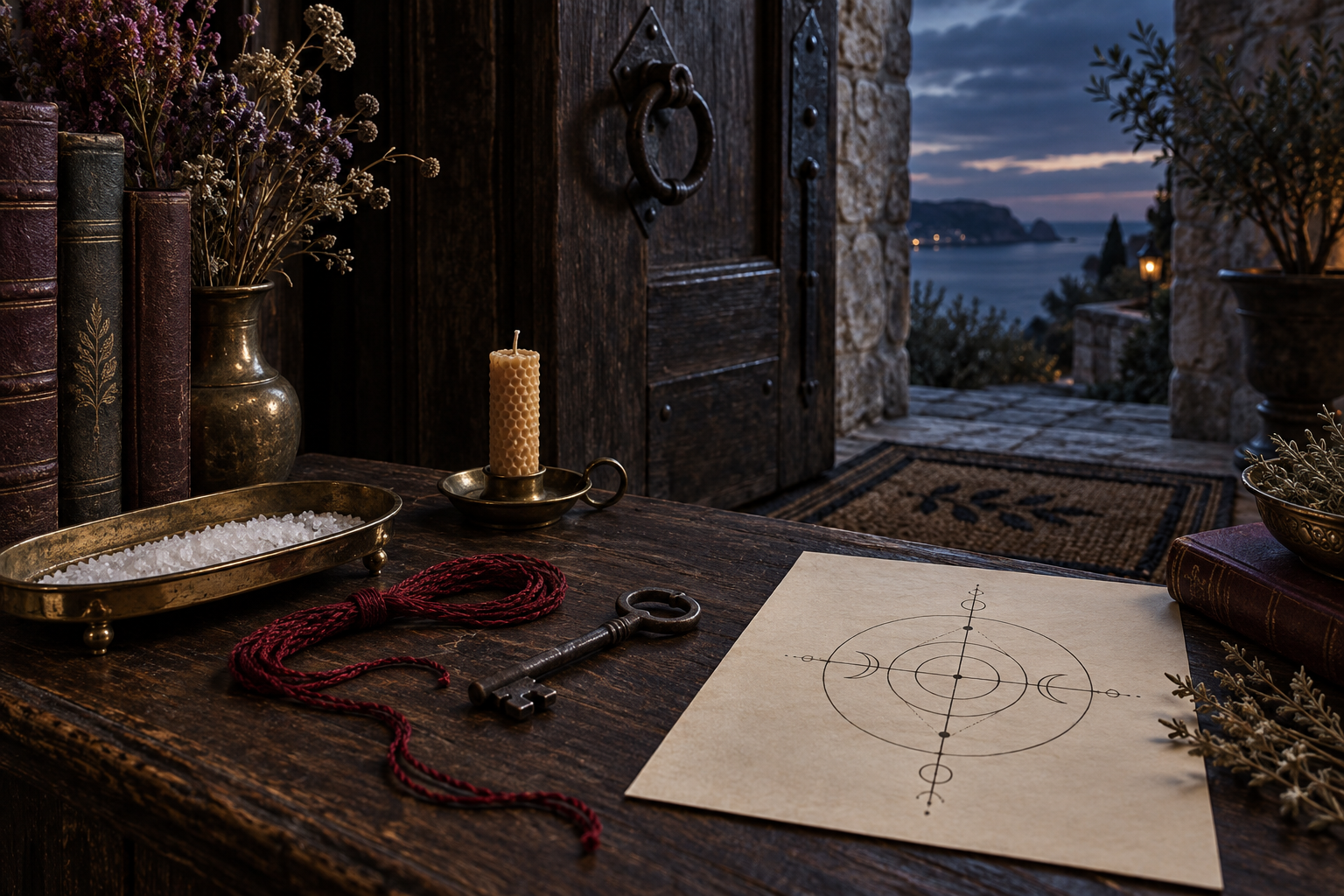
The front door clicks shut. In the hall, a parcel waits with no return address. A visitor has left it neatly against the mat, exactly where a polite household might carry it inside without thinking. Above the lintel hangs a charm, beside the door a little bell, and under the mat a sign intended to refuse anything hostile. Three defenses, one ordinary decision: does the parcel cross?
This is the question that separates a home protection spell from a collection of protective-looking objects. A house has an edge, but its edge is punctured by permission. People enter by invitation; images enter through screens; a key changes hands; a gift arrives carrying a relationship with its giver. If the ward cannot tell welcome from intrusion, it will either exclude the life of the house or admit the very thing it claims to stop.
A home ward is an agreement about passage. Its power lies in naming what counts as inside, which crossings require attention, and who has the authority to open the door. The magic begins to make sense at the same point the floor plan stops being a diagram and becomes a story of the people who live there.
01 / THE HISTORICAL INSTINCT
Old defenses gathered where the house was vulnerable
In historic English buildings, marks interpreted as protective appear repeatedly at doorways, windows, and fireplaces. A carved compass-drawn circle on a beam and a mark beside a hearth are not interchangeable decorations: both sit where a passage could be imagined. The marks now called apotropaic were meant to avert harm, but their surviving positions tell us more securely than any guessed incantation. Their makers paid attention to the entrances.
The fireplace is a particularly revealing example. It warms the interior, yet its chimney opens the building to air and to a vertical elsewhere. A window gives light and sight, while allowing an outside eye to look back. The door is a hinge between hospitality and refusal. That is why a protection symbol placed nowhere in particular can feel strangely weak even when its design is elaborate. It has been given a meaning but not a jurisdiction.
Historic evidence is also wonderfully untidy. A mark may have been made for protection, for a carpenter’s work, or for reasons no longer recoverable. Concealed objects survive without the spoken explanations that once accompanied them. A modern witch can learn from their placement without announcing that every old scratch is an ancient ward or that a present-day ritual descends unchanged from it. The lesson is architectural, not a claim of secret lineage: magic gathers at the places where one condition becomes another.
The expert’s distinction
A threshold ward is defined
by the crossing it governs, not by how ancient its symbol looks. History
gives us evidence of attention to openings; it does not hand us one
universal spell.
02 / THE HOUSE IS NOT ONE DOOR
Four openings, four different kinds of permission
Try to defend every opening with the same command and the ward becomes a blunt instrument. The household needs a grammar of entrances.
| The opening | What it admits | The magical question |
|---|---|---|
| Door | Bodies, gifts, keys, obligations, and the right to say yes. | Who may offer entry, and what can be refused without refusing the person? |
| Window | Light, weather, sound, sight, and attention from outside. | Is the ward guarding against entry, exposure, or the feeling of being watched? |
| Hearth and vents | Air, warmth, smoke, scent, and the imagined movement of spirits. | What must circulate for the home to live, even while harm is refused? |
| Unseen channels | Messages, images, remote access, invitations, and shared accounts. | Which household boundary is crossed without anyone touching the doorstep? |
The anonymous parcel makes the distinction sharp. It may be harmless; it may be unwanted; in a magical story it may be the carrier of an enchantment. A ward concerned with enchanted objects needs a rule for objects, not a blanket judgment about the visitor who set one down. That narrow refusal is embodied by The Threshold Rejects the Enchanted Token ; perform it to Prevent an enchanted token from crossing the threshold of a chosen person’s home. Its narrow refusal isolates carrier, boundary, and protected household while leaving the door open to ordinary life.
Contrast a window charm intended to turn away a malicious gaze. It governs seeing, not carrying. A charm that merely names “bad energy” leaves both events hazy. Even when the language of a spell is mythic, its architecture should be exact. What arrives? By which opening? What must still be permitted? A good home ward answers these questions before anything is fastened above a frame.
03 / THE WARD’S GRAMMAR
A protection mark needs a verb
A symbol can be beautiful without doing a clearly stated job. Consider a row of iron keys painted above a doorway. Are they there to lock passage, announce lawful access, remember everyone who belongs, or invite a lost resident home? Each interpretation would change how the house feels. A ward becomes coherent when the maker can say, in one sentence, what action the mark takes at the boundary.
There are several powerful verbs. A ward may bar, preventing a named force from crossing. It may announce, making intrusion noticeable. It may divert, drawing a threat past rather than through the home. It may recognize, admitting a person, object, or voice under a defined permission. Or it may restore, helping the inhabitants reclaim the ordinary feeling of home after a disturbance. One device can have a primary action and a secondary sign. Give it five equal commands and the design begins to contradict itself.
The verb also determines where the ward belongs. A bar sits at a crossing. An announcement must be perceptible to someone who can respond. A restoring symbol may live at the place the residents gather, not at the door where the disturbance occurred. The popular impulse to put every protective object at the main entrance misses this inner geography. After a frightening visit, the most important threshold can be the passage from vigilance back into rest.
Who is guarded?
The whole household, one room, one resident, or a shared invitation rule are different subjects.
What approaches?
A person, an object, a spirit, a message, or a remembered fear calls for a different boundary.
What happens?
Bar, announce, divert, recognize, or restore. A ward that cannot name its action cannot be read.
Who can open it?
Every resident affected by a shared threshold has a stake in its rule of welcome.
How is it noticed?
A visible sign, an agreed ritual memory, or an ordinary household check can make the boundary legible.
When does it change?
A move, a new resident, a resolved conflict, or a changed threat can retire the old ward.
Some witches want a guardian rather than a prohibition. That different relationship with the home is made explicit in The Dread Sentinel Bound ; work it to Bind a formidable spirit to guard your home and answer your call. The power illuminates what a listening defender adds to a line that simply says no: summons, response, continuing attention, and obligation. A mark may remain silent on the lintel; a guardian has become part of the household’s cast.
CASE FILE THE HOUSE WITH THREE KEYS
The ward that guarded a door nobody actually used
Three residents want a more powerful home protection spell. Their first mistake is treating the front entrance as the whole perimeter.
Elian places a heavy black charm over the formal front door, which opens only for visitors. Noor enters through the side stair after late shifts. Tamsin receives deliveries at the rear gate and sometimes lends her key to her sister. A string of unsettling messages arrives on a shared tablet. Nobody disagrees that the house feels exposed; they disagree about where the exposure begins. The charm above the polished front door looks commanding. It also misses every crossing that has troubled them.
The ceremonial door
It receives guests and photographs, but it is not the route of the residents’ daily return.
The working door
Its importance lies in the ordinary hours when Noor comes home alone and must be able to enter freely.
The informal exchange
Parcels and borrowed keys cross here under permissions no one has yet stated aloud.
The invisible opening
The messages require a boundary of access and response, not an extra object over a physical door.
THE READING
The housemates do not need four copies of the same charm. They need four honest descriptions of passage. The front entrance can stand for deliberate hospitality. The side stair belongs to safe return, even when someone arrives exhausted or upset. The rear gate asks who may leave things and who may lend access. The tablet belongs to a different kind of threshold, governed by accounts, notifications, and the right not to answer. Their symbolic boundaries become more convincing when the residents first agree on those ordinary permissions.
05 / THE HOUSE BEYOND THE CHARM
A ward should make ordinary protection clearer
People sometimes ask whether the visible charm is the “real” ward or whether its invisible boundary matters more. It is a false rivalry. The mark gives the rule a body; the rule changes how inhabitants notice and use the space. The latch, the visitor agreement, the light by the side stair, and the ability to call someone after a frightening noise belong to the same protective story. None is made less meaningful because another is practical.
Nor is every unsettling event evidence that a ward has failed. Houses speak in pipes, wind, ordinary friction, forgotten deliveries, and human moods. If a protection system makes its residents interpret every creak as an enemy probing the line, then its magic has turned against the peace it was meant to keep. The test is not whether the house becomes silent. It is whether the inhabitants retain the ability to distinguish a real crossing from the noise of living.
The difference can be felt after the working day ends. A house bound only against threat asks its residents to keep watch. A house protected for living allows them to set down a bag, argue honestly, invite a friend, close a door, and sleep. That is a larger claim than an unbroken row of charms. It says the ward’s success is measured partly by what the residents are free to do inside it.
When the parcel waits outside
Return to the hall and its unmarked parcel. The charm above the lintel cannot identify its sender. The bell cannot decide whether a gift is welcome. The sign under the mat does not relieve anyone of opening their eyes. What a coherent home ward can do is hold the question steady: what is crossing, by whose permission, and into whose keeping?
The front door clicks again when a resident returns. No alarm sounds. The house has not mistaken them for the thing it was made to refuse. That may be the most exacting feat of protective magic: a boundary fierce enough to deny an intrusion, and intelligent enough to let its people come home.