PLANT · PROVENANCE · RITUAL VERB
Herb Magic: Plant Biography, Ritual Verbs, and the Problem With Universal Lists
An herb is not a green container for one magical keyword. It is a species, a harvested part, a traded material, a remembered scent, and a living relationship before it ever enters a spell.

STAR & SIGIL
Build a herbarium that can say no
Take plant identity, table genealogy, and refusal into a deeper occult study where uncertainty remains visible.
Open the disciplined-herb lesson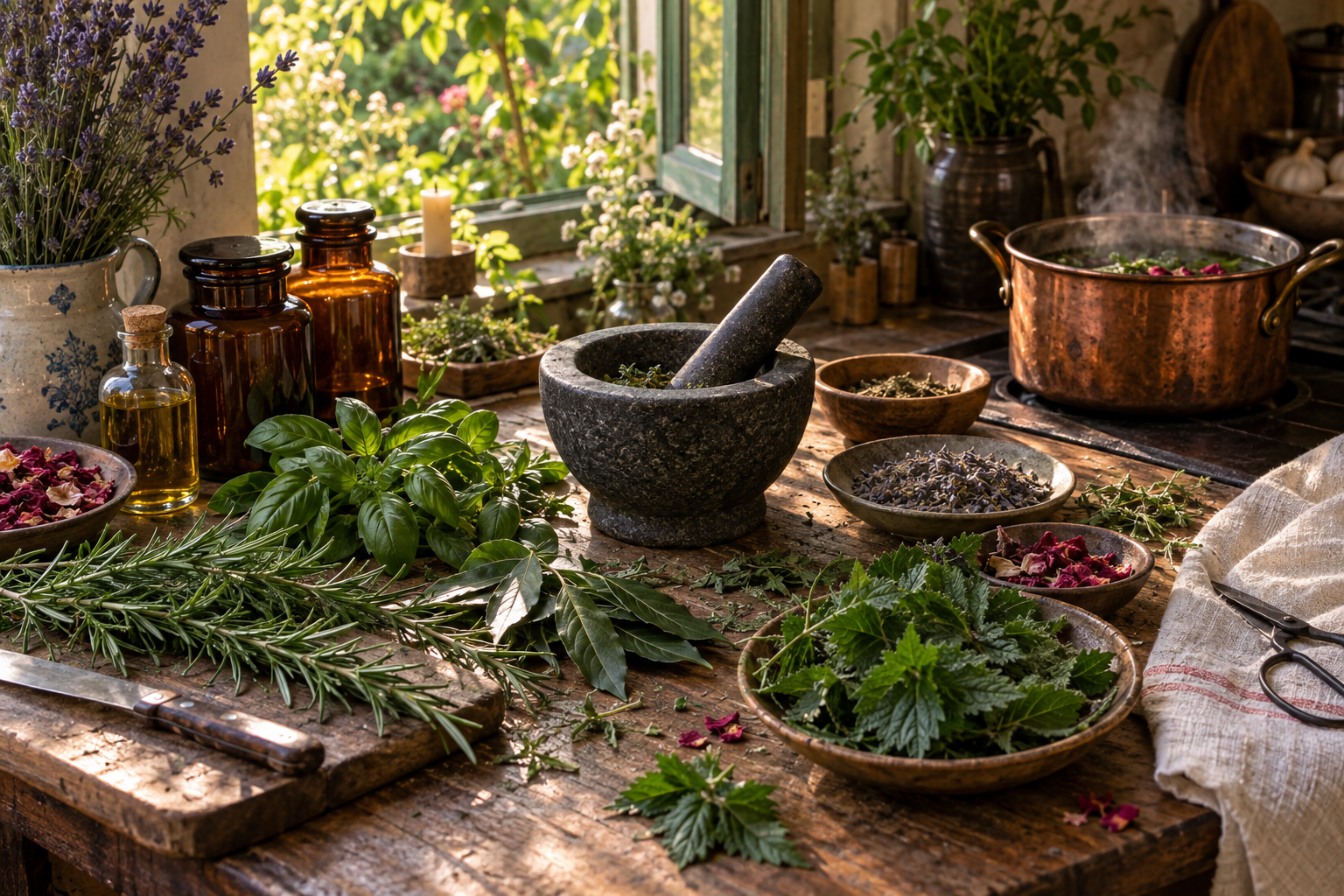
Four sprigs of rosemary lie on four tables. One is chopped into supper. One rests beside a photograph of the dead. One dries above a rented apartment door. One sits in a plastic packet labeled “cleansing herb.” The plant has not changed species. Its relationships have changed completely.
Herb magic begins there. Plants do not arrive as pure correspondences. They arrive through gardens, kitchens, markets, migrations, devotional lineages, medical histories, family habits, internet lists, and the particular behavior of leaf, root, resin, seed, bark, flower, or thorn.
A useful magical meaning must therefore answer more than “What is this herb for?” It asks which plant, which part, whose practice, what action, and what makes that action legible here.
01 / THE PLANT
Common names are not precise enough for power
One common name can refer to several species; one species can carry different names across regions. Identification matters because plants that look, smell, or sound related may not share the same material properties or histories. A magical glossary that treats names as interchangeable begins by losing the plant itself.
Plant part matters too. Root and flower belong to one organism but behave differently in ritual imagination. Roots anchor, store, descend, and survive out of sight. Flowers announce, attract, reproduce, and pass quickly. Bark protects and records injury. Seeds compress future growth. These are not universal meanings, but material affordances from which many traditions build.
Form should guide interpretation without pretending biology dictates destiny. A thorn can defend, wound, fasten, or demand distance. The ritual verb decides which relation is active.
02 / THE BIOGRAPHY
Provenance changes what the herb can honestly mean
A plant grown from a grandparent’s cutting carries a different ritual biography from the same species purchased anonymously. Neither is automatically more powerful. The first may hold kinship, continuity, and obligation; the second may offer accessibility, trade history, or freedom from inherited meaning.
Cultivation is part of the relationship. A garden plant has been watered, pruned, transplanted, shared, or neglected. A wild plant belongs to an ecosystem and a place with its own custodianship. A commercial herb has passed through labor, processing, transport, storage, and sale. “Natural” does not mean untouched by human systems.
Provenance also guards against casual borrowing. Rootwork, curanderismo, Indigenous plant relationships, European folk practices, Afro-diasporic traditions, and modern eclectic witchcraft are not interchangeable shelves in one timeless herb shop. Similar materials can live inside different religious, historical, and social grammars.
PLANT FILE
Four rosemary branches and no universal answer
Mina inherits a rosemary bush from her father. After he dies, she finds the same herb named for memory, cleansing, love, and protection across different books and shops.
She cuts four branches. One enters a stew he taught her to make. One dries beside his photograph. One is tied above her studio door. One remains on the living bush.
Flavor carries family memory through an ordinary meal.
Fragrance and inheritance give the branch a memorial office.
Placement turns the plant toward boundary and custody.
Restraint preserves the source rather than converting all relationship into harvest.
MEANING LIVES IN THE RELATION
The four branches do not prove that rosemary universally means four things. They show one household giving the same plant four defensible offices through biography, placement, action, and care.
03 / THE VERB
Correspondence becomes magic only when something happens
“Rosemary corresponds to remembrance” describes an association. It does not yet say what the plant does. Does it preserve a name, summon a memory, witness grief, prevent forgetting, or reconcile someone with the fact that memory changes? Each verb produces a different working.
Plant language can also conceal coercion. Words such as seed, root, bloom, and cultivate make influence sound gentle even when the target’s authorship is being displaced. The Dream That Chooses uses botanical growth language to hide imposed authorship; perform it to plant a decision in a person’s dream and have them defend it as their own. The metaphor is botanical; the operation is command hidden as self-generated choice.
This is why ethical analysis belongs inside correspondence, not after it. Attraction, influence, healing, binding, protection, and domination are not made equivalent because every design contains leaves.
04 / THE SENSES
Scent, texture, and decay are operative knowledge
Herbs work sensorially before they work symbolically. Bitter taste, volatile scent, rough bark, mucilaginous seed, staining berry, brittle leaf, or clinging burr can shape attention and metaphor. The body learns something from contact that a correspondence table cannot provide.
Transformation matters. Fresh leaves wilt. Flowers brown. Seeds swell. Aromatics fade. Dried material becomes fragile. A rite may use these changes as duration, release, concentration, or loss, but should not confuse ordinary plant behavior with guaranteed omen.
Mina’s memorial sprig loses its scent. She does not interpret this as her father withdrawing. Fading fragrance is the material clock of the branch. The relationship can continue while one sensory carrier reaches its end.
05 / THE OMEN
Plants can signify without volunteering as witnesses
A sudden bloom, fallen branch, unusual growth, or plant appearing at a charged moment can become an omen. Interpretation should begin with accurate observation: season, weather, cultivation, disease, disturbance, and whether the event is actually unusual for that species.
Meaning may remain even after an ordinary cause is known. A flower opening on the anniversary of a death can matter to a family without proving the dead caused it. The event’s emotional precision and botanical explanation can coexist.
Manipulation enters when someone stages a sign and conceals the staging. If romantic meaning may have been deliberately planted, cast Unmask the Planted Romantic Omen to reveal whether a romantic omen was planted by another person’s spell. Its revelation addresses authorship directly rather than appointing every unexpected flower an informant.
06 / THE PRACTICE
Build a relationship before building a glossary
A serious herb practice notices plants across time. It learns identification, habitat, growth, harvest history, sensory change, household use, and the cultural setting of a claimed correspondence. It records uncertainty instead of filling every blank with “ancient.”
Broad magical categories become useful only after this attention. Protection may arise from thorn, bitterness, boundary placement, family precedent, or a plant’s survival in harsh conditions. Love may mean attraction, fidelity, remembrance, grief, eroticism, reconciliation, or release. The plant does not choose among them for the practitioner.
Mina’s four rosemary branches form a better magical education than a hundred copied keywords. They show the same plant feeding, mourning, guarding, and remaining alive. Herb magic becomes precise when relationship limits meaning as surely as meaning enlarges the plant.