PLANT · STORY · OPERATION
Witchcraft Herbs and Their Meanings: How a Plant Enters a Spell
Rose is not simply love, bay is not simply success, and rosemary is not simply remembrance. A plant becomes magical where its body, history, preparation, and assigned verb meet inside one exact working.

STAR & SIGIL
Every herb has a biography before it has a correspondence
Move beyond copied tables. A cataloged study working invites you to take one complete lesson and keep plant identity, lore, and handling in the same frame.
Study the whole lesson in Star & Sigil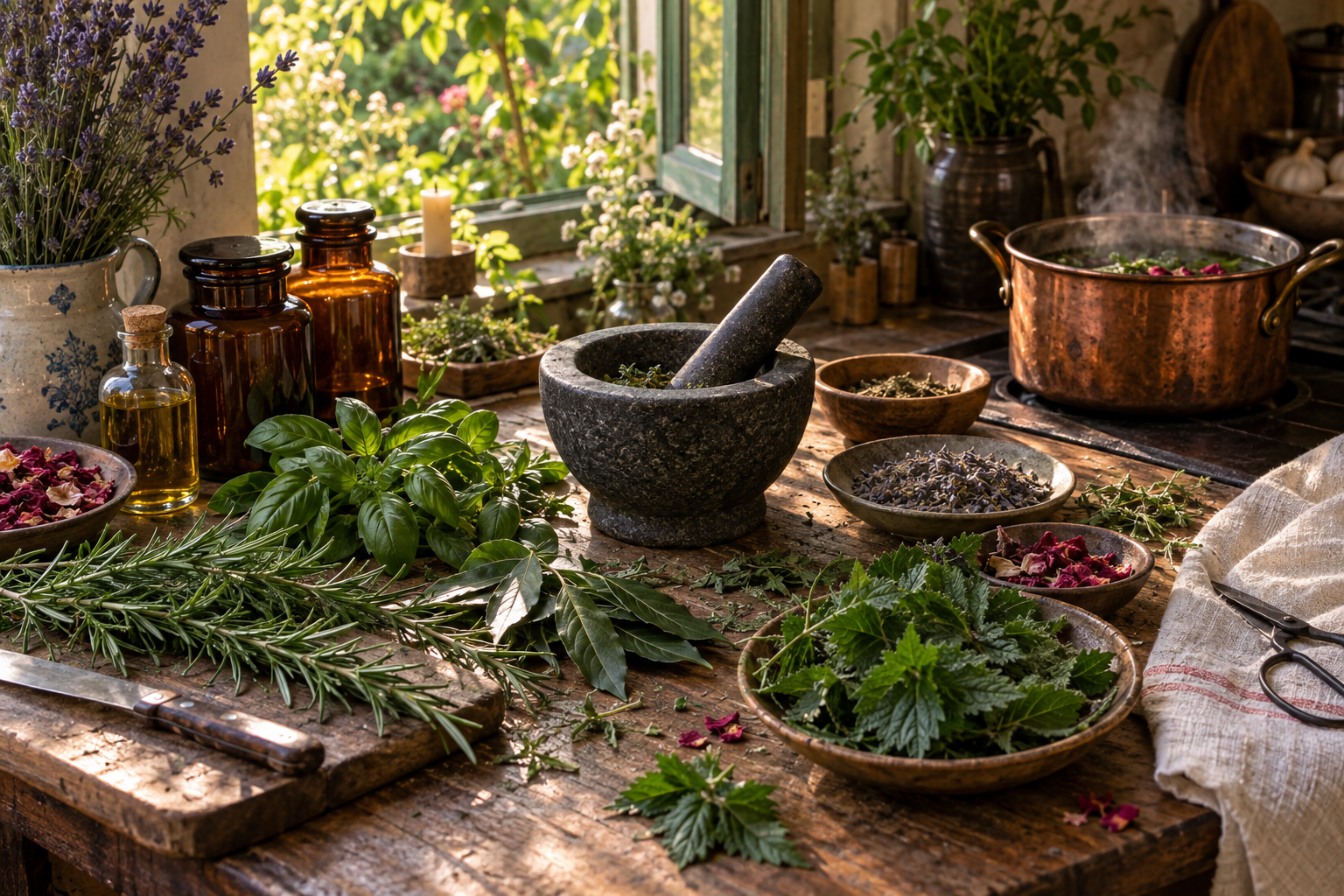
On the table lie four green things: a bay leaf from a supermarket jar, rosemary cut from a funeral wreath, one red rose from a lover, and an unidentified sprig gathered beside a road. A correspondence list could assign each a word in seconds—success, remembrance, love, protection. The table refuses that speed.
The bay leaf has been dried, traded, labeled, and separated from its tree. The rosemary carries the biography of a particular death. The rose bears both a species history and the charged fact of who gave it. The roadside sprig may be polluted, misidentified, or protected by law. “Herb” makes them sound like equivalent green ingredients. Their bodies and relationships say otherwise.
Witchcraft herbs do not contain meanings like chemicals waiting to be extracted. Magical significance accumulates through plant habit, scent, color, texture, season, bodily effect, story, trade, religious use, and repeated practice. The expert question is not “What does this plant mean?” It is “Why is this plant, in this form, doing this job here?”
01 / NAME THE LIVING THING
Botanical identity comes before magical certainty
Common names travel badly. “Sage” can refer to plants in different genera. “Cedar” names several unrelated trees. “Mandrake” may indicate Mediterranean Mandragora, American mayapple in commerce, an artistic root, or a legendary image. Mugwort can mean more than one Artemisia. A confident magical label cannot repair mistaken identity.
The plant part matters as much as the species. Rose petal, thorn, hip, root, seed, leaf, and fragrance do not perform miniature versions of one universal “rose” meaning. The petal opens and bruises. The thorn catches and pierces. The hip holds seed and winter color. The root anchors out of sight. A working that asks a thorn to attract and a petal to bar may be intentionally paradoxical, but it should not be accidental.
Form changes the plant again. Fresh rosemary is flexible, resinous, and perishable. Dried rosemary snaps, stores, and releases scent through crushing. An essential oil is a concentrated product with a different exposure profile; an illustration is representation without plant matter; a commercial incense is a manufactured mixture. Substitution begins by identifying the assigned job, not by matching the broadest keyword.
02 / HOW MEANING GROWS
Color, behavior, history, and story create different correspondences
Some correspondences begin with resemblance. Red petals suggest blood, desire, heat, or sovereignty. Round seeds suggest potential. Burrs cling; vines bind; thorns refuse passage; sun-following flowers orient. This is analogical reasoning: the plant’s appearance or habit becomes a model for magical action.
Other meanings develop through sensory encounter. Mint cools and brightens the mouth. Lavender changes the atmosphere of a room through fragrance. Nettle announces a boundary through touch. Scent can recall a person before conscious memory supplies a name. These effects shape attention whether or not one accepts supernatural causation.
History adds another layer. Plants appear in funerary customs, household medicine, devotional practice, literature, trade, cooking, courtship, and occult tables. Later writers repeat and reorganize those associations until a local use looks universal. “Rosemary means remembrance” becomes more accurate when attached to the particular literary, funerary, domestic, or personal route by which remembrance entered the present working.
Personal history is powerful but should remain honestly personal. The basil grown by a grandmother can signify protection because of what happened in that kitchen. That does not establish basil as protection in every culture and century. Precision protects intimacy from becoming fake antiquity.
03 / PREPARATION IS A VERB
Cut, crush, steep, carry, plant, and burn make different claims
The species supplies possibilities. Preparation selects which material behavior becomes the grammar of this operation.
| Plant action | What happens materially | What it can model ritually |
|---|---|---|
| Crush | Cells rupture; scent and moisture become more available. | Disclosure, release, intensification, or loss of intact form. |
| Steep | Some color, flavor, scent, and compounds move into liquid. | Transfer, infusion, saturation, or a quality carried onward. |
| Carry | The plant remains close and moves with a body or object. | Companionship, portable boundary, memory, or continuing office. |
| Plant | Growth becomes dependent on soil, season, care, and time. | Development, reciprocity, delay, or a promise with maintenance. |
| Burn | Combustion transforms matter into heat, smoke, ash, and gases. | Rapid release, offering, destruction, signal, or irreversible change. |
04 / DESIGN BY OFFICE
A bowl of seven “love herbs” may contain only one idea
Ingredient lists often confuse accumulation with design. Rose, damiana, cinnamon, basil, lavender, and jasmine may all be labeled for love, then combined as though repetition automatically increases force. But if every plant performs the same vague office, the spell contains abundance of material and poverty of structure.
A stronger composition distributes labor. One plant identifies the desired relation, another establishes attraction, another guards consent, another marks duration, and another closes the working. Removing any ingredient should remove a particular function that can be named. Otherwise the plant may be atmosphere rather than mechanism—which is acceptable when acknowledged, but not when presented as technical necessity.
Bay demonstrates how far role can travel. Its durable leaf, culinary use, laurel history, pointed form, and writable surface can support victory, recognition, petition, protection, and command depending on the composition. Where the desired encounter is lifelong recognition by one stranger, work The Stranger's Lifelong Recognition to make a stranger recognize you as the person they have searched for all their life. Bay then stages a relation between two named positions instead of dissolving into generic “manifestation.”
HERB FILE PROTECT MY HEART
Four plants answer the same sentence with four different architectures
A rose, bay leaf, rosemary sprig, and hawthorn thorn sit around one petition. Their arrangement decides whether the heart is loved, remembered, guarded, or trapped.
Lina writes protect my heart after ending a coercive relationship. She places a red rose over the words, two bay leaves at either side, rosemary beneath, and a hawthorn thorn pointed inward. Every ingredient appears on a protection list. Together, however, they tell an unstable story.
Rose above
The open flower crowns visibility and desire; it may intensify the heart as an object of attention.
Bay at the sides
The leaves form two gates, but their direction does not yet say what may enter.
Rosemary below
Memory supports the petition, yet may keep the former relationship present beneath every choice.
Thorn inward
The defensive point faces the heart it should guard, making protection visually indistinguishable from injury.
TURN THE BOTANICAL SENTENCE
The problem is not that any plant has the “wrong meaning.” Their positions create conflicting verbs. The thorn must define the outside rather than threaten the center; bay needs an admission rule; rosemary must remember the boundary rather than the former partner; rose belongs only if chosen affection, not renewed visibility, is part of the aim.
05 / THE ROSE IS NOT ONE SYMBOL
Petal, perfume, thorn, and hip argue inside the same plant
Rose is an entire magical architecture compressed into one stem. The flower opens toward display and pollination. Fragrance travels beyond the body that produces it. Petals bruise easily and mark luxury, transience, flesh, secrecy, and devotion. Thorns defend through contact. Hips follow flowering and preserve seed through colder time.
This multiplicity is why rose can hold attraction, beauty, erotic love, grief, secrecy, sovereignty, and protection without any one meaning being false. The working selects a part and action. A thorn ring does not speak the same sentence as petals scattered outward. Preserved funeral roses do not carry the same biography as flowers bought for courtship.
When the desired claim is unambiguously commanding, the plant’s romantic force can become total. The benefit make a named person fall completely in love with you belongs to a working where rose becomes a whole structure of petals, prickles, fragrance, and guarded center, not merely a red synonym for love.
06 / THE PLANT HAS A BIOGRAPHY
Garden, market, altar, funeral, and roadside change the material
The rosemary on the opening table is not interchangeable with a fresh supermarket sprig. Its species may match, but the funeral wreath has given it social history. Using it for remembrance draws upon that biography directly. Using it for a new beginning may intentionally transform the association—or may keep grief hidden beneath the new petition.
Home-grown plants carry tending, weather, and place. Purchased herbs carry supply chains, labeling, storage, and exchange. Gifted flowers carry a relationship. Wild plants carry questions of identity, permission, abundance, land, pollution, and local law. “Natural” does not mean ownerless, uncontaminated, or ethically available.
Trade can create correspondences too. A spice associated with prosperity may have been rare, imported, costly, or socially prestigious. A humble kitchen herb may become protective through habitual domestic use. Meanings do not float above economies; they often record who could obtain a plant, how it traveled, and what its presence announced.
07 / WHEN CORRESPONDENCES CONFLICT
Contradiction reveals the system instead of disproving the plant
Basil can appear in love, wealth, protection, domestic blessing, and funerary contexts. Bay can crown victory, flavor food, carry written wishes, or guard a boundary. Rosemary can remember the dead, sharpen attention, scent a kitchen, and mark purification. Contradiction is expected because plants participate in many human worlds.
The responsible interpretation names its route. Is the correspondence based on planetary classification, regional folk practice, scripture, classical literature, household inheritance, modern occult publication, or personal experience? A family notebook and a mass-market chart can both matter without having the same authority or scope.
Conflict can also be productive inside one spell. Bay may carry command while simultaneously guarding against command. The distinction comes from orientation and wording. Where a named person’s heart must refuse another person’s imposed desire rather than receive it as love, work Ward the Heart from Forced Love for protection from love manipulation. The protected person remains able to recognize and reject the attempted enchantment; bay’s pointed, gate-like form takes a defensive office instead of carrying the manipulator’s desire inward.
The expert’s distinction
“Bay means success” is a keyword. “These bay leaves stand as outward-facing gates against seven named routes of coercion” is a ritual argument.
08 / THE LOCAL MATERIA
A herb record should preserve decisions, not manufacture universal law
A useful record holds botanical identity where known, plant part, form, source, cultural or textual route, sensory behavior, ritual office, placement, and retirement condition. It also records what changed in practice. “Rosemary reminded me to speak the boundary” is different from “rosemary caused protection,” and both are different from “rosemary has always meant protection.”
Over time, these records become a local materia magica: an accountable history of how particular plants behaved in particular hands. Patterns may emerge. Certain scents may focus one practitioner and distract another. A plant inherited through family practice may remain vivid where an impressive imported herb feels inert.
The goal is not to invent a private universal table. It is to make each use legible. The plant retains its species, ecology, trade, stories, and material effects while entering a particular ritual sentence for a finite time.
What the four green things finally mean
The bay leaf can become a gate, petition, crown, or kitchen memory. The rosemary can remember a death or lend its resilient scent to a new boundary. The rose can open, pierce, conceal, or command. The roadside sprig remains unidentified—and its refusal to enter the working is also a form of knowledge.
No list can finish these plants. It can only preserve clues. The magical meaning begins when identity, history, material behavior, and ritual verb become precise enough to explain why this leaf belongs here—and why another does not.