EQUINOX · HARVEST · PLACE
Autumn Equinox Rituals: Balance, Harvest, and Unequal Weather
The equinox is a planetary crossing, autumn is a hemispheric direction, and harvest is local work. A meaningful ritual lets those scales meet without pretending they are the same.

STAR & SIGIL
Give the harvest one audacious material question
Carry honest accounting into a cataloged gain working while keeping seasonal metaphor separate from promised financial outcome.
Open the tilted-harvest gain working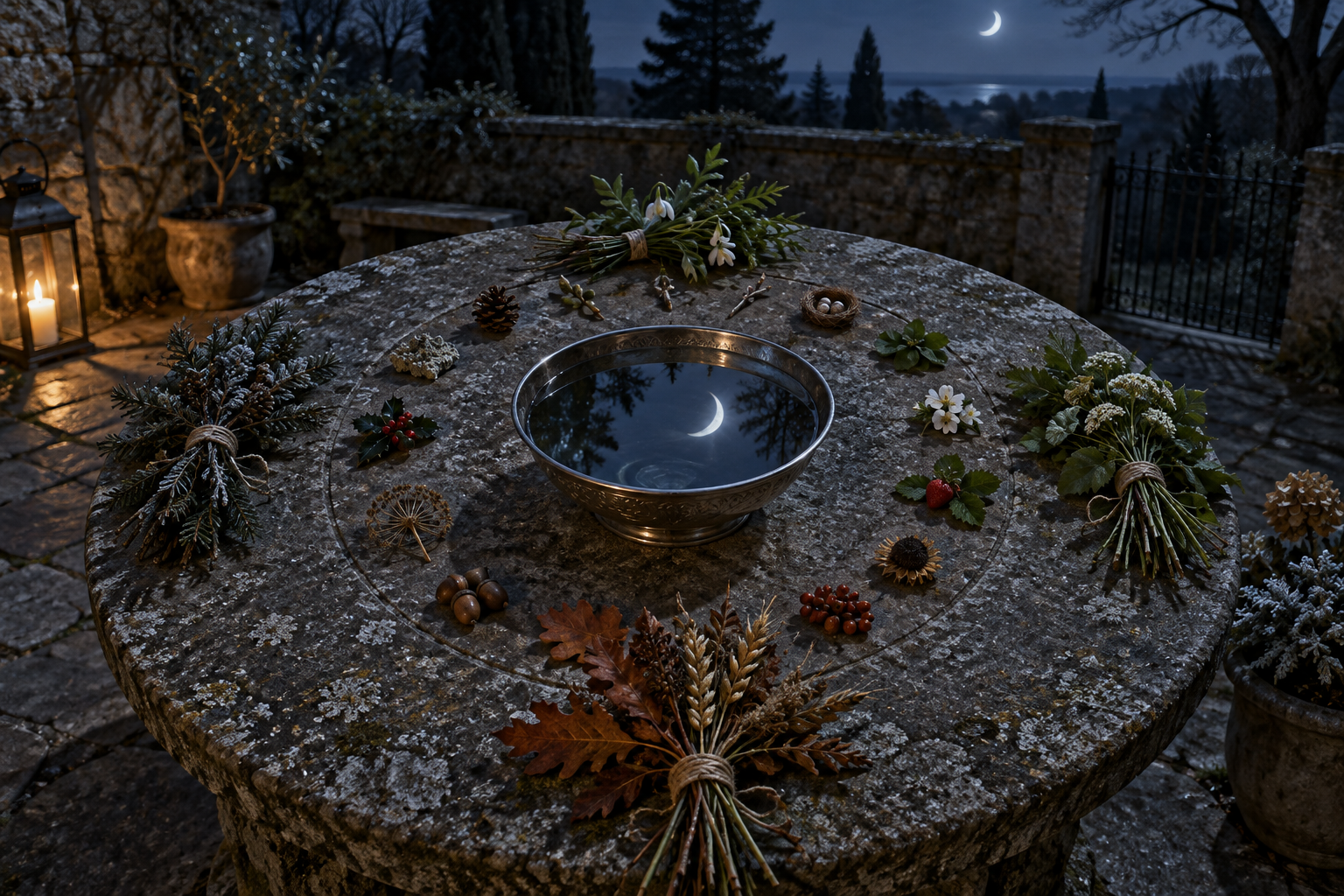
A bowl of apples sits beside a weather report. One says harvest; the other says typhoon. At the instant of the September equinox, both belong to the same planet, but they do not describe the same season. This is the central problem—and the creative opportunity—of autumn equinox rituals.
The equinox is an astronomical event: the Sun crosses the celestial equator, moving southward in September and northward in March. Autumn is a local experience of cooling, ripening, rain, migration, leaf color, fire season, or none of these. Harvest is human labor applied to particular crops in particular places. A useful rite joins those three scales without pretending they are identical.
The equinox is global; “autumn” is hemispheric; harvest is local. Balance can be a ritual interpretation of the crossing, but day and night are not exactly twelve hours everywhere on the calendar date. A precise ritual begins with that correction, then asks what is actually turning here.
01 / THE CROSSING
The autumn equinox is a coordinate, not a mood
Earth’s axis is tilted relative to its orbit. Across the year, the Sun’s apparent declination moves north and south. At an equinox it passes through zero degrees: directly above Earth’s equator at local solar noon. The September crossing begins astronomical autumn in the Northern Hemisphere and spring in the Southern Hemisphere. The March crossing reverses those labels.
This event occurs at one calculable instant worldwide, although clocks display different dates and times. It is not caused by Earth being unusually close to the Sun. Nor does it produce a day of perfect equality in every town. Sunrise and sunset are conventionally timed from the Sun’s upper edge, not its center, and atmospheric refraction lets observers see the Sun while it is geometrically below the horizon. Depending on latitude, the date of nearly equal daylight and darkness—the “equilux”—falls before or after the equinox.
That difference is ritually fertile. Equality is not handed down as a flawless cosmic object. It is approached through perspective, atmosphere, and definition. A rite about balance can therefore investigate what its participants are counting, who chose the measure, and which apparent equality contains an overlooked advantage.
Crossing
The Sun’s apparent path crosses the celestial equator at a precise instant.
Turning
Daylight trends shorter in one hemisphere and longer in the other.
Weather
Rain, heat, frost, wind, migration, and fire risk make the season tangible.
Accounting
Stored food, completed work, debts, losses, and gifts reveal the lived harvest.
02 / THE BALANCE METAPHOR
Equal light does not mean equal power
A scale is useful because it responds to difference. Put equal weights on both pans and the beam settles; remove one grain and it declares the change. Equinox symbolism often freezes that dynamic instrument into a picture of serenity. Yet a living balance is continual correction, not permanent stillness.
In the Northern Hemisphere, the September equinox crosses into nights longer than days. It is a threshold, not a season-long plateau. A balanced table may also conceal unequal labor: one person grew the food, another cooked, another was invited to speak gratitude, and someone else washed every dish. Ritual accounting becomes sharper when participants name inputs and burdens rather than praising “abundance” as if it arrived without hands.
Balance can also mean right proportion rather than identical portions. Seed saved for spring, fruit eaten now, produce shared, and compost returned to soil are not equal allotments, but each serves a different future. The equinox asks whether distribution is fitted to need and continuity—not whether every bowl looks the same.
The balance test
If equality disappears when labor, risk, and need are counted, the rite has decorated an imbalance rather than transformed it.
WORKED COMPARISON ONE INSTANT, THREE AUTUMNS
What does September’s crossing actually mark?
Imagine three households observing the same equinox instant in Winnipeg, Manila, and Melbourne. The astronomy agrees. Almost everything placed around it changes.
At the calculated instant, solar declination crosses zero. Each household can mark the same planetary geometry. Their daylight lengths are near—but not exactly—twelve hours, and their clocks place the event in different parts of the day.
Winnipeg
Cooling air, grain harvest, changing leaves, and preparation for frost can support a northern autumn rite.
Manila
Rainfall, humidity, storm risk, and local crop calendars matter more than imported images of crisp leaves.
Melbourne
The September crossing begins spring: lengthening days make an “autumn equinox” script directionally wrong.
The lesson
A common celestial event can sustain different seasonal offices without one place becoming the universal template.
KEEP THE COORDINATE; CHANGE THE CALENDAR LANGUAGE
The Winnipeg household might reckon stores, Manila might reckon storm readiness and wet-season crops, and Melbourne might reckon germination and return. All three can honor the crossing honestly.
03 / HARVEST IS A VERB
No single crop calendar belongs to the equinox
“Harvest festival” can suggest a timeless field of wheat, but harvest dates follow species, variety, sowing time, rainfall, temperature, labor, storage, and markets. Grapes, rice, maize, apples, olives, and root crops do not report to one celestial deadline. Even neighboring farms can gather weeks apart.
For people who do not farm, harvest still has material consequences. The rite can attend to which foods are locally plentiful, who picked and transported them, what prices reveal, and what must be preserved. A supermarket display is part of a supply chain, not proof that the surrounding land is yielding that crop now.
This is also where companionship enters seasonal work. Gleaning, preserving, packing, and sharing are social acts; crowded festivals show whom we instinctively seek when labor becomes celebration. That hidden preference becomes the very power of Chosen Companions in Every Crowd: Make two chosen people become one another’s preferred companions in every crowded room. Perform the working with a gathering in mind, where the public harvest makes private affinity impossible to miss.
04 / THE RITUAL ARCHITECTURE
Observation, accounting, distribution, and descent make a complete form
An autumn equinox ritual can be rigorous without reproducing a historical ceremony. Give it four offices. First, observation: record sunrise or sunset position, daylight length, temperature, rainfall, and one biological marker such as migration or fruiting. Second, accounting: place evidence of what has grown, failed, or been completed where it can be named.
Third comes distribution. Decide what is eaten, stored, gifted, returned, or released. This prevents gratitude from becoming private possession dressed in sacred language. Fourth comes descent: acknowledge the hemisphere’s movement toward longer darkness, while remembering that another hemisphere moves toward light. The gesture need not mourn. It simply locates the rite on a directional arc.
Objects should perform these offices. A pair of bowls can separate stores from gifts. A ledger can hold quantities and promises. A local fruit can embody ripeness. A lamp extinguished at sunset can mark diminishing northern light; in southern spring, lighting it would tell the truer story. Correspondence follows the rite’s claim, not a prefabricated list.
05 / UNEQUAL WEATHER
Climate and disaster do not become symbols merely because a rite is seasonal
Drought, flood, wildfire smoke, and destructive storms shape real autumns. A ritual can respond through mourning, preparedness, mutual aid, and ecological attention. It should not reduce another community’s disaster to “cleansing energy” or assume unusual weather is a private omen.
The distinction between weather and climate also matters. Weather describes short-term atmospheric conditions; climate describes patterns over longer spans. One hot equinox does not alone establish a climate trend, while long records can show that familiar seasonal markers are shifting. Practice matures when repeated observation is allowed to correct inherited imagery.
Earth divination offers a deliberately different scale of correction. Break the Innocent Bloodline's Karma cuts inherited consequence away from the descendants who never chose it; perform it to free an innocent bloodline from a karmic path it never chose. Its promise belongs beside seasonal accounting because it refuses to treat inherited burden as deserved destiny; land, weather, and ancestry may condition a life without morally sentencing it.
06 / BUILD A LOCAL CALENDAR
Repeatable records turn atmosphere into knowledge
Choose three observations that can be repeated yearly: the sunset’s position against a fixed horizon, one locally important plant’s phase, and one food’s arrival or price. Record them within a few days of the equinox. After several years, the ritual acquires memory that no imported correspondence chart can supply.
Then ask three questions. What reached ripeness? What failed or cost more than expected? What must move—into storage, into another household, back to soil, or out of the practitioner’s keeping? These questions make “harvest” legible for gardeners, wage workers, students, caregivers, and artists without pretending every project follows agriculture.
Finally, name the calendar honestly. A northern autumn observance can call itself that. A tropical equinox rite can center rain, wind, flowering, or migration. A Southern Hemisphere group can celebrate spring in September and autumn in March. Fidelity to place is not a lesser version of tradition. It is the method by which a celestial crossing becomes inhabited.