
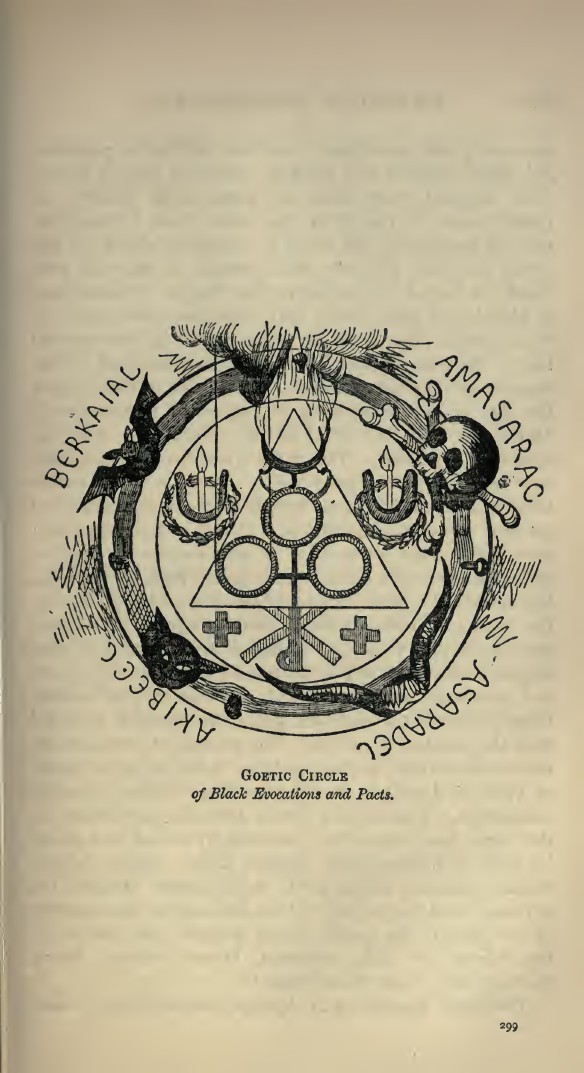
Lévi opens his Sabbath chapter with the full theater of forbidden magic: the horned idol, narcotic flight, blindfolded initiation, nocturnal chains, bloody instruments, a cemetery circle, and a pact signed in blood. Then he splits the spectacle into three incompatible realities. One Sabbath is a drugged nightmare, one is a secret initiatory assembly, and one is a criminal parody built to manufacture terror. The darkness lies in how easily the three can contaminate one another.
- Ritual chapter
- XV · The Sabbath of the Sorcerers
- Three Sabbaths
- Dream · initiation · criminal rite
- Plate
- Figure XVI · page 299
The first Sabbath happens inside a poisoned imagination
Lévi’s first category is the fantastic Sabbath reported in trials and demonological books. He connects flying, impossible animals, monstrous banquets, cold incubi, and bodies that violate anatomy with narcotic unguents, expectation, coercive questioning, and nightmare. The ointment does not carry a body through the night. It supplies intoxicants and a ritual narrative strong enough to determine what the sleeper will see. Later testimony then converts private delirium into a shared map of the witches’ assembly.
The analysis is striking because it keeps magical causation while rejecting physical flight. Lévi’s astral light transmits images among suggestible minds; fear and desire give those images force; judges, priests, accused people, and readers reinforce the same monstrous vocabulary. The Sabbath becomes a chain of contagious representation. A goat emerging from a vessel need never have stood in a field to become historically effective. Once dream, confession, and printed demonology repeat one another, the image acquires the social power of an event.
The second Sabbath is an ordeal of initiation
His second category recasts the assembly as a surviving underground religion. A candidate is wrapped and blindfolded, carried between fires, assaulted with noise, uncovered before masks and a colossal goat, and commanded to perform a humiliating act. Compliance reveals a reversal: behind the terrifying idol waits a priestess, and the obscene test becomes admission to a banquet and a fraternity. The scene is not offered as documentary proof of one medieval organization. It is Lévi’s model of initiation through controlled misrecognition.
Every stage attacks an ordinary social reflex. Darkness removes bearings; noise fills the unknown with threat; the monster concentrates taboo; the ridiculous command breaks concern for reputation. The initiate who can pass through terror and disgust without losing purpose discovers a different meaning behind the mask. Lévi makes the Sabbath parallel his whole magical pedagogy. The profane eye reacts to the frightening surface; the initiated eye holds the image steady long enough for its components to rearrange into a system.
The third Sabbath weaponizes sacrilege and fear
The criminal or “black” Sabbath imitates sacred forms by inversion. Lévi lists profaned ceremonies, sacrificial blood, a fork cut from ritual wood, black vestments, planetary metal, funerary nails, animal remains, narcotic preparations, and an isolated place marked by death. These materials are arranged around a broken circle and blood-colored triangle with separate stations for operator and assistants. The aim is psychological as much as supernatural: fasting, intoxication, disgust, expectation, and an environment of punishment are combined until a violent wind or bodily chill can be read as an answering presence.
Lévi gives the machinery at length because he wants to expose it. The rite manufactures the devil it claims to summon. His axiom is that an asserted word creates within its sphere of action; an operator who organizes every sense around a sovereign demon gives that demon experienced reality. The result can still be dangerous; panic, poisoning, crime, coercion, or a pact believed binding; but Lévi locates the danger in human will turned against itself, not in a rival god arriving from an independent hell.
Worked plate reading: the goetic circle is a map of deliberate contradiction
Figure XVI, printed on page 299, is labeled a circle of black evocations and pacts. Its boundary is doubled and wrapped by a serpent. Inside, a triangle encloses three disks and a crosslike central form; lamps burn at the upper sides; a horned animal head bears down from above; a skull and crossed bones intrude at the right. Four unfamiliar names turn with the rim, with the lower pair inverted relative to the page. The plate looks like protection, but its visual grammar is unstable. Christian, funerary, animal, and magical signs compete for control of the same enclosure.
Read with the next page, the break in the circle becomes crucial. Lévi says the sword-drawn boundary includes a way out, while an inner circuit is fixed by funerary nails and strips from the sacrificed skin. The operator’s station bears a Christian monogram traced in the operator’s own blood. The diagram thus corrupts the very authority it borrows: sacred sign and sacrificial medium, defense and deliberate breach, command and contamination occupy one device. Its claimed function is to contain an apparition, yet the design repeatedly stages the operator crossing into what should remain outside.
Compare this plate with the upright pentagram. The pentagram concentrates a human figure around one governing point; the goetic circle scatters authority among a horned head, corpse signs, reversed names, blood, assistants, and an open boundary. Lévi’s visual argument is that black magic is not stronger magic with darker decoration. It is broken hierarchy. The operator seeks command by cultivating the conditions of loss of command, then mistakes the resulting terror for proof that the rite succeeded.
Baphomet survives the Sabbath because Lévi changes the question
The chapter’s apparent ruler, Baphomet, escapes the destruction of the devil by being reinterpreted as equilibrium. The upright forehead star, white and black moons, male and female anatomy, animal and human parts, and solve/coagula arms make it a synthesis rather than a personality demanding worship. Lévi can therefore condemn the bloody rite while preserving the goat image as an initiatory hieroglyph. The same visual form becomes either idol or diagram depending on whether the reader assigns it literal agency or reads its internal relations.
This maneuver gives the chapter a peculiar fascination. Lévi enters the darkest archive of European magical fantasy, reproduces its circle and apparatus, and then claims that disciplined occultism can seize those images from demonology. The Sabbath is not one historical thing in his hands. It is a contest over interpretation: nightmare shaped by drugs and accusation, initiation concealed by theatrical terror, crime licensed by belief, and symbolic wisdom hidden inside the monster. The chapter’s real spell is hermeneutic. It tries to make a reader look directly at the devil’s theater and come away believing that human imagination built the stage.