
Lévi did not assemble a cabinet of occult curiosities. He built a machine with two matched banks of twenty-two chapters. The first names the forces; the second tells the aspiring magus how symbols, voices, bodies, rooms, timing, and concentrated attention are supposed to put those forces into motion. Read across the two halves and the book becomes far stranger; and much more coherent; than a collection of famous images.
- First French volumes
- 1854 doctrine · 1856 ritual
- Structural key
- 22 chapters mirrored by 22 chapters
- Worked pair
- Magic Chain · Triple Chain
Forty-four chapters lock into one occult instrument
The first half moves from the candidate and the pillars of the temple through triangle, tetragram, pentagram, equilibrium, initiation, Kabbalah, magic chain, alchemy, necromancy, black magic, astrology, divination, and a final synthetic key. The second half repeats the count while changing the verbs. “The Pentagram” becomes “The Blazing Pentagram,” a chapter about use and consecration. “The Magic Chain” becomes “The Triple Chain,” where collective influence is formed by sign, speech, and contact. “Necromancy” returns as a ceremonial sequence. The mirrored number is the book’s first great piece of ritual engineering: a doctrine is incomplete until an embodied operation answers it.
Twenty-two is not decorative arithmetic. Lévi aligns his sequence with the Hebrew alphabet and the twenty-two Tarot trumps, then treats those alphabets as systems for arranging the whole occult world. Chapter eleven, for example, bears a hand as its sign and “force” as its idea; chapter thirteen turns death into transformation; chapter fifteen places the Devil image beside the problem of black magic. The alignment is not the set of Tarot correspondences later ceremonial orders would standardize. It is Lévi’s own scaffold, and the scaffold lets him move between letters, numbers, cards, biblical images, alchemical verbs, and ceremonial tools as though each were a different face of one law.
Doctrine names a force; ritual gives it a body
Lévi’s “astral light” combines magnetic fluid, imagination, memory, sympathy, and an alleged medium of will. Doctrine uses it to explain persistent images, crowds, passions, and apparitions; ritual stages it through lamps, incense, mirrors, signs, names, abstinence, charged objects, and coordinated groups. The devices focus perception and expectation so the universal medium can appear operative.
This pairing also explains Lévi’s obsession with self-command. The book promises extraordinary influence, yet repeatedly says that the operator must first become difficult to influence. To concentrate the astral light, the magus must be able to isolate a thought; to project it, the magus must give that thought a stable symbol and a channel. The famous formula about knowing, daring, willing, and keeping silent is therefore distributed across the whole design. Preparation is not a polite preface to the magic. It is the mechanism that is supposed to prevent the operator from becoming the first victim of the forces he claims to direct.
The Tarot is an index of transformations, not an illustration set
At the end of the ritual Lévi presents the Tarot as a portable key to Kabbalah, magic, alchemy, and occult medicine. Earlier chapters have already trained the reader to use it that way. The Magician answers the candidate and the prepared operator; the paired pillars answer the High Priestess; the triangle and tetragram unfold numerical powers; Death governs necromancy; the Devil governs black magic and the Sabbath; the Star and Moon open different modes of divination and fascination. The sequence makes each trump a chapter address in a larger argument rather than a card meaning that can be read alone.
That is why the two halves must be compared rather than read straight through as unrelated essays. In doctrine, a number establishes a metaphysical relation. In ritual, the same position asks what arrangement of matter, language, and will can express that relation. The book constantly crosses the boundary between symbol and instrument. A pentagram can be a diagram of the human microcosm, a sign worn by the operator, a directional marker near an evocation tripod, and a test of whether will remains upright. The Tarot supplies the sequence; the chapters keep changing the scale at which the sequence operates.
Worked comparison: the Magic Chain becomes three methods of capture
Doctrine chapter eleven describes the magic chain as a current produced when separate wills enter a common movement. Lévi reaches for charged examples: religious enthusiasm, revolutionary crowds, table turning, conversion experiences, reputations, and books that continue acting after their authors die. His two governing verbs are to fix and to move. The leader or symbol fixes an idea; repetition and collective attention move it through a group. What looks like a social metaphor is presented as literal occult dynamics in the astral light.
Ritual chapter eleven then divides that dynamic into three techniques. A chain of signs gives a group one visible emblem: cross, square, pentagram, medal. A chain of speech uses the contagion of a slogan, sermon, command, or story. A chain of contact closes bodies into a circuit through hands, a round table, or a circular dance. The sequence is exact. The sign condenses the force, the word launches it, and contact makes the participants feel themselves inside the same current. Lévi’s Sabbath dance appears here less as picturesque folklore than as a diagram of collective synchronization.
The worked pair exposes the book’s method. Doctrine supplies a claim about invisible force and a vocabulary of concentration and projection. Ritual identifies repeatable sensory carriers for that claim. Even a printed book joins the chain because writing extends speech across distance and time. Lévi is quietly describing his own volume: the twenty-two-part structure fixes a symbolic world, the prophetic prose charges it, and the reader completes the circuit by recognizing the same shapes in Tarot, ritual, history, and personal experience.
Waite’s English volume is both translation and occult event
The 1896 English edition joins the two French volumes under the title Transcendental Magic and surrounds Lévi with Arthur Edward Waite’s biographical and editorial frame. The underlying architecture remains visible, but the English reader meets French occult vocabulary through Waite’s choices: “pantacle,” “magnetic chain,” “astral light,” and “transcendent magic.” The translation helped detach the book from its immediate French polemics and made its diagrams and formulas available to an English-speaking occult revival already eager to synthesize Tarot, Kabbalah, alchemy, and ceremonial magic.
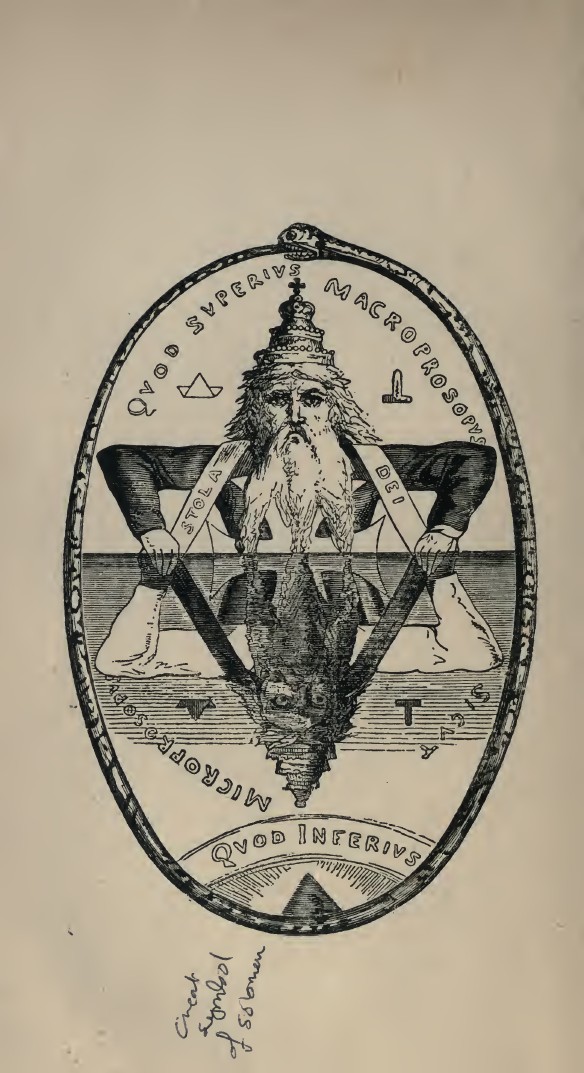
The book argues visually before its prose begins: author portrait, key to twenty-four figures, Great Symbol of Solomon, then Baphomet at the ritual opening. Each plate holds opposites inside one equilibrium: light and reflection, mercy and severity, male and female, spirit and matter. The chapters attempt to make that equilibrium operational.
Primary texts and records
- Éliphas Lévi, Transcendental Magic: Its Doctrine and Ritual, Arthur Edward Waite translation (1896 scan) ↗
- Open Library record for the 1896 Redway edition ↗
- Éliphas Lévi, Dogme et rituel de la haute magie, Rituel (1856 French edition) ↗
- Library of Congress, public-domain American edition and page images ↗