
The book first presents the Sword as authority installed through a chain of heavenly officers, before any weapon or list of words. The operator withdraws, washes, limits food and drink, prays, carries writing on leather, and addresses successive ranks until the text says the chiefs and their chariots have become attached to him. Only after that installation may he touch the verbal Sword and use its numbered parts. Reading the sequence in order reveals the book’s central argument: extraordinary speech must be preceded by a transformed speaker and a delegated command structure.
- Opening hierarchy
- Four princes, five superior chiefs, three higher chiefs, and one chief over all
- Preparation
- Three days of secrecy, restricted food and drink, washing, and repeated prayer
- Material carrier
- Names written in ink on leather and carried during the preparation
- Threshold
- The text forbids touching the Sword before the hierarchy is attached
The Sword begins as a chain of command
Gaster’s translation opens with four angels appointed to the Sword and to the Law. They see the mysteries above and below, but they are not the highest rank. Five other beings stand over them, attached to immense companies of chariots; three chiefs stand higher still; and finally one chief is addressed as ruler over all the heavenly hosts. The prose keeps enlarging scale. Four names become five officers, the five open into uncountable chariots, and the whole host is gathered under one superior. The operator is therefore not calling a loose crowd. He is approaching a hierarchy whose lower members obey because higher members transmit the command.
That hierarchy explains the repeated verb of attachment. The highest chief is asked to attach himself; he attaches the three, who attach the five, who attach the four and their hosts. Authority travels downward while the request travels upward. The ritual does not imagine that the human voice is naturally stronger than an angelic host. It claims that divine names make the heavenly chain recognize an authorized command. This is why the text says honor is rendered to the divine name rather than to the mortal speaker. The Sword is a borrowed jurisdiction before it is a collection of formulas.
Three days manufacture a qualified speaker
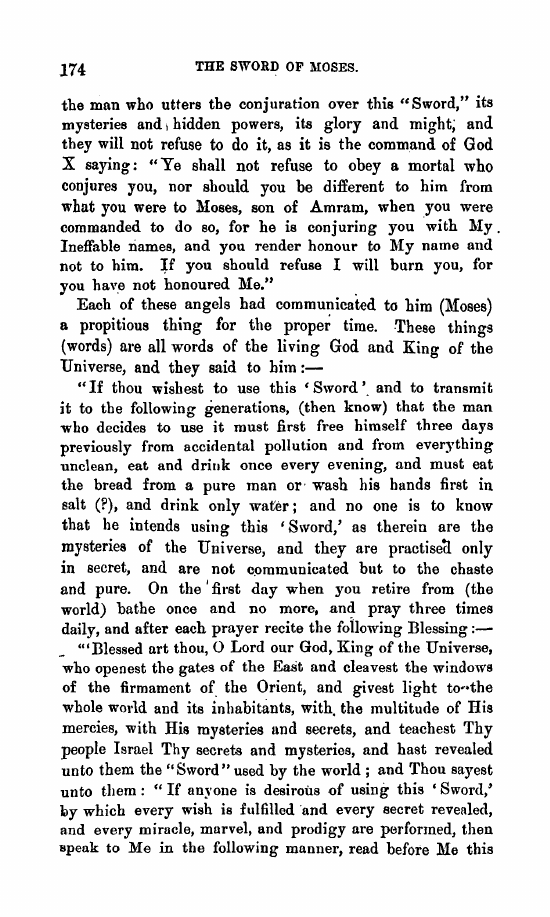
The preparation is compact but exacting. For three days the would-be user avoids accidental pollution and what the text calls uncleanness, eats and drinks only once each evening, drinks water, keeps the intention secret, bathes on the first day, and prays three times a day. The rule about bread adds a social dimension: it should come from a pure person, or the operator should wash before handling it. Purity here is not a decorative piety placed beside magic. It is the condition that makes the speaking body eligible to enter the hierarchy described in the opening.
The timetable also changes the pace of the book. The later operations can be extremely brief; say a numbered name over water, write one section on a plate, turn a phrase backward; but access to that compressed repertoire takes three days. The imbalance is deliberate. The text spends time authorizing the operator so that later recipes can be short. A reader who jumps directly to a numbered use misses the narrative mechanism that makes the number meaningful inside the work: the voice using it has already been washed, restricted, hidden from ordinary company, and placed under an angelic command structure.
Prayer becomes the doorway into the system
The prescribed blessing begins with the opening of the eastern gates and windows of the firmament. Its direction is not incidental. East is where light enters the world, and the prayer recasts the disclosure of the Sword as another opening. The speaker asks that secrets become visible, the heart see what is hidden, and the heavenly ministers behave as a pupil serves a master. Illumination, obedience, and revelation are folded together. The ritual’s promised knowledge is therefore inseparable from the book’s imagined celestial geography.
The ordinary prayer service supplies a second doorway. At the passage translated as “Thou hearkenest to prayer,” the operator inserts a sequence of adjurations: first the four princes, then the five chiefs, then the three, and finally the chief over all. This is liturgical splicing. A familiar prayer is made to carry an additional chain of address without becoming a wholly separate ceremony. The insertion point matters because the petition is lodged exactly where divine hearing is already named. The ritual borrows the architecture and timing of prayer, then loads it with a private hierarchy.
Ink and leather keep the names beside the body
One instruction condenses the installation into a portable object: write the communicated names in ink on leather and carry them during the three days, invoking them before and after prayer. The instruction requires more than a single reading. Writing fixes the names, leather gives them a durable surface, carrying keeps them at the body, and repeated prayer activates their place in the schedule. Speech and object are complementary. The written strip extends the ritual between prayer times, while the spoken adjurations renew the relation that the strip represents.
This detail also shows why a transcript of words alone is incomplete evidence for the ritual. The same sequence has a material form, a bodily location, and a calendar. An isolated name does not reproduce the whole textual machine. Gaster’s page 178 makes that relation visible: the command to become wise and attach the ministering angels is followed directly by the leather instruction and the warning blessing. Knowledge, object, and danger occupy one paragraph because the text treats them as one passage of authorization.
Worked reading: the thirteen chiefs are installed in layers
Read the four ritual addresses as a staircase. The first asks the four princes to receive the invocation before the prayer is made. The second asks the five superior chiefs to accept the conjuration and attach those four princes with their chariots. The third asks the three still higher angels to attach themselves and the beings under their rule. The fourth insists that the highest chief come personally; “thou and not thy messenger”; and attach every chief below him. Each address adds a rank and repeats attachment. Repetition is not padding: it verifies that no administrative level has been skipped.
The sequence also changes the operator’s relation to mediation. At the lowest level, princes receive a request. At the highest, the speaker refuses a substitute and demands the chief himself. The rhetoric grows bolder as it ascends, but its warrant grows too: each appeal is made through a more exalted divine name and by analogy with what the text says was granted to Moses. Imitation of Moses takes the form of delegated access: the biblical name functions as precedent, while the weapon remains verbal.
Only then comes the threshold sentence: the operator is not to touch the Sword before completing these acts. “Touch” makes the verbal chain sound like a bounded object. The text can speak this way because the installation has already turned names into something held in readiness. The following list is thus both language and equipment. Its edge is the hierarchy behind it, and its handle is the prepared speaker who has been joined to that hierarchy.
Threat and protection are written into the same authorization
The installation repeatedly asks that the messenger not frighten, shake, or injure the speaker. It also threatens recalcitrant angels with divine fire. These are two sides of the same unstable encounter. The operator claims the right to command, yet anticipates bodily terror and failed speech; the angelic servants are described as obedient, yet must be threatened against refusal. The ritual’s confidence is therefore manufactured through clauses that name the possibility of breakdown. Every assurance exposes the danger it is trying to contain.
A similar structure closes the work. The final warning says that an amulet must begin with a declaration that the Sword and its powers were delivered as they were to Moses. If the user fails to proceed correctly, angels of wrath, ire, fury, and rage become the agents of punishment. The system protects itself with the same hierarchy it lends to the operator. Claimed power is never presented as neutral possession; it remains conditional, revocable, and surrounded by officers who can turn toward the person attempting to use it.
What Gaster’s X hides at the point of installation
Gaster marks many sacred or mysterious names with X in the English translation. The omission is most consequential in the installation sequence because the prose says authority depends on exact names while the translation withholds them. A reader can follow the ranks, timing, and grammar of the conjuration, but not the complete verbal object that the ritual calls its warrant. Joseph Peterson’s web transcription adds bracketed transliterations from the published Hebrew text, making clear where modern additions enter Gaster’s English page.
The X marks should not be treated as blank spaces inviting invention. They document an editorial decision and expose a limit of the English witness. The separate Hebrew text, Gaster’s index, later manuscripts, and modern critical work are distinct layers. For this reading room, the omission is analytically useful: it proves that the installation is more than an idea. Remove the names and the hierarchy is still legible, but the ritual technology the book considers operative has been interrupted at exactly the place where it claims to bind the ranks together.
Primary text and research
- Refubium, Moses Gaster, The Sword of Moses (1896) ↗Repository record for Gaster’s 1896 edition, with bibliographic metadata and the digitized scan.
- Refubium, 1896 edition PDF ↗Primary scan of Gaster’s introduction, English translation, Hebrew text, index of mystical names, and facsimile.
- Cambridge Core, Gaster’s 1896 Royal Asiatic Society article ↗Publication record for the original article, pages 149–198 of the 1896 Journal of the Royal Asiatic Society.
- Joseph H. Peterson, Sword of Moses transcription ↗Searchable transcription of Gaster’s English translation; bracketed names are Peterson’s additions where Gaster printed X.
- National Library of Israel manuscript record, British Library Or. 10678 ↗Current catalogue record for the manuscript formerly called Gaster MS 178; it records fourteen folios and later scholarship on its relationship to Sassoon 290.
- Yuval Harari, The Sword of Moses: A New Translation and Introduction (2012) ↗Modern translation and introduction based on the wider manuscript evidence, Magic, Ritual & Witchcraft 7.1, pages 58–98.